
Hairstyle
20 Black Wig Hairstyles for a 2027 Look
Black Wig 2027 hairstyles featuring chin length sleek bobs and blunt collarbone bobs. See 20 sharp and sleek styles for 2027. Get the details for each look.

A black wig haircut is a cut shape worked into a black unit, and the current range runs from a chin-length bob to mid-back layers. Curtain bangs and soft face-framing layers are the fringe requests right now, often paired with a glossy finish instead of flat-ironed ends.
This list holds 20 Black Wig ideas, from blunt chin bobs that need a trim every six to eight weeks to long layered cuts with more styling time. Fine hair that falls flat, a fringe that will not sit, or a grow-out line you would rather not see: each cut here answers one of those. Density and face shape decide the pick.
Sleek Chin Length Bob

Courtesy of: naijabeautyhair.com
A chin-length bob with a middle part and a sleek, polished finish proves that clean lines need no embellishment. This cut works best on thick, straight hair starting at the chin, and the vertical line of the style helps elongate rounder face shapes. Ask your stylist for: a chin length sleek bob with a middle part. A smoothing serum keeps the glossy finish intact, and the baseline needs a trim every six weeks to stay sharp.
Blunt Collarbone Bob
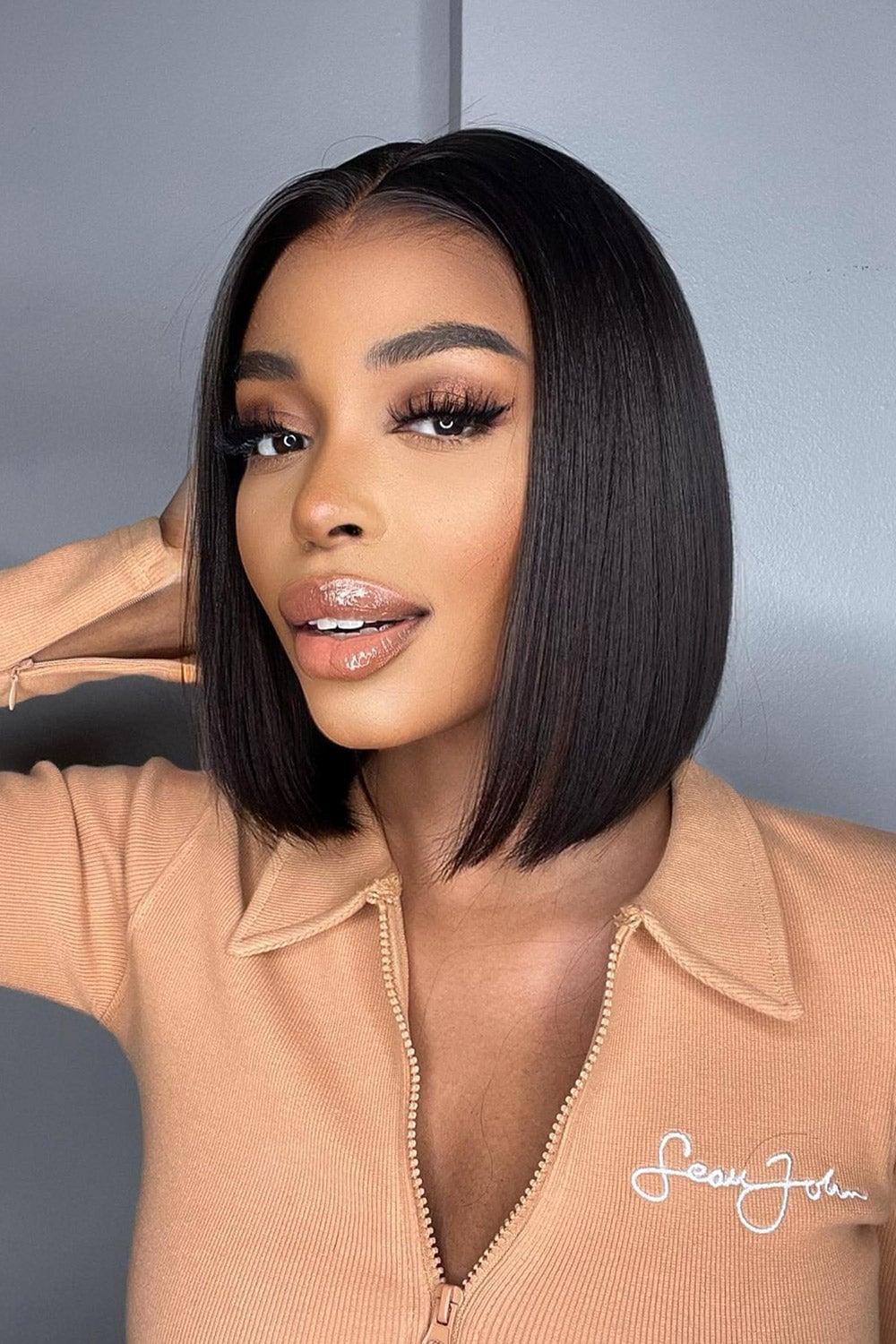
Photo credit: ygwigs.com
A blunt collarbone bob lands in that sweet spot between a short bob and longer lengths. The middle part and fine, straight texture keep the look clean rather than heavy, which is the risk with a shorter blunt cut. Ask your stylist for: a blunt collarbone bob with a middle part. This version suits most face shapes because the collarbone length adds a softening line without sacrificing the sharpness of the blunt ends. A trim every six to eight weeks preserves the precise baseline.
Sharp Chin Length Bob, Straight
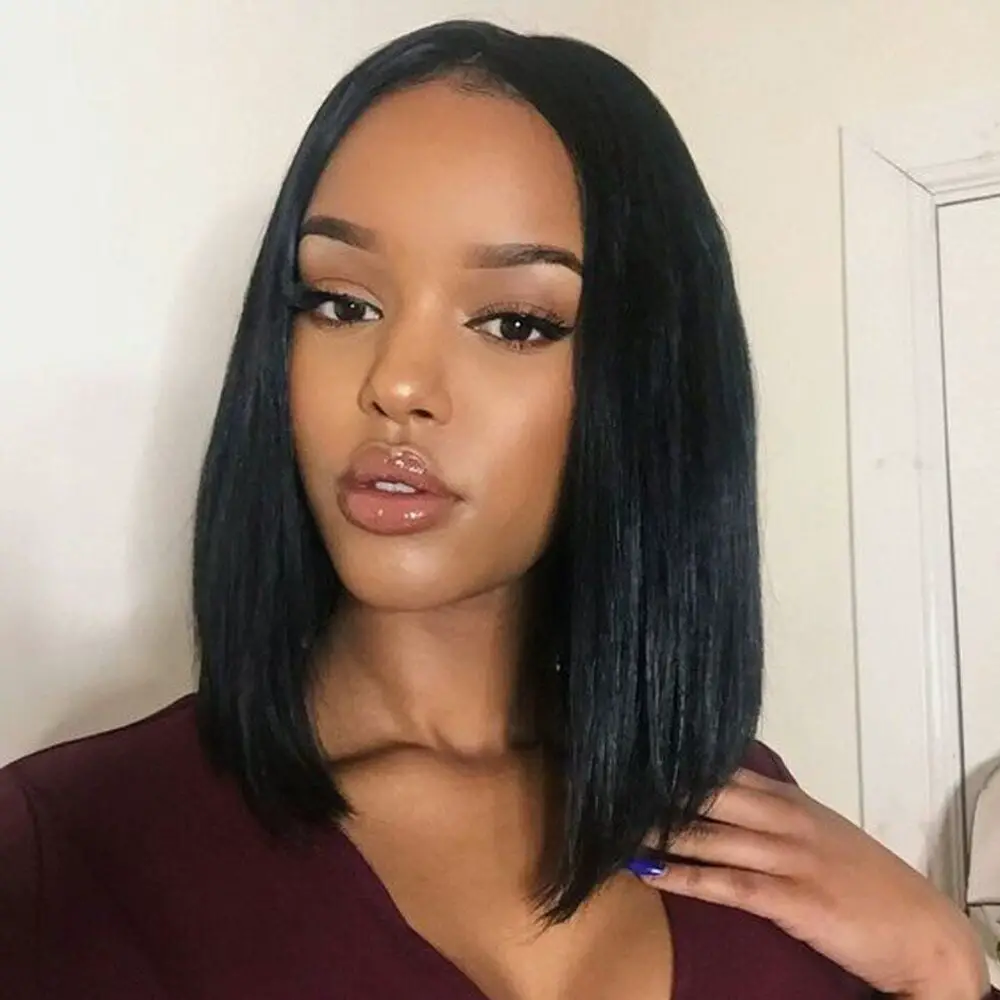
Image credit: walmart.ca
Is it a bob or is it a statement? The sharp chin-length bob with a middle part answers that question with blunt ends and zero compromise. Ask your stylist for: a sharp chin length bob with a middle part. The fine, straight texture and sleek styling make the precision of the cut the only detail that matters. Round faces get a lengthening effect from the chin-length line, while the absence of layers keeps the silhouette deliberately simple.
Polished Collarbone Blunt Bob, Straight
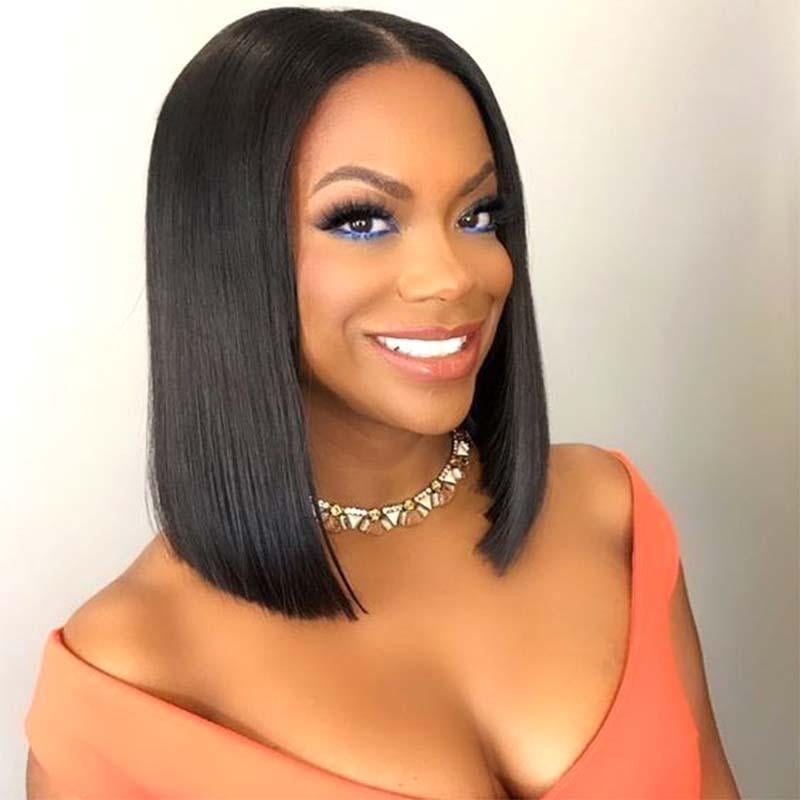
Source: surprisehair.com
A collarbone-length blunt bob with a middle part demands a commitment to the straight blowout. The fine texture and glossy finish shown here come from a flat iron and a heat protectant, not luck. Ask your stylist for: a collarbone blunt bob with a middle part.
The polished look holds best when the cut is fresh, so plan on a baseline trim every six weeks. This cut signals precision and works for any setting where you want the hair to communicate competence.
Sleek Collarbone Blunt Bob, Middle
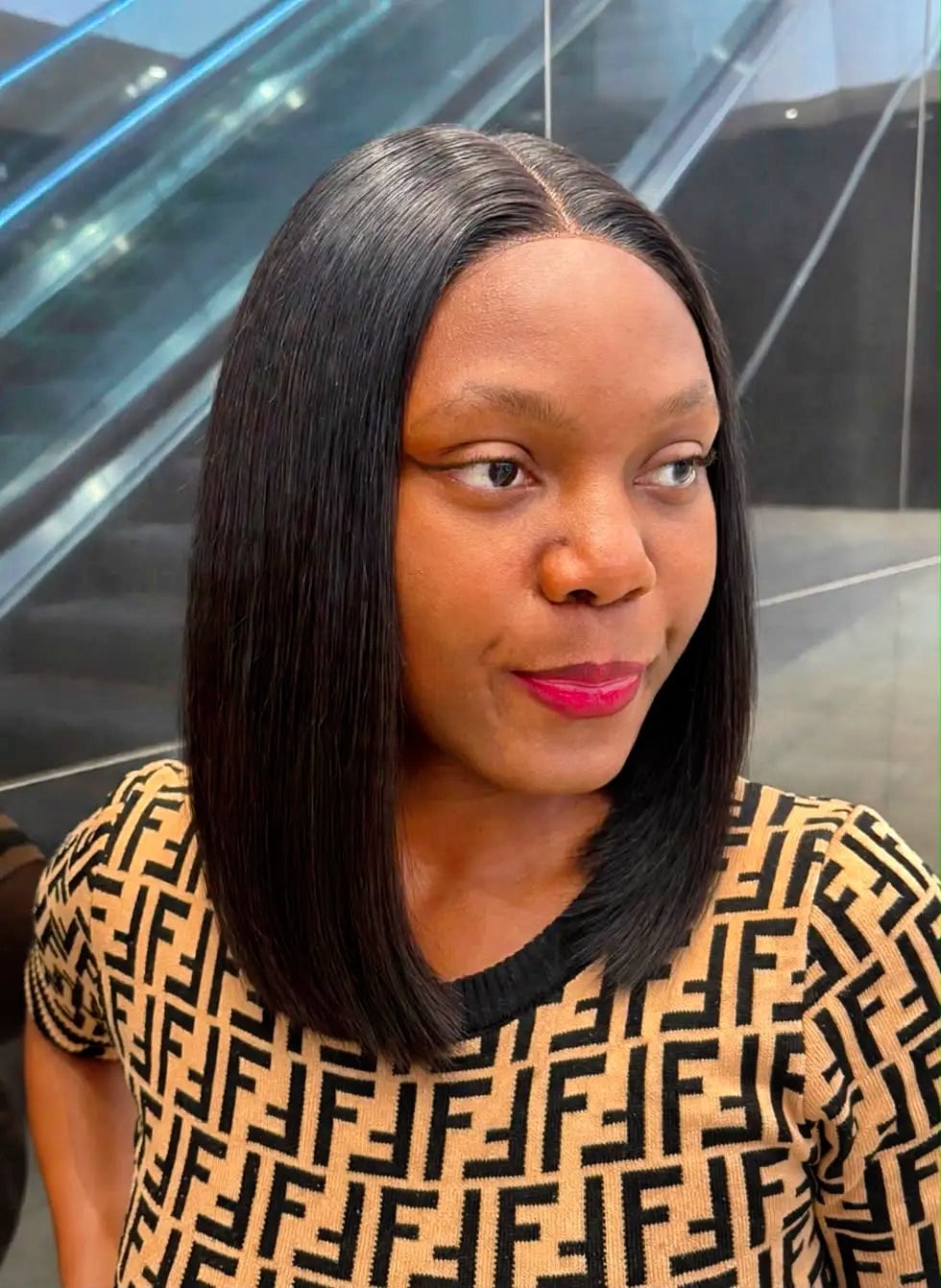
A sleek collarbone blunt bob with a middle part achieves its clean silhouette through a single, continuous cutting line. No layers, no texturizing, just a straight-across baseline that forms one solid shape. Ask your stylist for: a sleek collarbone blunt bob with a middle part. The fine, straight texture is ideal because any bend or wave would break the sharp line. This cut suits most face shapes and requires a trim every six to eight weeks to prevent the ends from softening into a wispy finish.
Sharp Chin Length Bob Blowout, Middle
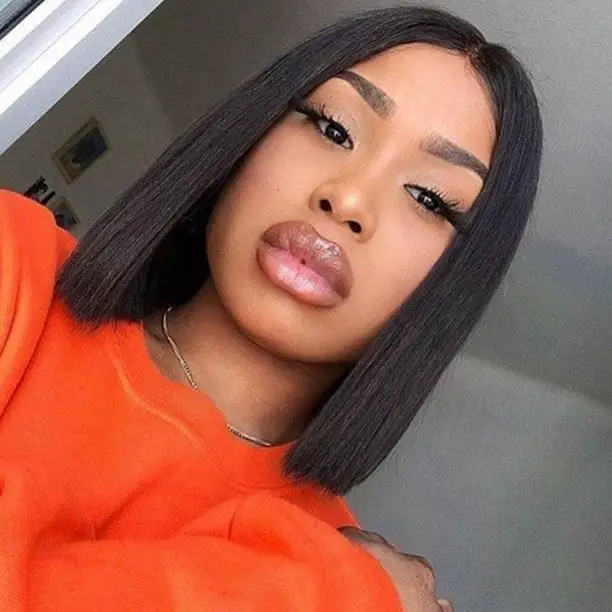
Courtesy of: walmart.ca
It looks like a close cousin to a blunt bob, but the blowout here makes all the difference. This chin-length cut relies on a middle part and a smooth, rounded finish, not a flat-ironed edge. Fine hair benefits from the round brush technique at the roots, though the same sleekness can make thinner strands look sparse if you skip the volume step. Ask your stylist for: chin length bob, smooth blowout, middle part. A salon blowout holds best, but a round brush and a cool shot at home replicate the shape for about two days.
Blunt Chin Bob With Clearly Displaying The Sharp
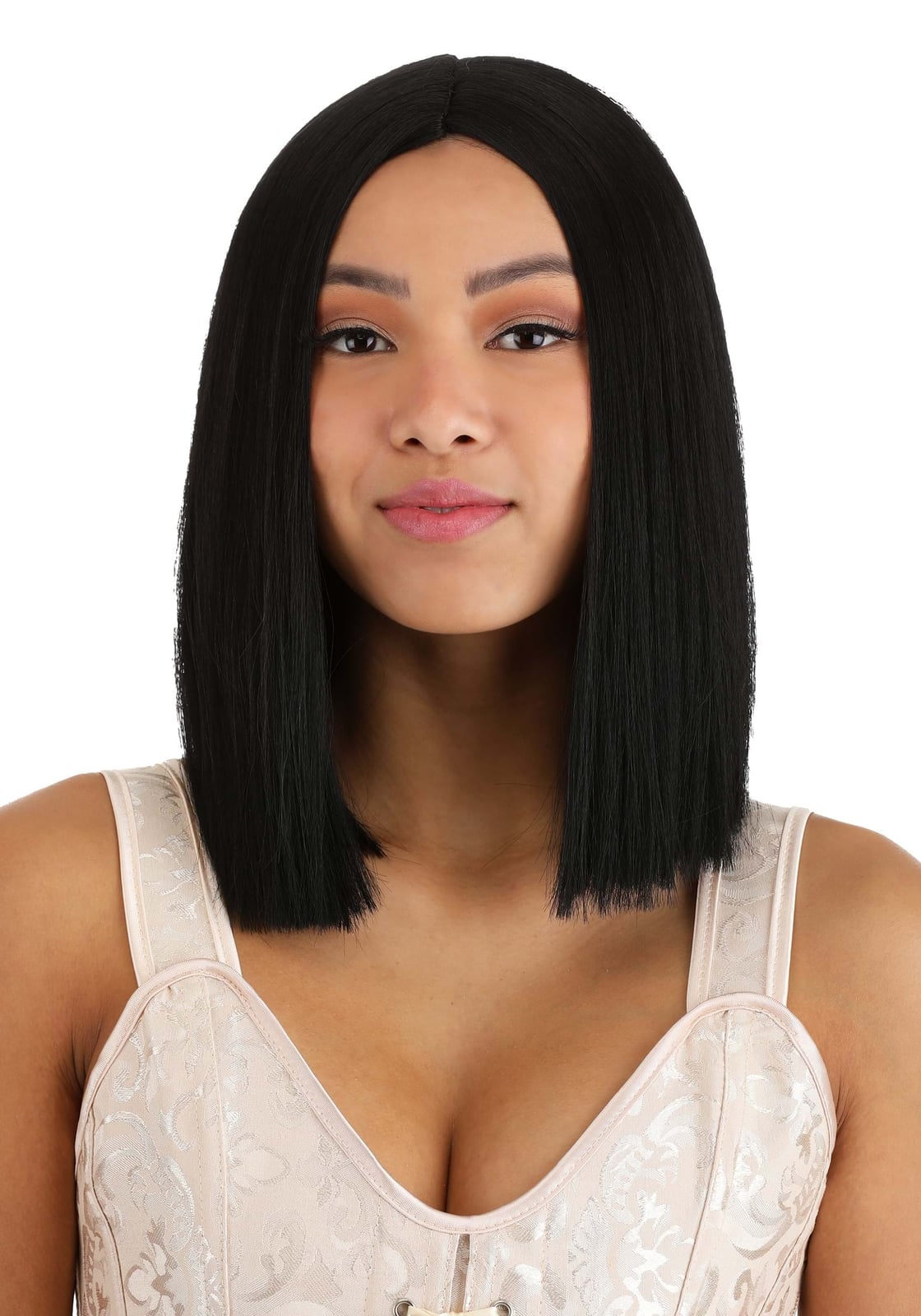
Photo credit: halloweencostumes.com.au
How many times have you seen a blunt chin bob that looks sharp on the mannequin but somehow reads as sad on a real head? The difference is density. This cut needs fine, straight hair at chin length to hold that clean, graphic line; anything thicker or coarser will push the ends outward. Ask your stylist for: blunt chin bob, middle part. The middle parting and no bangs keep the silhouette minimal, but the real work is in the trim. A blunt bob usually needs a trim every six to eight weeks to keep the hemline from looking chewed.
Sleek Chin Length Bob Side Part

Image credit: fabmood.com
The side part changes the geometry of a chin-length blunt bob completely. Where a middle part divides the weight evenly, a deep side part shifts the volume to one side, softening a square jaw and adding asymmetry to a round face. The sleek finish on fine hair needs a heat protectant and a flat iron at a moderate temperature to avoid creasing.
Upkeep is predictable: the blunt ends show every new millimeter of growth, so a trim every six weeks keeps the line sharp. The side part itself grows out gracefully; you can switch sides or go middle for a week without losing the cut’s integrity. Just reset the part when the hair starts to fall flat on the heavier side.
Blunt Chin Bob With Short Fringe

Source: annabelleswigs.co.uk
A short fringe turns a straightforward blunt chin bob into a retro style. The fringe sits above the brow, cut straight across, while the rest of the bob holds that same blunt line. Fine, straight texture is ideal here because the fringe stays put without constant re-styling. Ask your stylist for: chin length blunt bob, short fringe. The fringe should land just short enough to show the eyebrows, so bring a reference photo. The side part keeps the rest of the bob from looking too severe.
Chin Length Bob With Straight Fringe, Middle
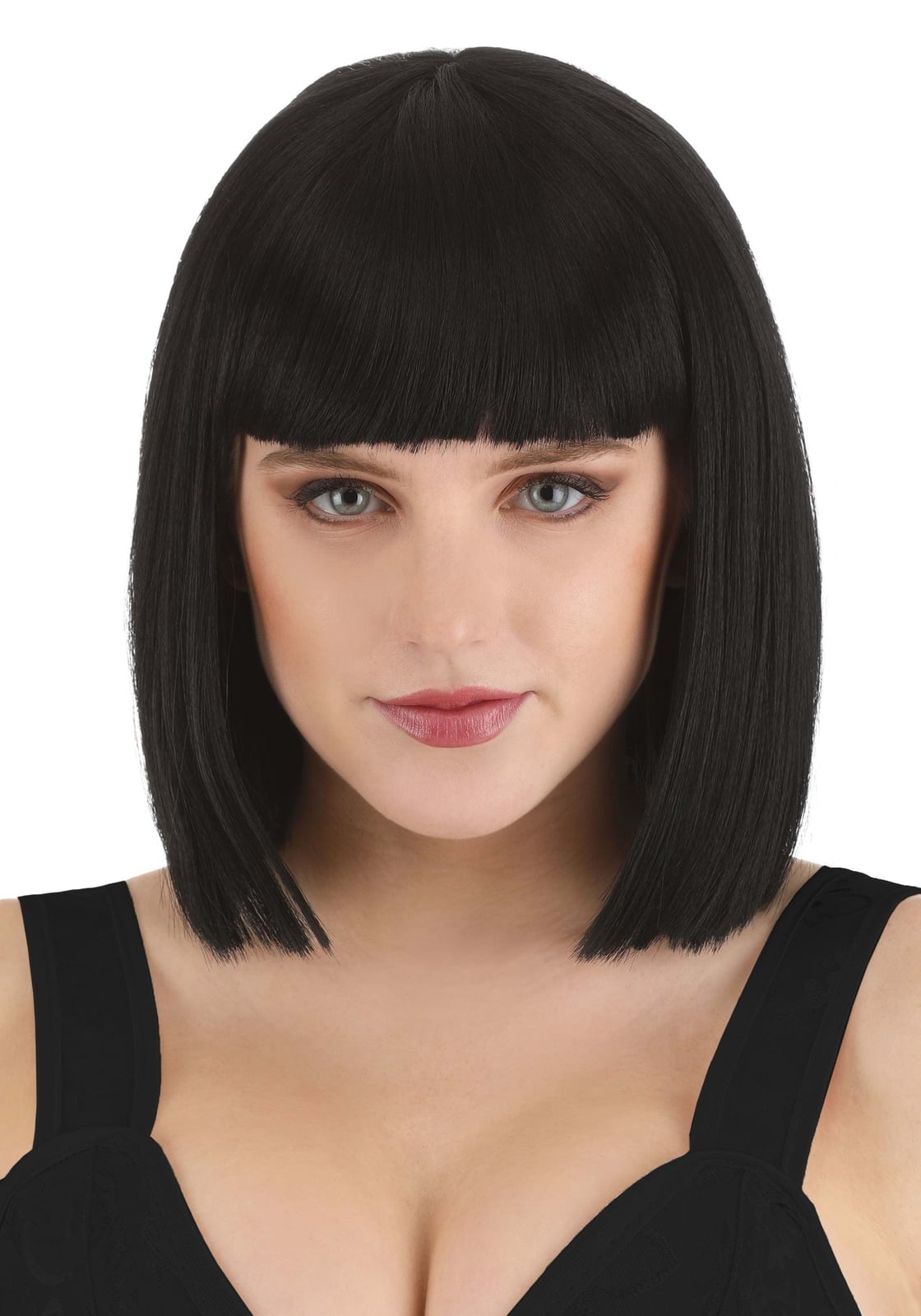
Source: halloweencostumes.com
This chin-length bob pairs a middle part with a blunt fringe that hits just above the brows, creating a strong horizontal line. Fine, straight hair handles the fringe well because there is no wave to fight. Ask your stylist for: chin length bob, straight fringe. Upkeep requires a fringe trim every three to four weeks and a bob trim every six. A flat iron on low heat keeps the fringe smooth without adding shine that looks greasy.
Geometric Bob With Blunt Bangs
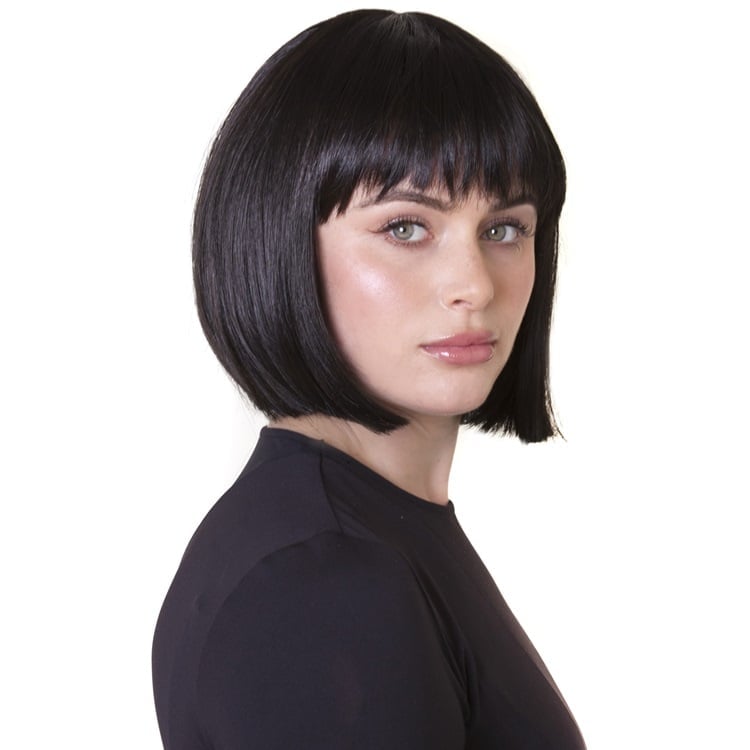
How precise does a blunt cut need to be to look clean and not uneven? Very. This chin-length bob with blunt bangs and a side part demands a steady hand and a sharp eye, because every millimeter shows on fine, straight hair. There are no layers to hide behind, no texture to blur the line, just a clean, graphic silhouette that relies on geometry.
The hair must be cut when it is bone-dry and then checked again after a blowout. Ask your stylist for: chin length bob, blunt bangs, side part. A light mist on the fringe gives it a little separation without breaking the line. This is a salon-only cut: those blunt bangs will need a trim every three weeks to keep their edge, and the bob itself needs a refresh every six to eight weeks.
Shoulder Length Straight With Blunt Bangs

Courtesy of: crackerjackcostume.com.au
A shoulder-length cut with blunt bangs creates a horizontal line that widens a narrow face and shortens a long one. The side part adds asymmetry, which keeps the whole thing from reading as too severe. Medium texture holds the shape best; very fine hair may need a light product to stop the ends from looking thin. Ask your stylist for: shoulder length straight, blunt bangs, side part. A flat iron keeps the finish smooth, and the bangs need trimming every two to three weeks so they do not slide into your eyes.
Natural Kinky Curly Shoulder Length
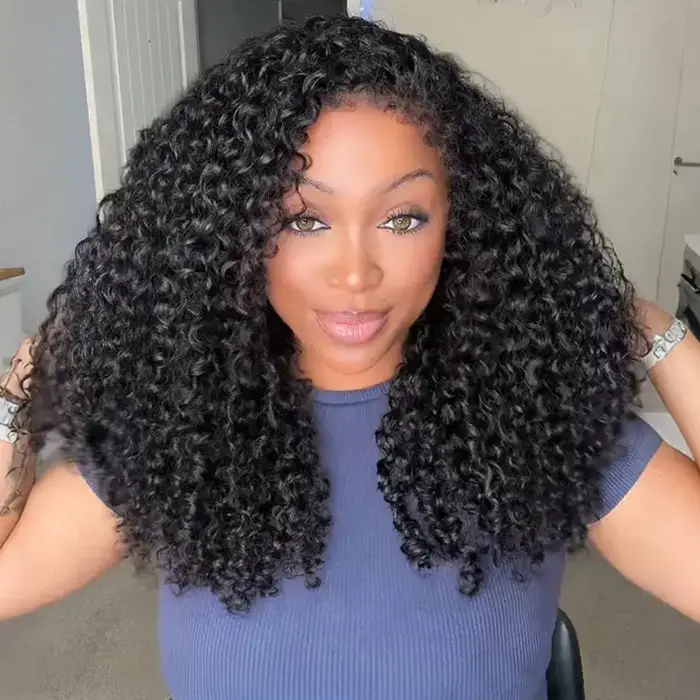
Photo credit: hermosahair.com
A kinky curl pattern at shoulder length shrinks up significantly, so the cut is longer than it reads. The middle part lets the volume fall evenly on both sides, and the natural edges avoid that uniform, helmet-like shape some curly wigs have.
Thick hair here needs a wide-tooth comb used only when wet and saturated with conditioner. Brush it dry and the definition disappears. Ask your stylist for: shoulder length kinky curly, middle part. A curl-defining cream applied to damp hair and left to air-dry gives the most consistent results. Plan on refreshing the ends every eight to ten weeks to keep the shape from puffing out.
Wavy Collarbone Bob With Curtain Bangs

Image credit: kiswok.com
What do you say to get a wavy bob that actually holds its shape through the day? You specify the length, the wave and the bangs in that order. This collarbone-length bob uses loose, defined waves and curtain bangs that part in the middle and sweep to each side. Thick, wavy texture carries the movement best; straight hair would need a curling iron and a prayer.
Ask your stylist for: collarbone wavy bob, curtain bangs. Request that the curtain bangs start at the cheekbone and blend into the layers below. A sea salt spray on damp hair, scrunched and air-dried, gives the wave without crunch. The bangs need a trim every four weeks; the bob itself can go six to eight weeks between cuts.
Mid-Back Layers With Curtain Bangs
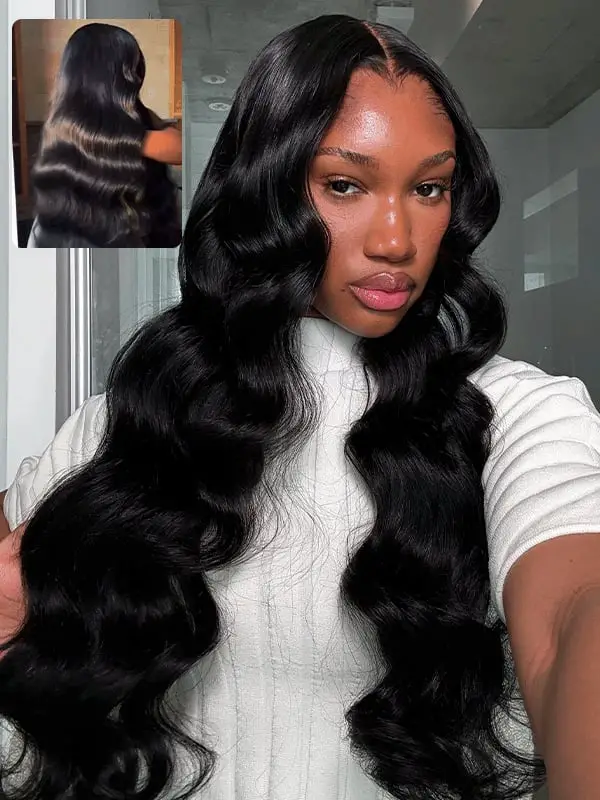
Source: sterlyhair.com
The technique behind this mid-back length is not just about removing weight. Long layers are cut vertically and point-cut at the ends so each section tapers into the next, creating movement without sacrificing density. The curtain bangs blend into the front layers, which keeps them from looking tacked on.
Thick, wavy hair benefits from this approach because the layers reduce bulk at the bottom while keeping the volume at the crown. Ask your stylist for: mid-back layers, curtain bangs, middle part. A large-barrel curling iron shapes the waves in a few minutes. The curtain bangs need a trim every four to six weeks; the layers can stretch to ten weeks between cuts.
Voluminous Mid-Back Curls
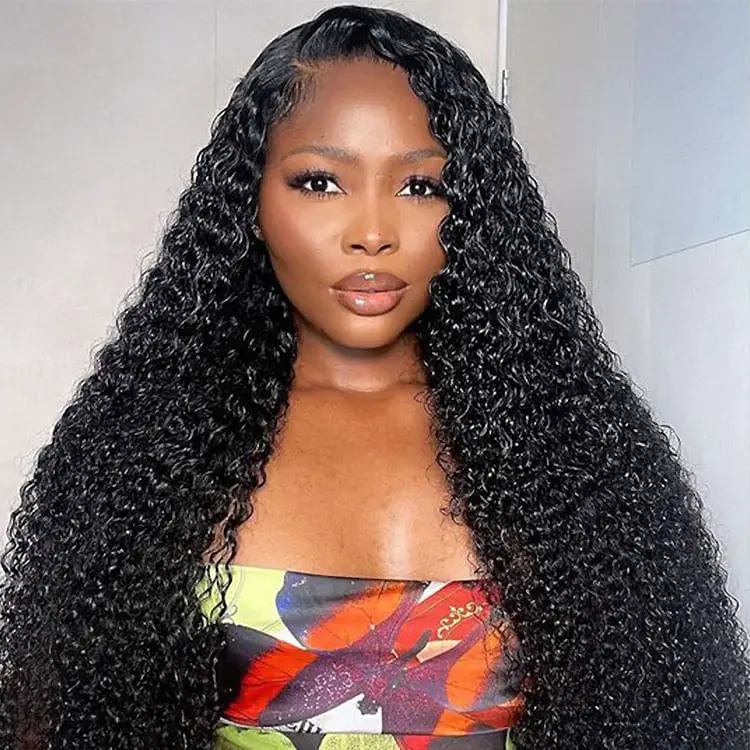
The design is smart: long layers cut through thick, curly hair keep the shape from turning into a triangle. Those mid-back loose curls have a side part and plenty of bounce, but frizz is a real risk. A salon diffuser and curl cream help, but humidity will still have opinions. This is not a wash-and-go situation, plan on refreshing with water and product each morning. Anyone with fine or straight texture should skip it; the volume needs density to look deliberate, not messy.
Glossy Mid-Back Straight Layers
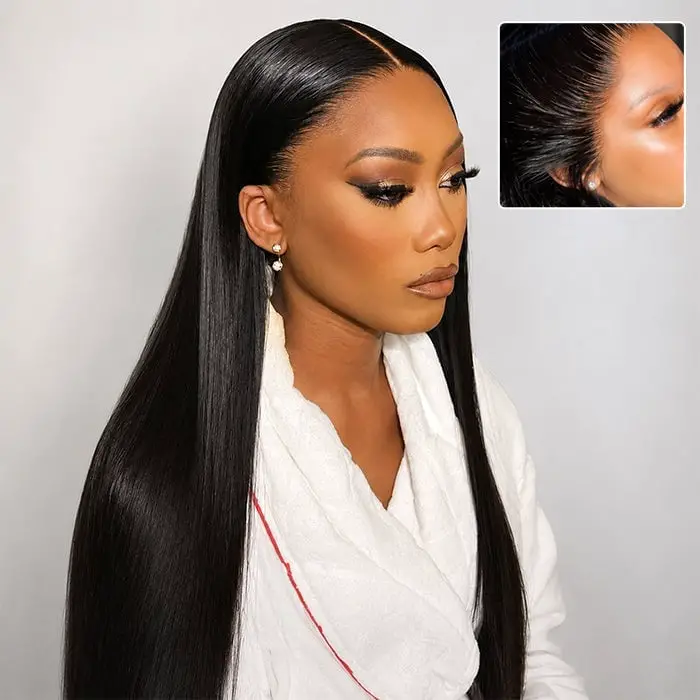
Courtesy of: hermosahair.com
A middle part and straight blowout on fine black hair can look flat if the cut is a single length. The face-framing layers here solve that, adding movement without losing the sleek finish. The shine is the point, so a serum goes on damp hair before drying. Ask your stylist for: mid-back straight layers with face-framing pieces.
Upkeep is about maintaining that gloss. A trim every ten to twelve weeks keeps the layers from growing past their intended shape. Daily heat styling is required to keep the blowout smooth, so a heat protectant is non-negotiable. The good news: the fine texture actually helps the shine last longer.
Long Sleek Straight Mid-Back
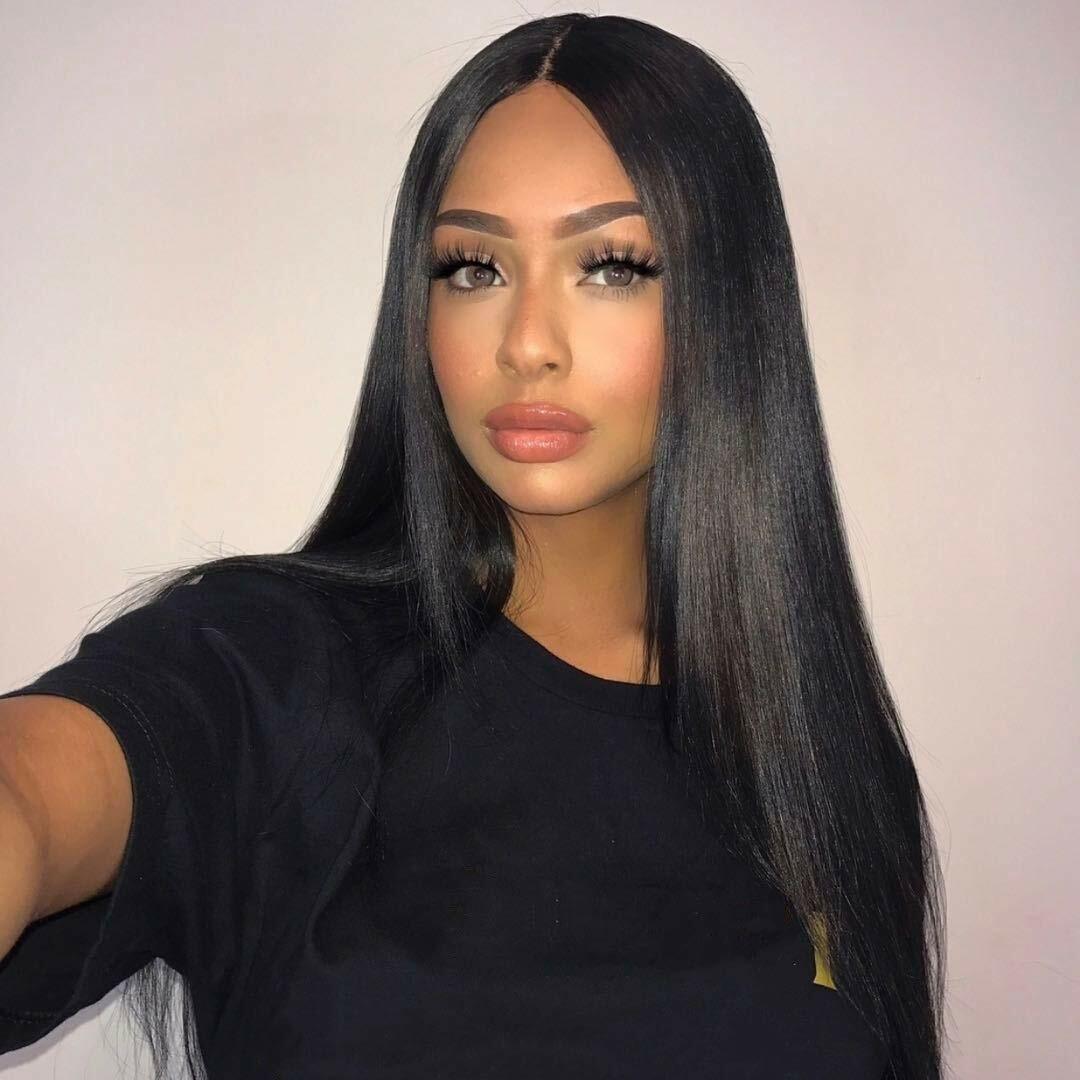
Photo credit: ebay.com.au
A long, straight, middle-parted wig suits fine hair that wants a polished, classic silhouette. The mid-back length and sleek styling work because the fine texture lays flat and reflects light evenly. Thick or coarse hair would puff out at the ends, defeating the smooth effect.
Ask your stylist for: long sleek straight wig with a middle part. This is a shape that relies on precision: any unevenness in the cut shows immediately. The absence of layers keeps the weight at the hemline, so it hangs straight and does not flip out. A flat iron and shine spray are your daily tools, and a trim every ten weeks keeps the ends from thinning out.
Extreme Length Straight Mid-Back
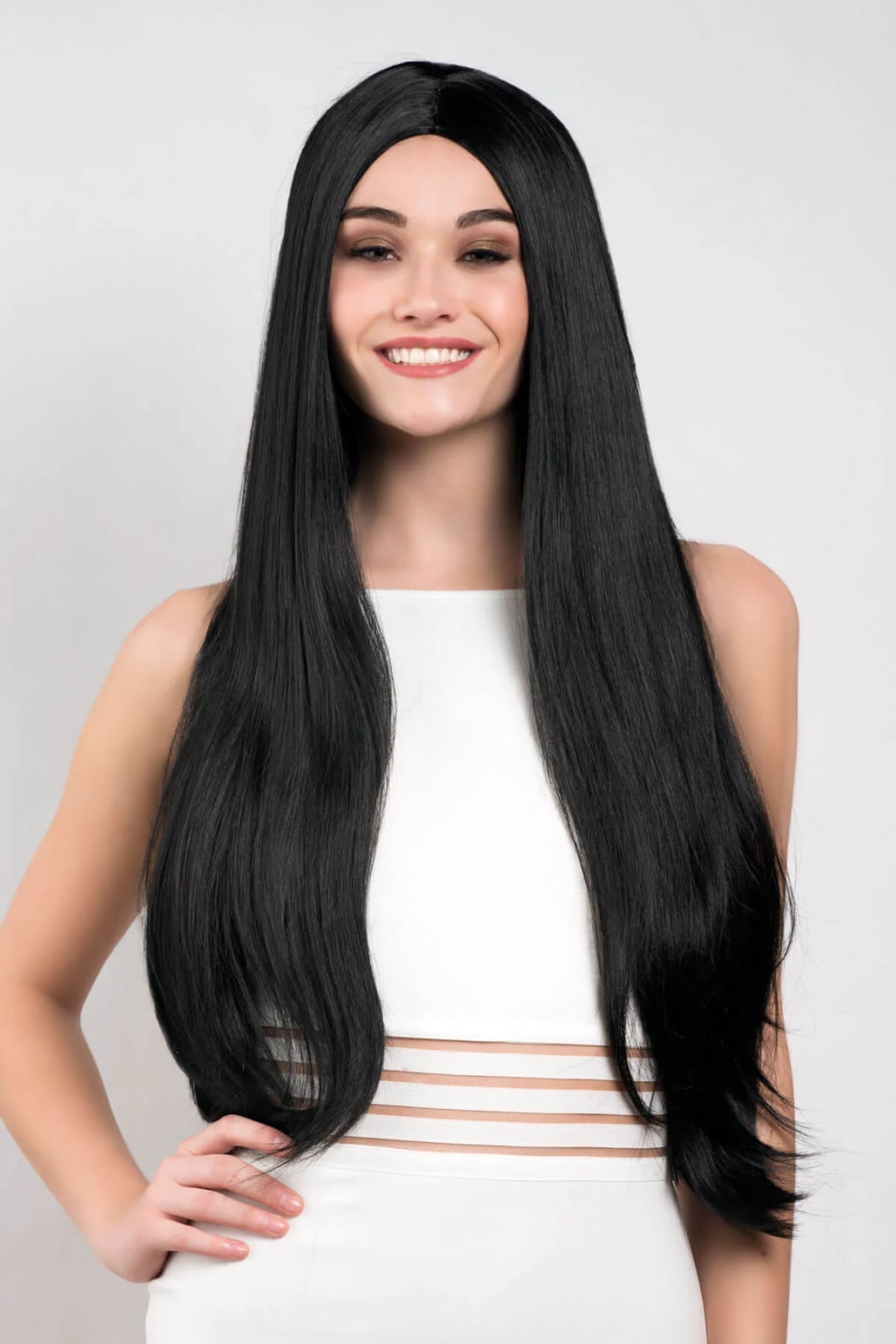
Image credit: annabelleswigs.co.uk
Mid-back is substantial, but this cut pushes that length to its visual limit with no layers and a middle part. The effect is dramatic: the hair flows in one uninterrupted sheet. Compared to a style with face-framing layers, this one reads as more formal and less forgiving. Every strand has to cooperate. Ask your stylist for: long straight wig, mid-back length, middle part. It is best on fine, straight texture; anything with wave or curl will fight the sleek line. The lack of layers means all the weight sits at the bottom, which can make the roots look flat on finer densities.
Collarbone Blunt Cut With Fringe
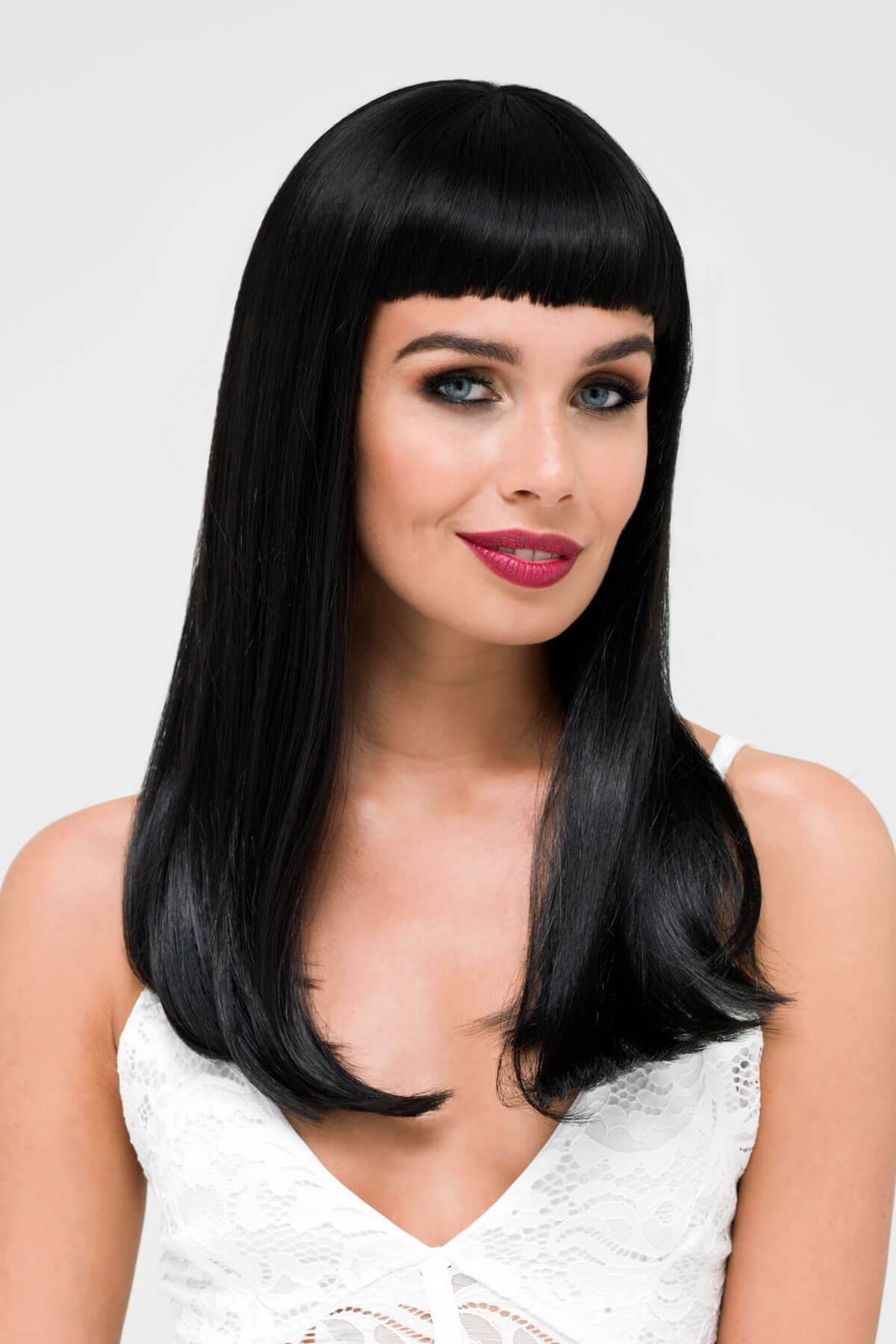
The collarbone length meets a straight fringe, and the blunt cut does not leave room for negotiation. This is a precise shape: the hemline hits straight across, and the fringe sits just above the brows. It works on fine, straight texture because the blunt edge needs density to look solid rather than wispy. Ask your stylist for: collarbone blunt cut with a straight fringe. The fringe is the focal point, so be specific about how thick you want it, too thin and it disappears, too heavy and it overwhelms the collarbone length. A flat iron is your main tool, and a trim every four weeks keeps the fringe from sneaking into your eyes.
Final Thoughts
Fine hair: keep one blunt baseline and skip heavy layers, because a single clean line reads thicker than a frayed one. Thick hair: layers take out weight and let the ends move. Round face: length below the chin and a middle part elongate. Square face: soft layers around the jaw do the softening.
- Trim the baseline every six to eight weeks for blunt cuts.
- Deep condition curly textures weekly to maintain moisture.
- Brush straight styles with a wide-tooth comb to prevent tangles.
- Use heat protectant spray before styling with heat tools.
Choose the black wig cut that best suits your desired look and maintenance.
Hairstyle
20 Short Natural Hairstyles 2027 with Textured Crop Undercuts
Short Natural Hairstyles 2027 featuring 20 looks. Explore textured crop undercuts and dark brown curly hair highlights for a fresh 2027 look. See the styles.
Short natural hairstyles cover everything from a silver afro the size of a dinner plate to a slicked buzz cut, and the current version leans glossy and lived-in: soft face-framing layers, a fringe that moves, color that grows out without a hard line. The cut does the work, not the hot tool.
What follows is 20 short natural hairstyles, ranging from a five-minute wash-and-go to a set that eats an evening, and from a crop you can trim on a schedule to a platinum shade that needs toning. Fine hair that collapses by lunch and a grow-out line that shows at week three are both addressed. Short Natural Hairstyles reward a good shape more than a long routine.
Voluminous Silver Afro
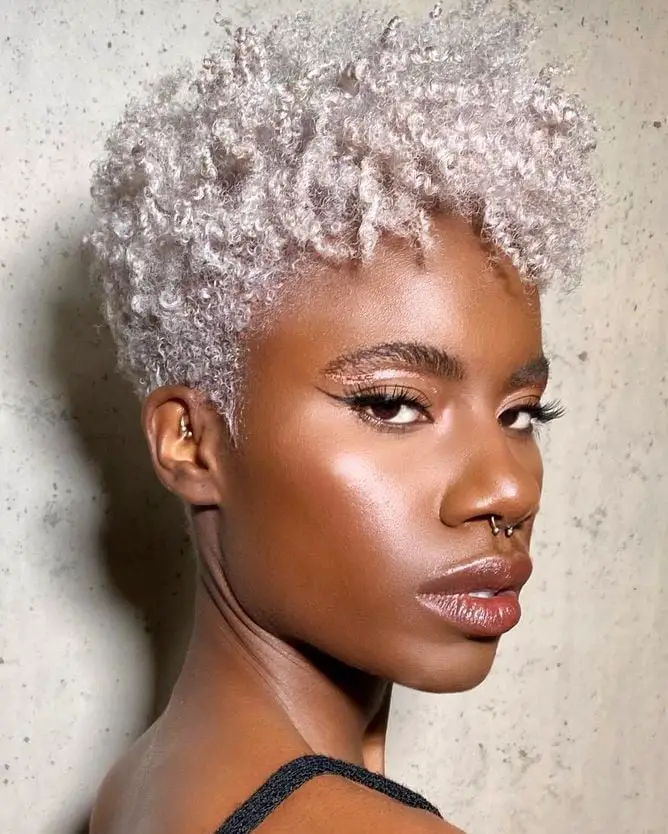
Courtesy of: hadviser.com
A silver afro is a bold move, and this cut lets the color do the talking. The cut sits at ear length, keeping the coily texture dense enough to hold its shape without extra help. It suits thick, coily hair that can carry volume; finer textures may find the look falls flat. Ask your stylist for: short afro, ear length, silver color. Keep the coil pattern defined with a moisturizing styling cream, and plan a trim every six weeks to keep the silhouette sharp.
Textured Crop With Undercut Detail
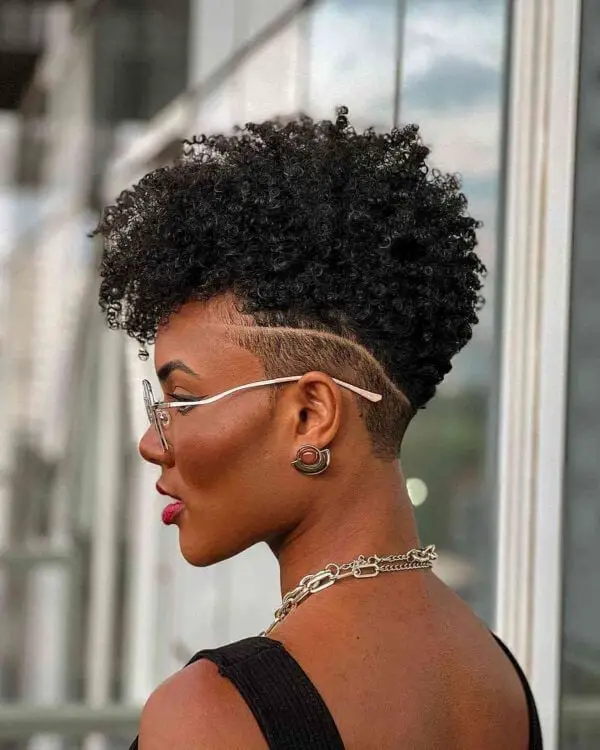
Photo credit: curlsqueen.com
Wondering how to get that sharp undercut line without losing the density on top? The trick is in the contrast. This textured crop keeps curly black hair at chin length, while the sides are shaved close with a precise line detail. It works best on thick, curly textures that can hold the shape up top. Ask your stylist for: textured crop with undercut and shaved line. Specify the top length you want to keep, and decide how much contrast you want between the curly crown and the clean sides.
The undercut is the part that needs regular attention. A shaved line starts to blur in about two to three weeks, so a touch-up at that interval keeps the design crisp.
Layered Waves Framing The Face
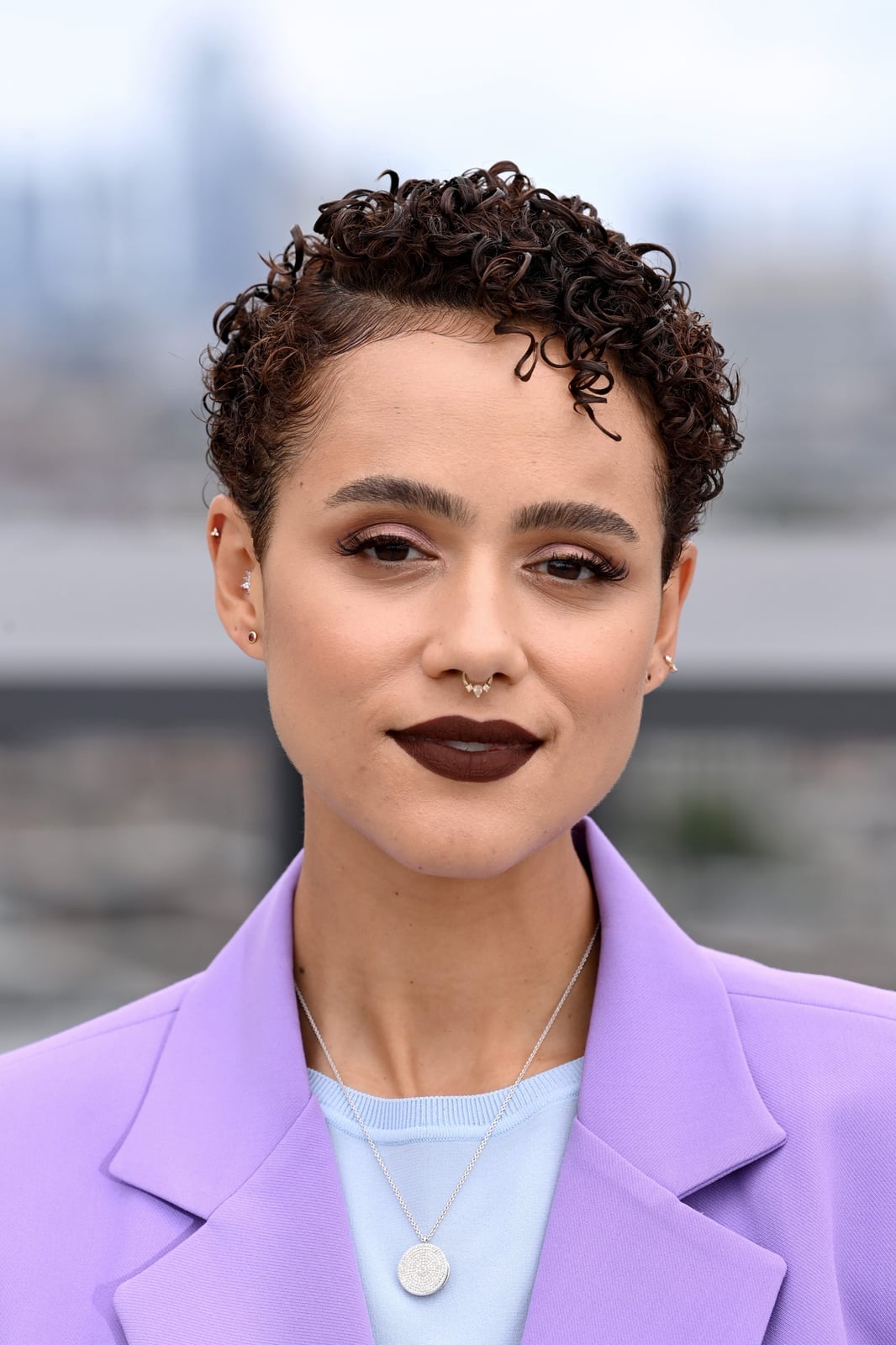
Image credit: oprahdaily.com
Fine wavy hair has a habit of losing volume an hour after you style it, which is why this cut puts the weight where it matters. The layers are concentrated at the crown, and the dark brown waves fall to ear length, framing the face without dragging it down. It suits fine to medium textures that need a lift at the roots. Ask your stylist for: short layered cut, face-framing volume. A sea salt spray adds grip, but the real work is in the trim: every six to eight weeks keeps the layers from growing out and flattening the shape.
Platinum Blonde Short Afro
Source: hadviser.com
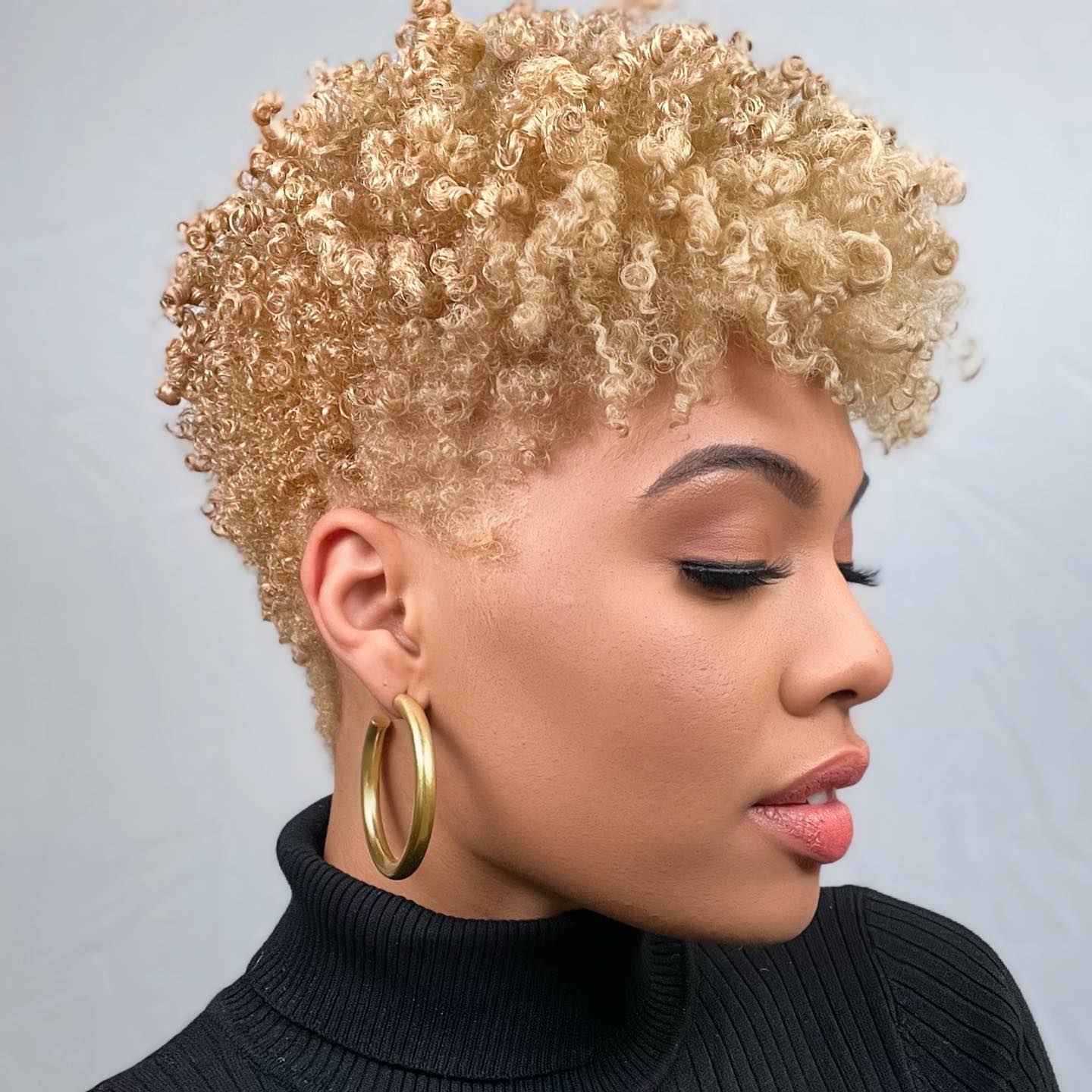
The tight coily curls are cut to ear length and left air-dried, which gives the color a matte, lived-in finish that a blowout would ruin. It suits thick, coily hair ready for a high-maintenance commitment. Ask your colorist for: short afro, ear length, platinum blonde. This is a salon-only project: the lightening process on dark bases takes hours, and the tone needs a color-depositing conditioner every couple of weeks to stop it from turning brassy.
Dark Brown Curls With Highlights
Via marieclaire.com
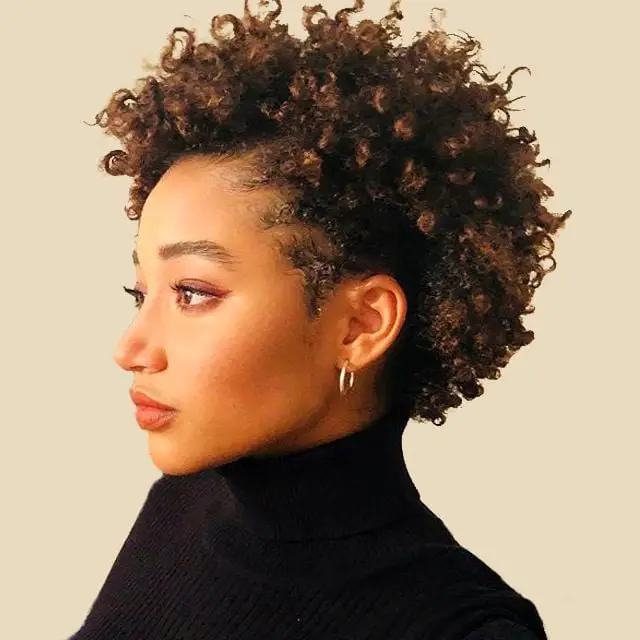
The blowout here is styled with a diffuser on low heat to lock in the shape, while subtle lighter highlights add dimension so the volume reads as texture, not frizz. The cut stops at ear length with short layers that keep the curls from drooping. Ask your stylist for: short layered cut, dark brown with subtle highlights, voluminous blowout. It suits thick, curly hair. Expect a trim every six to eight weeks, and a toning appointment for the highlights around the same mark.
Chin Length Spiral Curl Cut
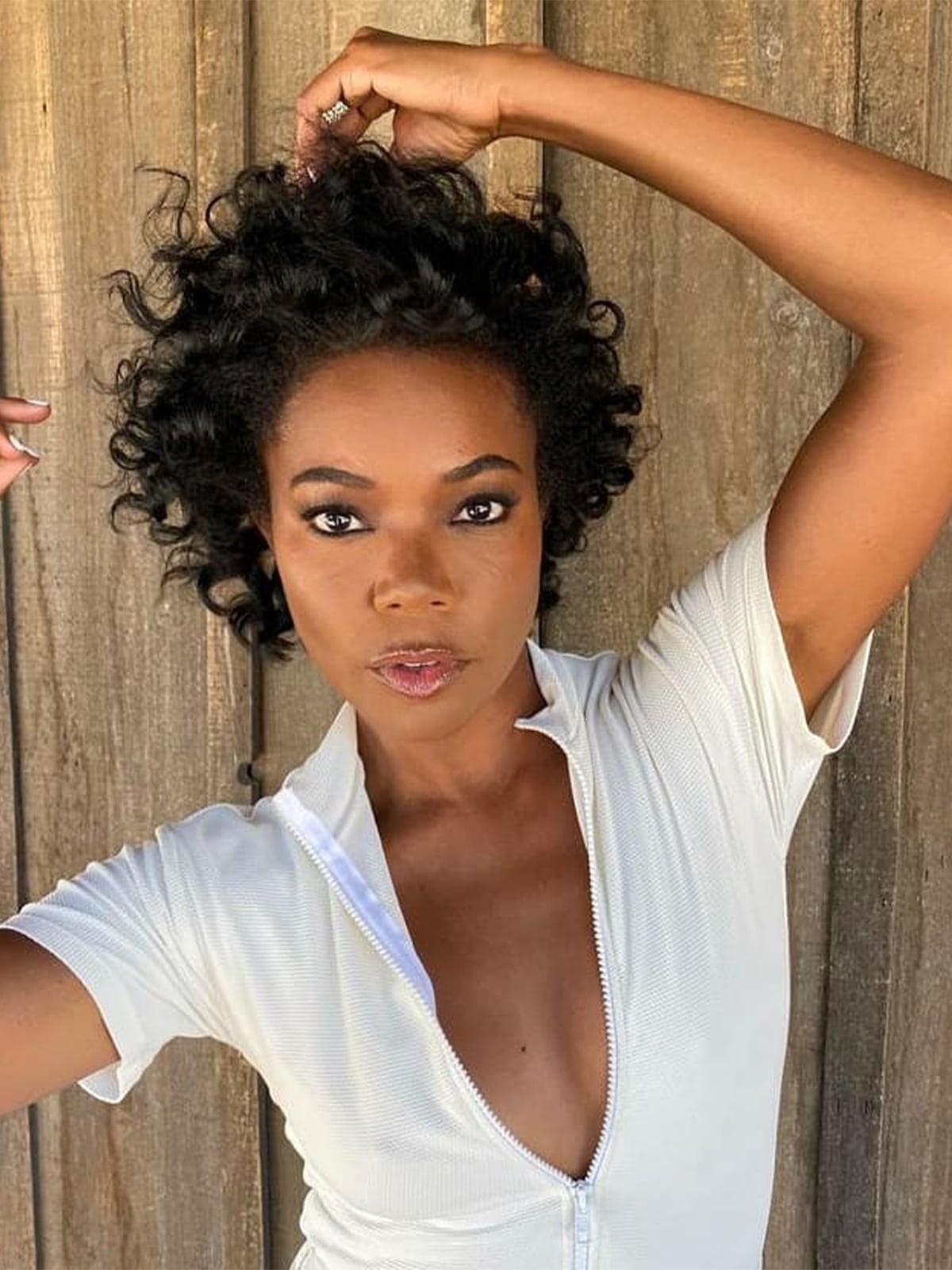
Courtesy of: whowhatwear.com
Can you get perfectly defined spiral curls every morning without it taking over your routine? This chin-length layered cut in black with a middle part gives thick, curly hair a shape that actually holds the curl pattern instead of fighting it. Ask your stylist for: chin length layered cut, defined spiral curls. The trade-off: achieving this level of definition daily means damp styling with curl cream and either air drying or diffusing, which adds time. A trim every eight to ten weeks keeps the layers from losing their shape, and the middle part helps the curls fall evenly rather than piling in one spot.
Shoulder Length Voluminous Curls
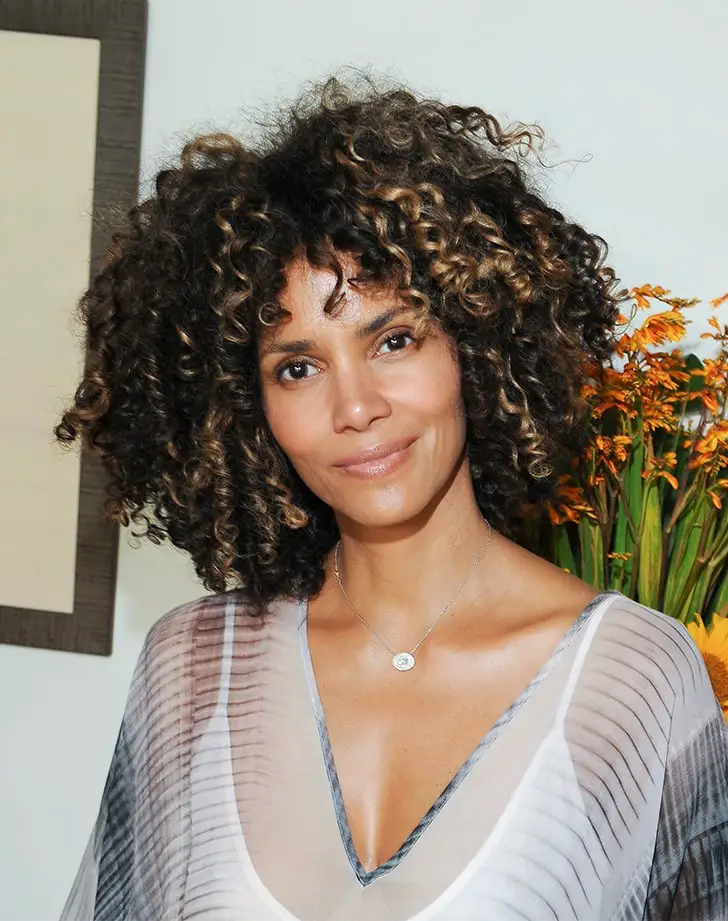
Photo credit: purewow.com
The volume here comes from a deliberate choice: layers cut into shoulder-length dark brown hair with lighter highlights, not from any product trick. A middle parting lets the curls fall symmetrically, and the highlights create dimension that keeps a head full of hair from reading as a single dark mass. Ask your stylist for: shoulder length natural curls with dimension.
This is a warm-weather style that adapts well. In summer, a lighter leave-in conditioner stops the curls from drooping in humidity. In cooler months, a heavier cream adds moisture without weighing the pattern down. The styling is straightforward: a wide-tooth comb on wet hair, then air dry or diffuse. Refresh between washes with water and a leave-in spray to reactivate the curl.
Short Cut With Shaved Sides
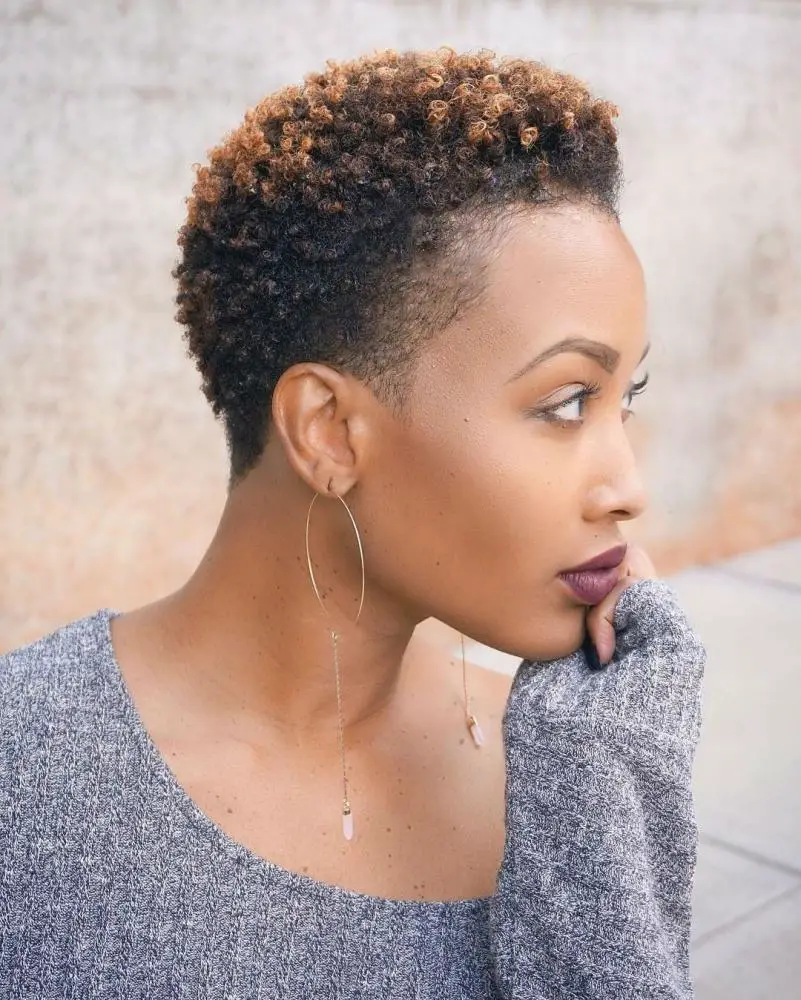
Image credit: wowangel.com
The most common mistake with shaved sides is taking the clipper too high, which shrinks the visual frame of the face. This ear-length cut keeps the shaved section low, ending around the temple, and tops it with black hair that has lighter brown tips, styled in defined curls. Ask your stylist for: short cut with shaved sides and textured top. The shaved sides need a salon visit every two to three weeks to stay clean, and the curls on top require curl cream applied to damp hair. This is not a DIY trim situation: the contrast between the shaved and textured sections demands a professional hand to keep the line crisp.
Tapered Twist-Out Texture
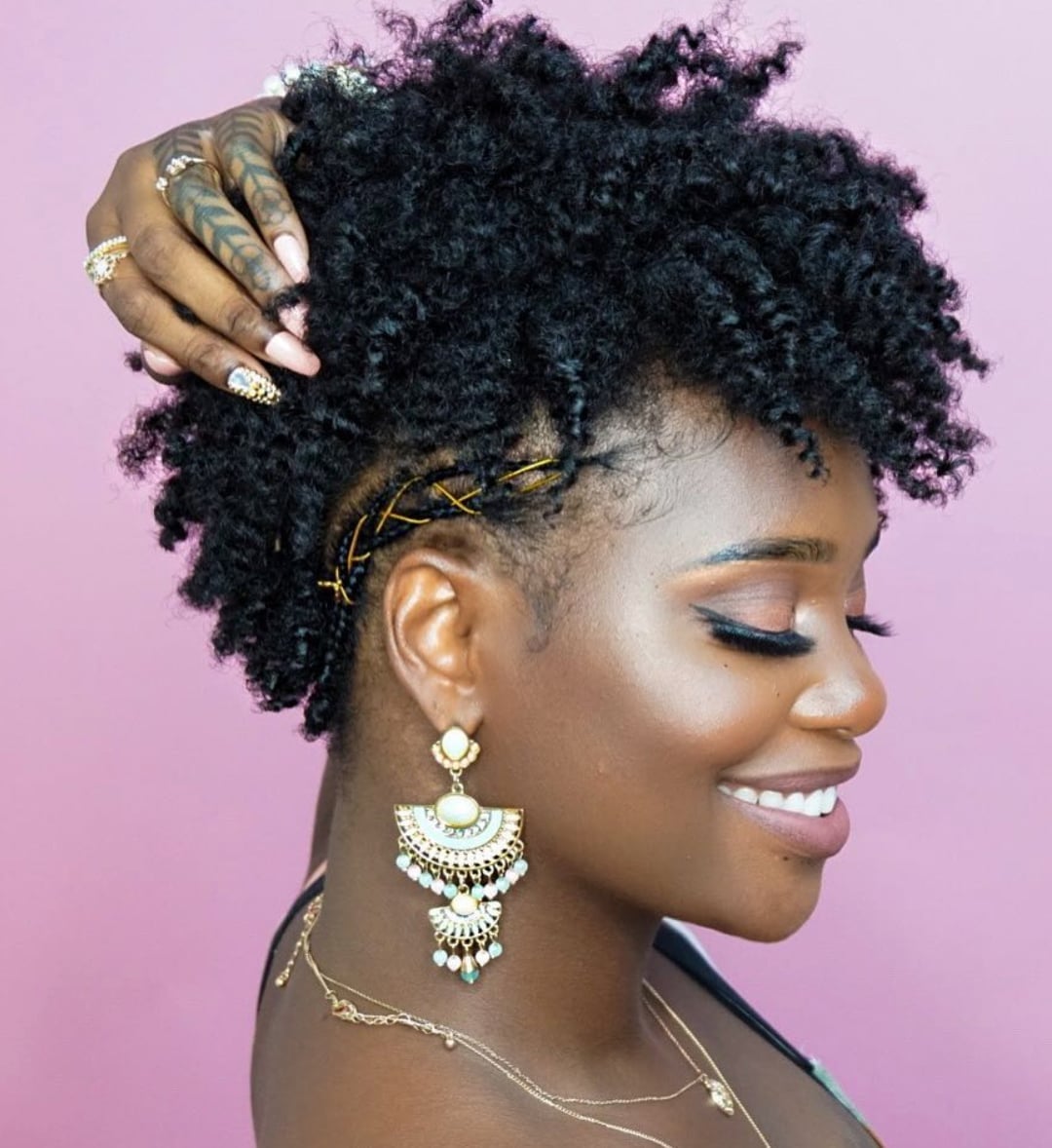
Source: auntjackiescurlsandcoils.com
A twist-out is not a braid-out. Both give defined texture, but the twist-out produces a rounder, more rope-like curl, while braid-outs create a flatter, zigzag pattern. This ear-length tapered cut uses a twist-out on black hair with subtle blonde highlights, with the sides slicked back for a polished finish. Ask your stylist for: short tapered cut, defined twist-out texture. The twist-out holds best when set with a setting lotion on damp hair and left to dry fully before unraveling. Refresh with a light oil or leave-in spray to maintain definition. This style suits a professional setting because the slicked-back sides keep it tidy, while the texture adds visual interest. A trim every six to eight weeks maintains the taper.
Defined Coils With Subtle Highlights and Ending Around The Ear
Source: curlsqueen.com
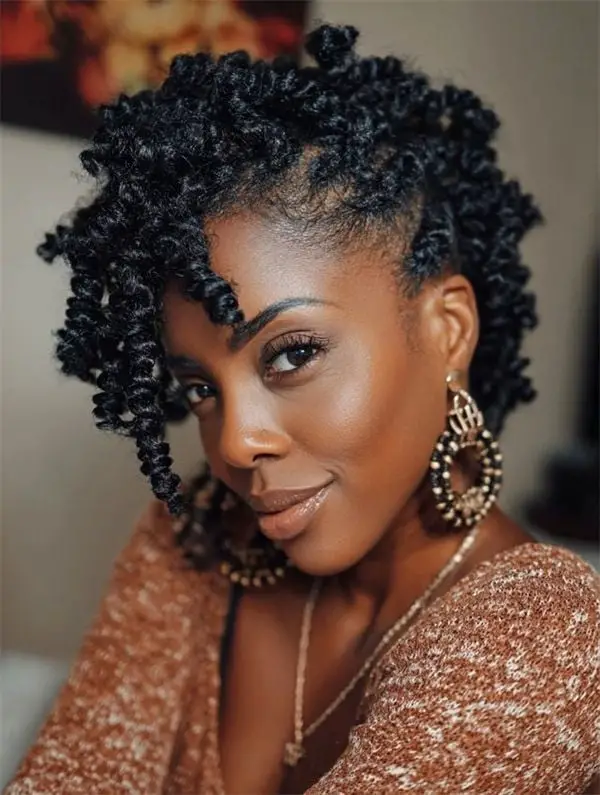
The side parting in this defined coil style does two things at once: it gives the lighter highlights a natural place to fall, and it stops the dense black base from reading as a single solid block. Thick, coily hair at ear length is the starting point, since the shape needs enough weight to hold the twist pattern overnight. Ask your stylist for: short cut, defined twisted coils, subtle highlights. To recreate the look at home, start with damp hair and a leave-in moisture cream, then twist small sections around your finger. Let them set until fully dry before unraveling. A light oil on the finished coils seals the shine without deflating the volume.
Rounded Black Afro Shape
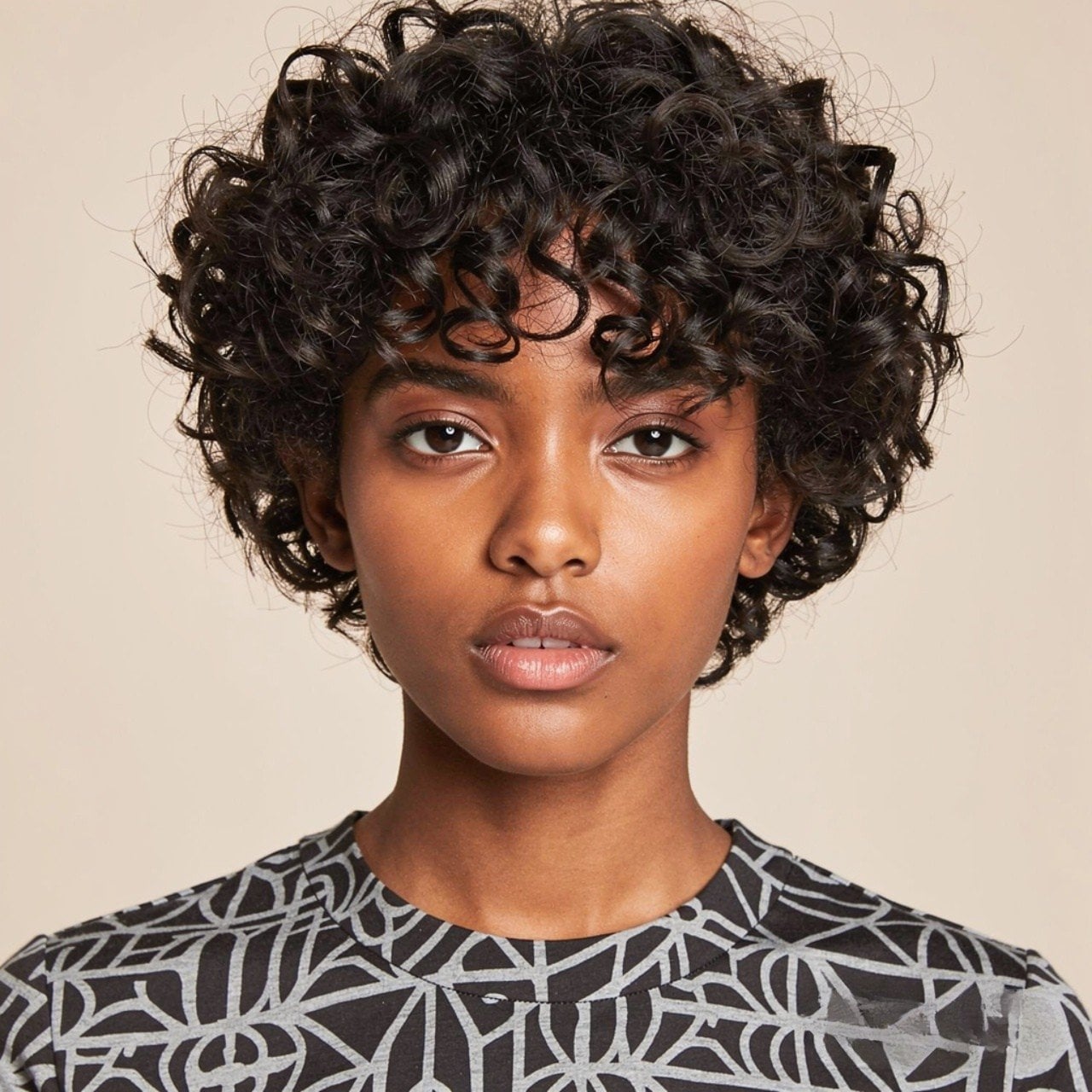
The middle parting is the quiet hero here, splitting the tightly coiled curls into two even halves that meet in a perfect dome at the ear. Air-drying is what locks in that symmetry, since the shrinkage pulls everything inward as it dries. Thick, coily hair starting at ear length gives the rounded shape enough weight to hold its line. Ask your stylist for: short afro, ear length, rounded shape. A water-based mist daily keeps the coils pliable, and a trim every six weeks preserves the silhouette before it drifts into triangle territory.
Voluminous Ear Length Afro
Courtesy of: whowhatwear.com
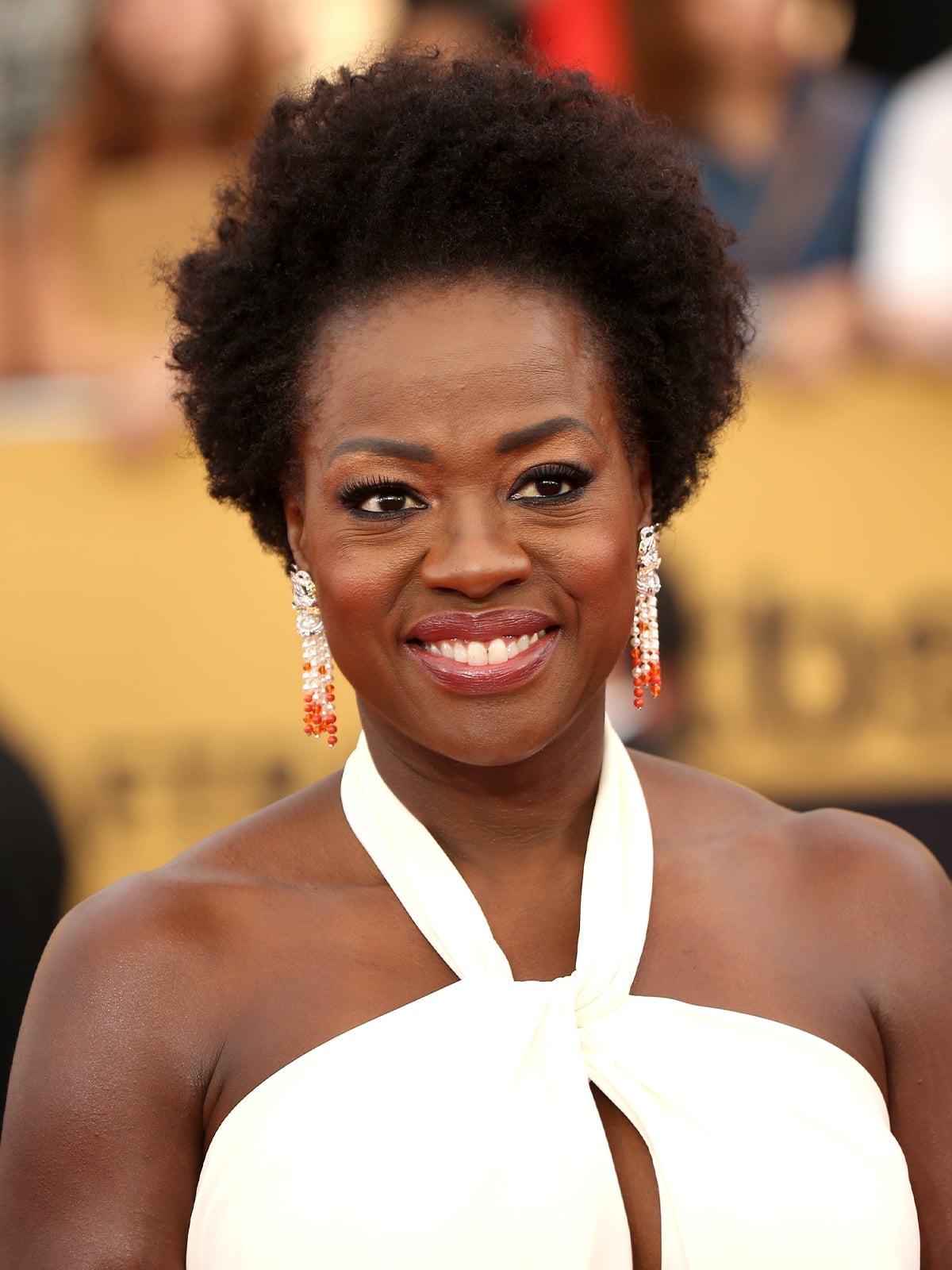
Wondering if you can get this much volume without a salon appointment? With thick, coily hair cut to ear length, the answer is yes, because the texture does the lifting for you. The black coils are dense enough to stand up on their own, so the shape comes from the cut, not from heat or product. Ask your stylist for: ear length afro, natural texture. A moisturizing styling cream and a quick finger fluff in the morning is the whole routine; a trim every six to eight weeks keeps the edges crisp.
Gray Pixie With Defined Curls
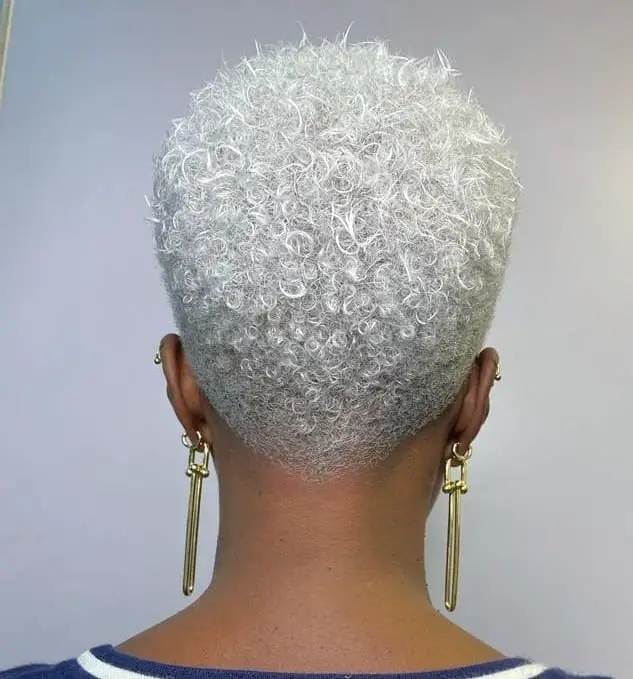
Photo credit: hadviser.com
The back view tells you everything about this cut, with the gray curls slicked back to show off the nape length and the fine texture that gives each coil its own space. Defined curls this small read as polished, but fine hair needs a light hold gel to stop them from collapsing by midday. A salon visit for the initial shape is worth it, since the taper has to be precise to keep the back from looking bulky. Ask your stylist for: short gray pixie, defined curls, slicked back. The honest trade-off is the trim schedule: every four to six weeks, or the nape starts to lose its line.
Air Dried Wavy Pixie

Image credit: oprahdaily.com
The side parting gives this wavy pixie a relaxed, just-rolled-out-of-bed look, and air-drying is what keeps the fine black waves from becoming a frizz halo. Humidity is a friend here, since it encourages the wave pattern to soften into loose bends rather than tight kinks. Ear length is the sweet spot, short enough to dry in minutes but long enough to show movement. Ask your stylist for: short wavy pixie, natural texture. A texturizing spray on damp hair and no other effort makes this the summer default, with a trim every six to eight weeks to keep the shape honest.
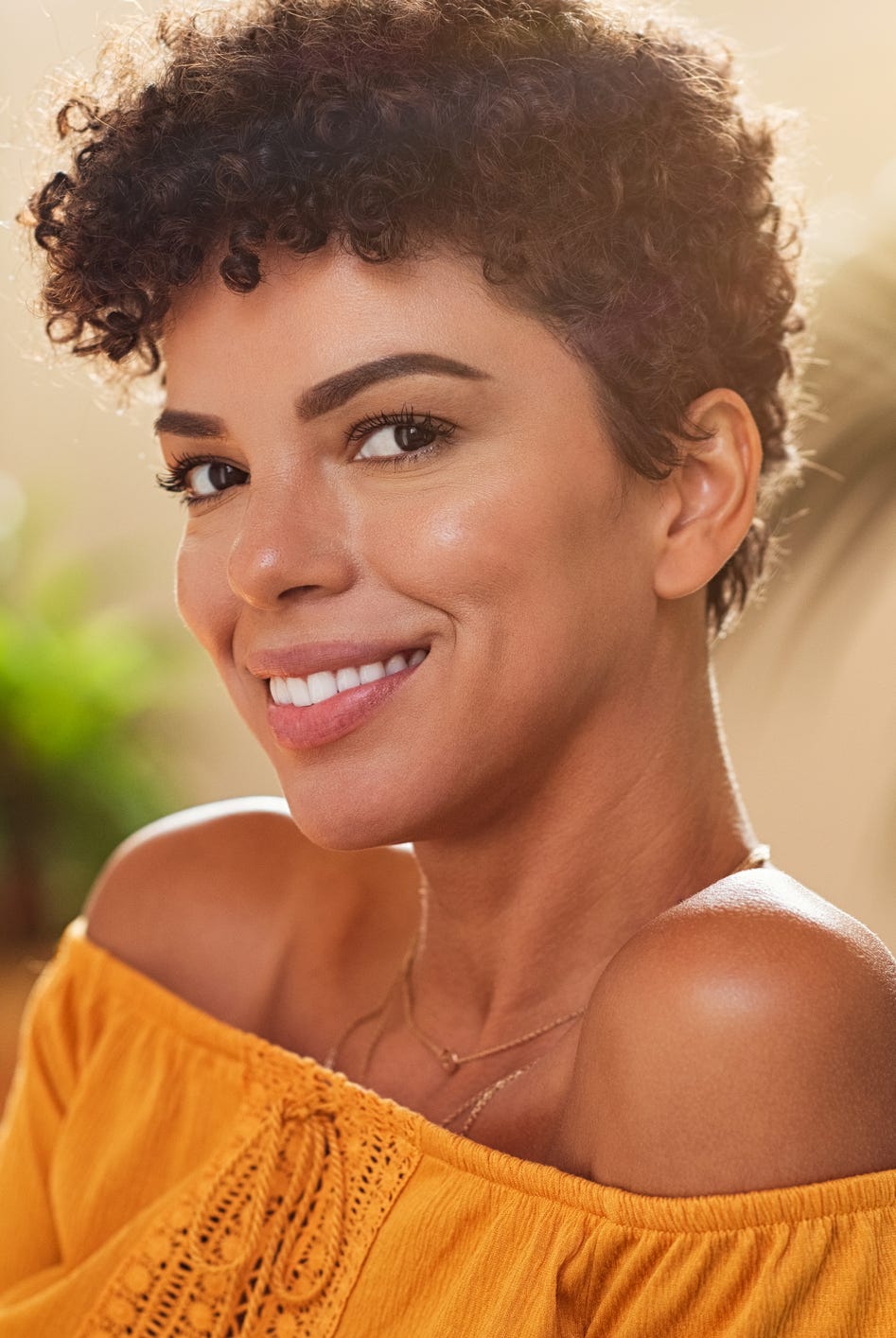
Textured Pixie With Curtain Bangs
Source: oprahdaily.com
How do you ask for bangs that soften the face? The words are curtain bangs, cut wispy so they feather around the temples instead of sitting heavy. On this dark brown pixie, the soft wavy texture and tousled styling keep the look relaxed. Ear length gives the bangs enough weight to sweep to the sides, and the fine texture stops them from clumping. Ask your stylist for: pixie cut with curtain bangs, soft texture. A texturizing spray and finger styling is the daily move, with a trim every six weeks to keep the bangs from outgrowing their job.
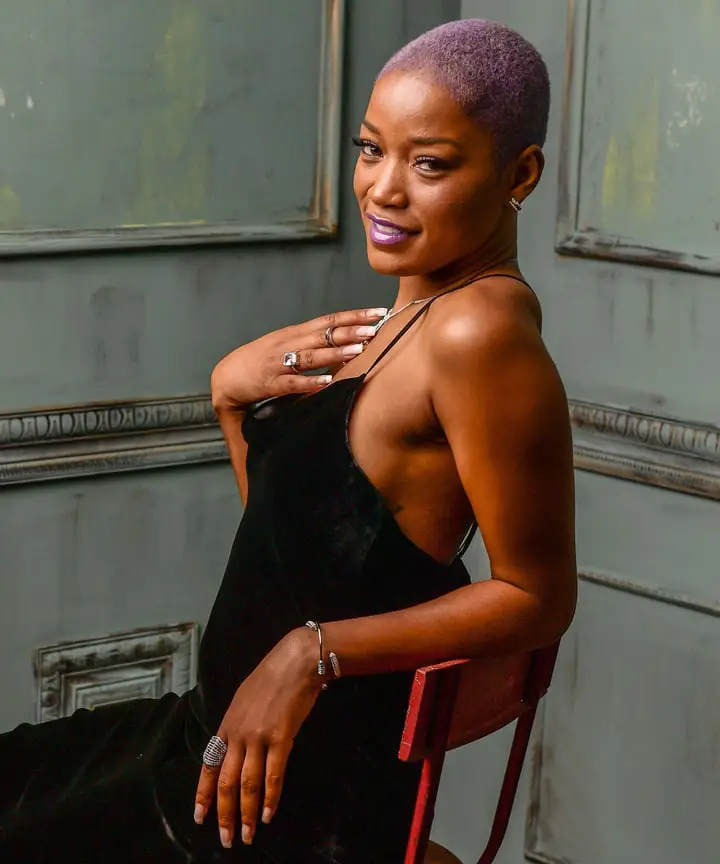
Vibrant Purple Pixie With Fringe
Via refinery29.com
A short pixie cut at ear length gets a saturated purple that lands somewhere between jewel and grape soda. The fine, straight texture and a short fringe swept to the side keep the color front and center. This look works best on straight hair starting at ear length, since the fine texture lets the shade read clearly without interference. Ask your colorist for: short pixie cut, vibrant purple, side-swept fringe. Applying a semi-permanent color at home is possible with a wide-tooth comb and a bowl. The fringe will need a dry-shampoo refresh between washes to stay separated.
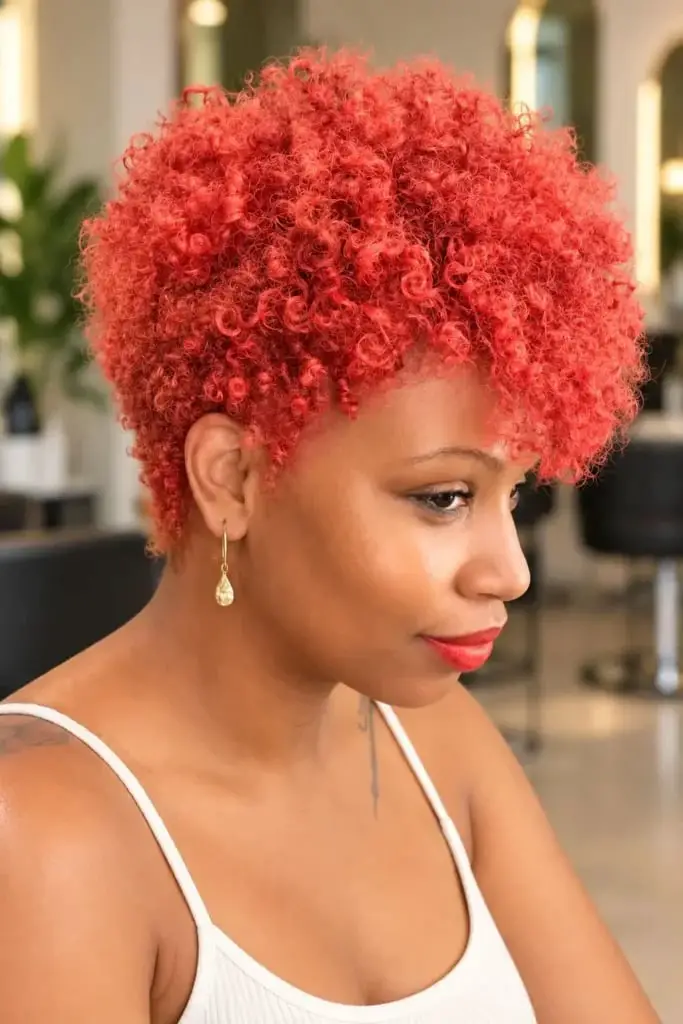
Bright Red Pixie With Undercut
Courtesy of: ablestyles.com
Thick, curly hair at ear length is the ideal starting point, as the natural volume fills the silhouette without extra work. Ask your colorist for: pixie cut with undercut, bright red voluminous curls. This is a salon-only project. The red requires a color-safe routine and a toning gloss every four weeks to keep the shade from shifting warm.
Slicked Black Buzz Cut
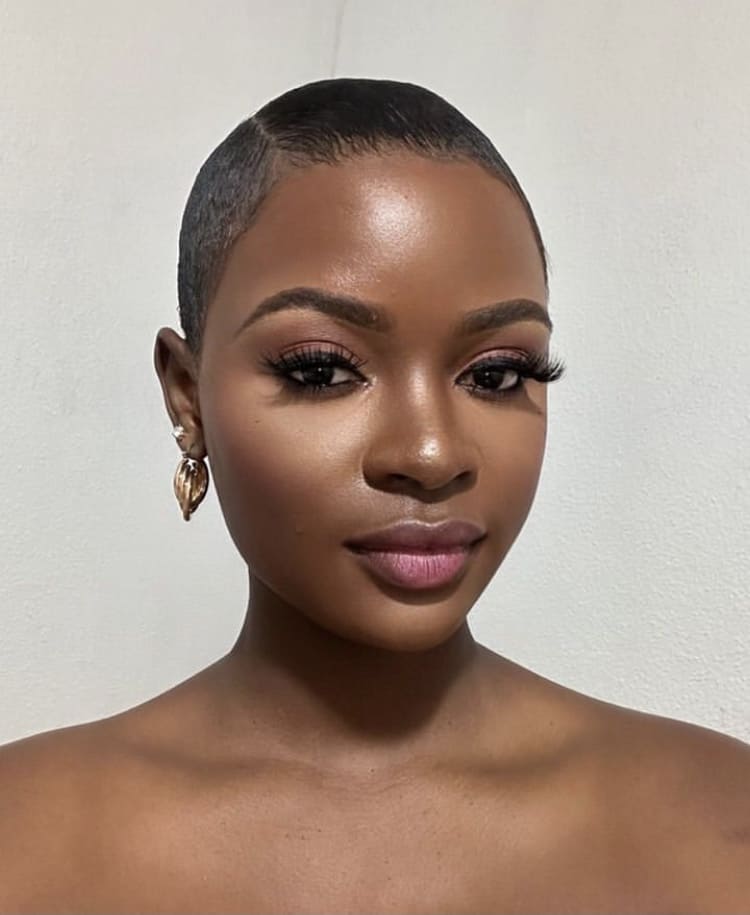
Photo credit: blackbeautybombshells.com
The mistake people make with a slicked buzz cut is treating it as a no-effort option. The sharp side parting here demands regular trims every two to three weeks; let it go four weeks and the precision evaporates. Fine, straight hair in black shows every line clearly, so the part needs to be drawn with a comb after washing. Ask your stylist for: slicked buzz cut, sharp side part. The honest downside is that the look is unforgiving, asymmetry in the cut reads immediately, so find a stylist who works with clippers daily.
Airy Platinum Blonde Pixie

Image credit: oprahdaily.com
A short pixie cut in platinum blonde relies on fine, straight texture to stay airy. The neat, lifted finish gives it weightlessness. Fine hair at ear length suits this version because it holds a light styling cream without getting heavy. Ask your colorist for: short pixie cut, platinum blonde, airy styling. The reality of upkeep is that the blonde demands root touch-ups every four to six weeks, and the fine texture needs a heat protectant before any blow-drying to prevent breakage at the nape.
Smooth Chin Length Bob
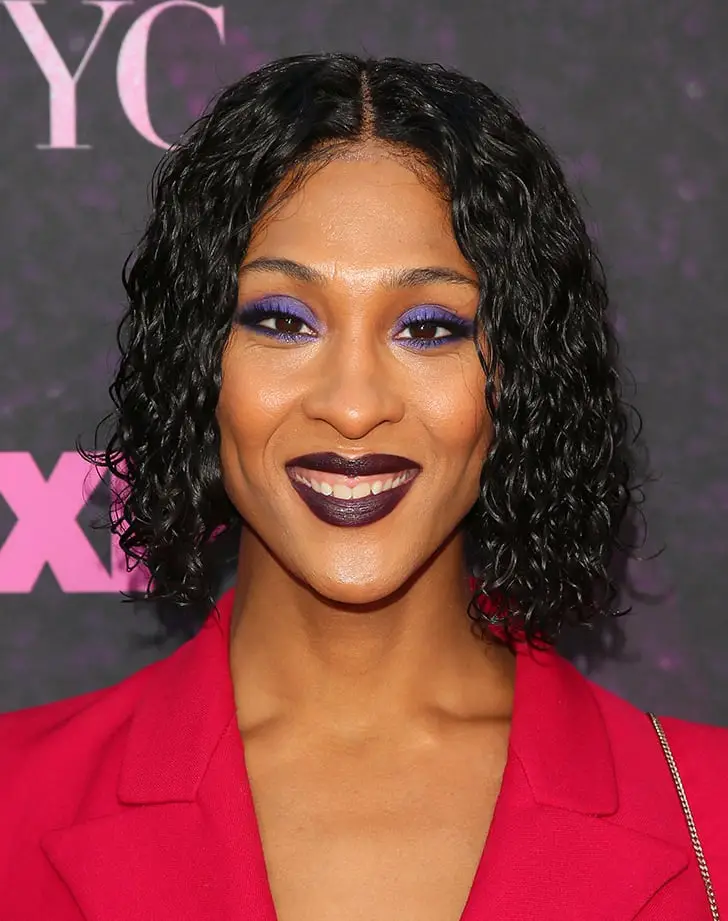
Via purewow.com
Who does a chin-length bob genuinely work for? Thick, straight hair that can hold a blunt edge without caving inward. The smooth, glossy finish here requires density, fine hair tends to look stringy at this length without added texture. Ask your stylist for: chin length bob, smooth finish. Wear and upkeep involve a flat iron for the sleekness and a trim every six to eight weeks to keep the baseline sharp. The benefit is that the shape stays recognizable during grow-out, so you get closer to ten weeks before it loses definition.
Final Thoughts
Pick by texture first. Fine hair holds volume best in a textured pixie or a layered crop, where a blunt baseline keeps the shape from collapsing. Coily hair keeps its roundness in an afro or a twist-out, and shaved sides add dimension without removing bulk on top.
- Trim afros and textured cuts every six to eight weeks.
- Tone vibrant color at week four, not week eight.
- Sleep on a silk pillowcase to keep coils intact.
- Work leave-in conditioner through coily textures daily.
Short natural hair offers more range than length ever did.
Hairstyle
17 Fulani Braids Hairstyles 2027 with Beads and Bohemian Curls
Fulani Braids Hairstyles 2027 featuring 17 looks with beads and bohemian curls. Get inspired by these wavy and black cornrow styles. See the looks!
Fulani braids are a West African protective style built from a crown of cornrows that feed into loose braids, often threaded with beads or shells at the ends. The current version leans lived-in: braids fall soft and glossy rather than stiff, with face-framing pieces and wavy ends doing the decorative work once reserved for heavy accessories.
This collection gathers 17 Fulani Braids Hairstyles, from collarbone crops to mid-back lengths, in solid black, copper and two-tone blends. Some are low upkeep, some need a steady hand at the scalp, and all of them solve the usual braid complaints: a flat crown, a visible part that wanders, ends that kink instead of curl.
Mid-Back Fulani Braids With Beads and Shells
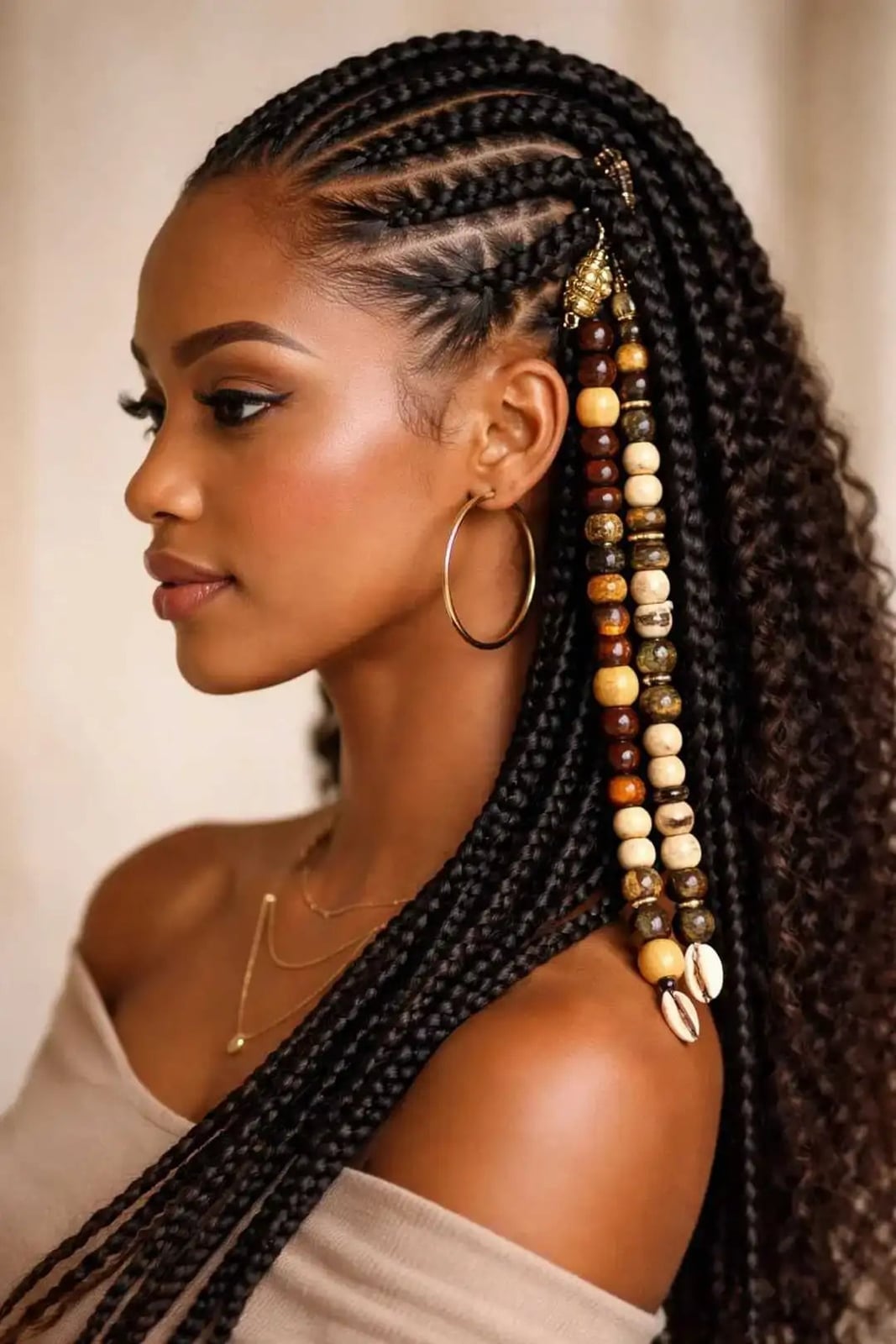
Courtesy of: ygwigs.com
The design starts with tight cornrows that sweep back from a middle parting, then releases into thick braids that fall to the mid-back. What sets this version apart is the finish: each braid ends in loose waves and curls, while wooden beads and cowrie shells are threaded along several strands. The black base is broken by subtle blonde highlights that add contrast along each braid. Ask your stylist for Fulani braids to mid-back with wooden beads and cowrie shells. Thick hair types starting at shoulder length or longer carry the weight of the beads best. The shells should be secured tightly during braiding so they do not slip off over time, and loose ends get trimmed every 10 to 12 weeks to keep the wavy texture looking deliberate.
Mid-Back Fulani Braids With Bohemian Curls
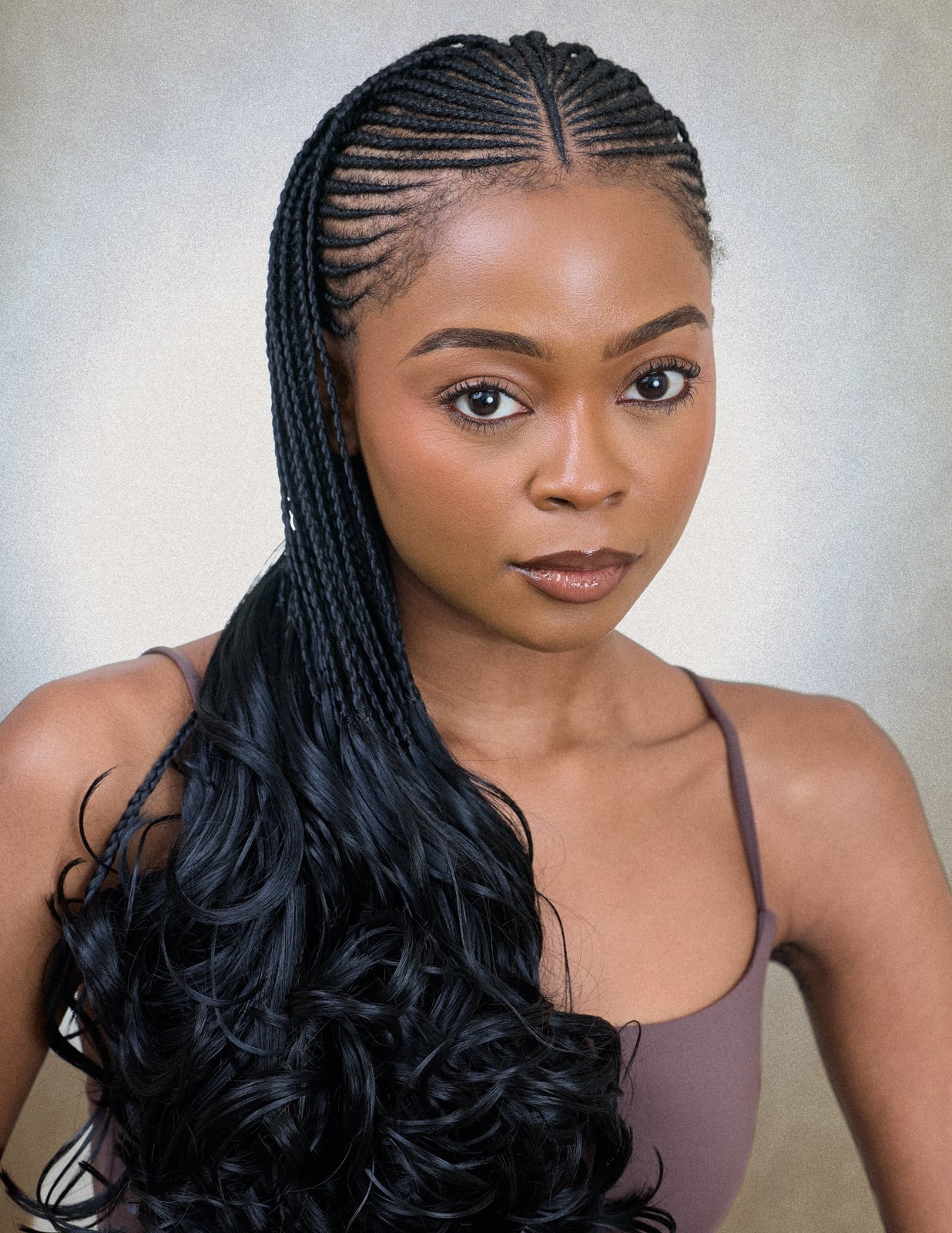
Photo credit: joliedensbeautybar.com
Wondering if bohemian curls will work on your hair? The braids here are dark brown with blonde highlights, and the mid-back length ends in thick, voluminous curls that soften the whole style. This one suits thick hair types of mid-back length or longer, since the extra fullness needs weight to hang well. Ask your stylist for Fulani braids with bohemian curl ends. To keep the curls bouncy, gently separate them with your fingers rather than a brush. Re-curl the ends every 4 to 6 weeks to refresh the shape, and you have a style that holds its volume for everyday wear or special events.
Mid-Back Straight Box Braids With Amber Beads
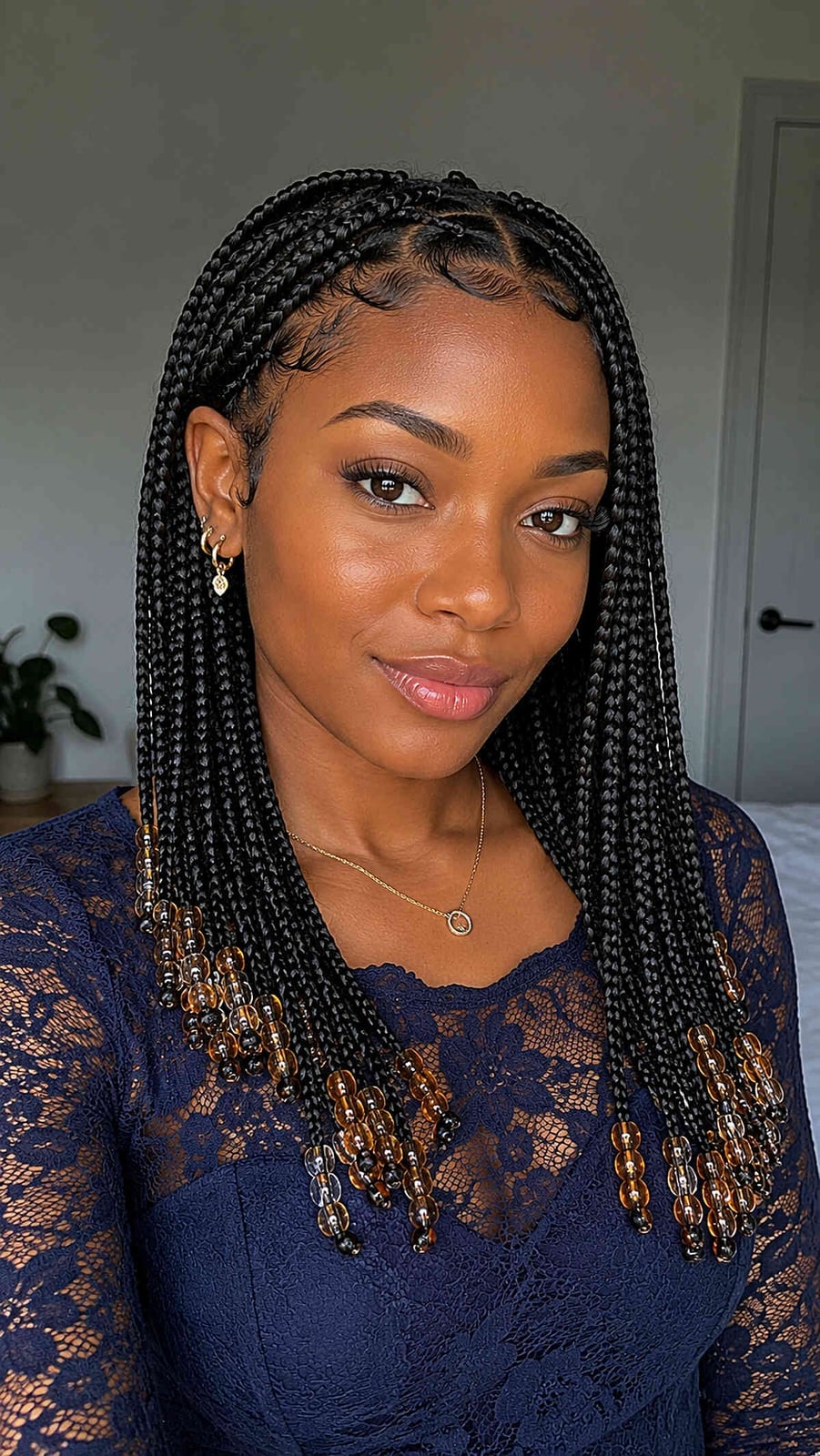
Image credit: latest-hairstyles.com
Thin, straight box braids are spaced evenly from a middle parting, each one running clean to the mid-back with amber and clear beads threaded at intervals. The baby hairs along the hairline are laid down smooth, which gives the whole look a polished finish. Ask your stylist for mid-back thin straight box braids with amber beads and baby hairs. This is a salon-only style: the precision of the parting and the bead placement require a professional appointment. The baby hairs need a light pomade to stay sleek, and the braid ends get trimmed every 8 to 10 weeks if they start to fray.
Solid Black Mid-Back Fulani Braids With Cornrows
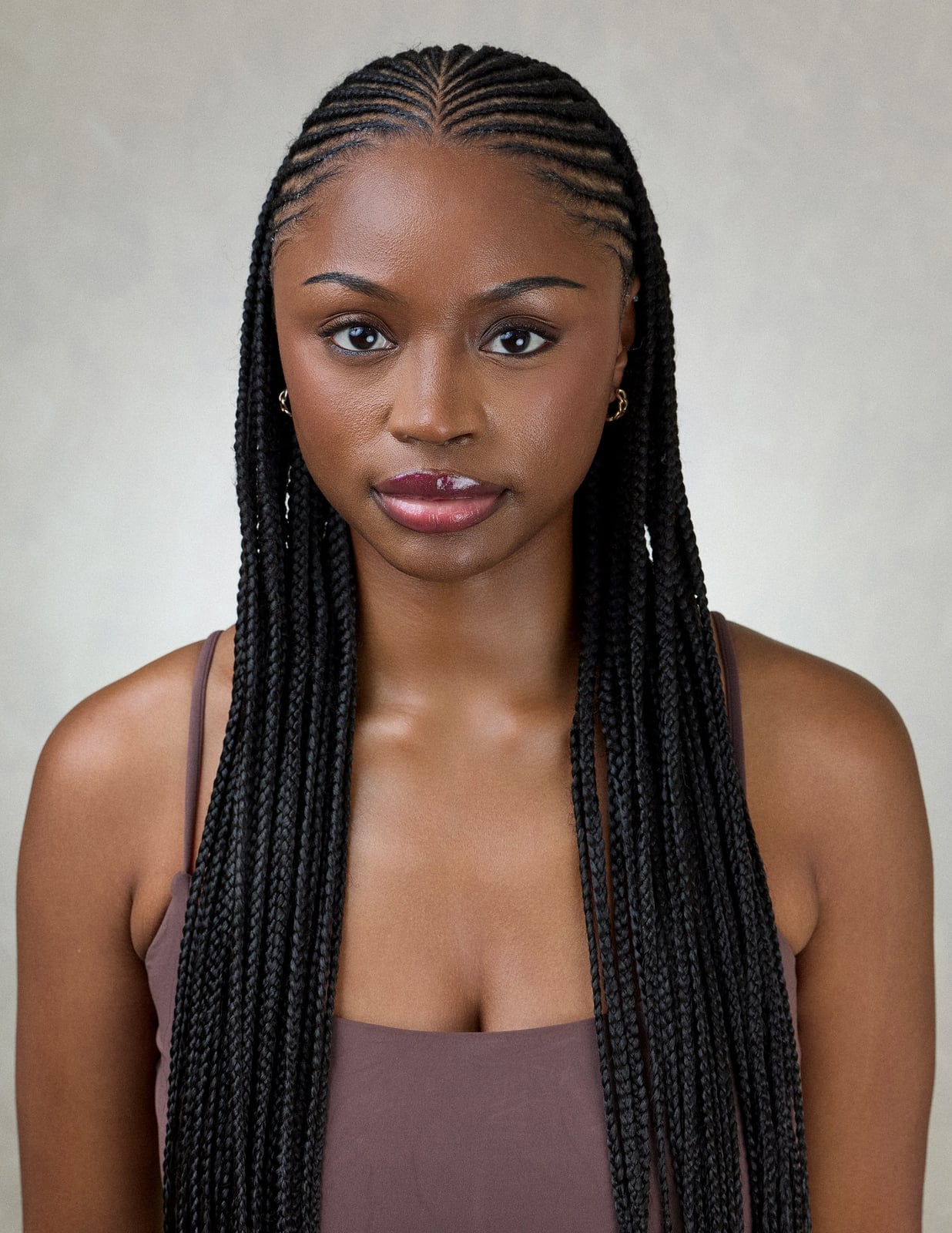
Source: joliedensbeautybar.com
Where the beaded version draws the eye with ornaments, this one relies on the contrast between the neat cornrows on top and the long, thick box braids that fall straight down the back. The solid black color keeps the silhouette uniform, so the scalp pattern does the talking. Ask your stylist for Fulani braids with scalp cornrows to mid-back, solid black. It suits thick hair types of mid-back length or longer, and the even tension during braiding is what keeps the cornrows lying flat. The one real drawback is the weight: the thick braids can pull on the scalp after a long day, so it is not the lightest option for an active week.
Mid-Back Wavy Fulani Braids With Intricate Parting
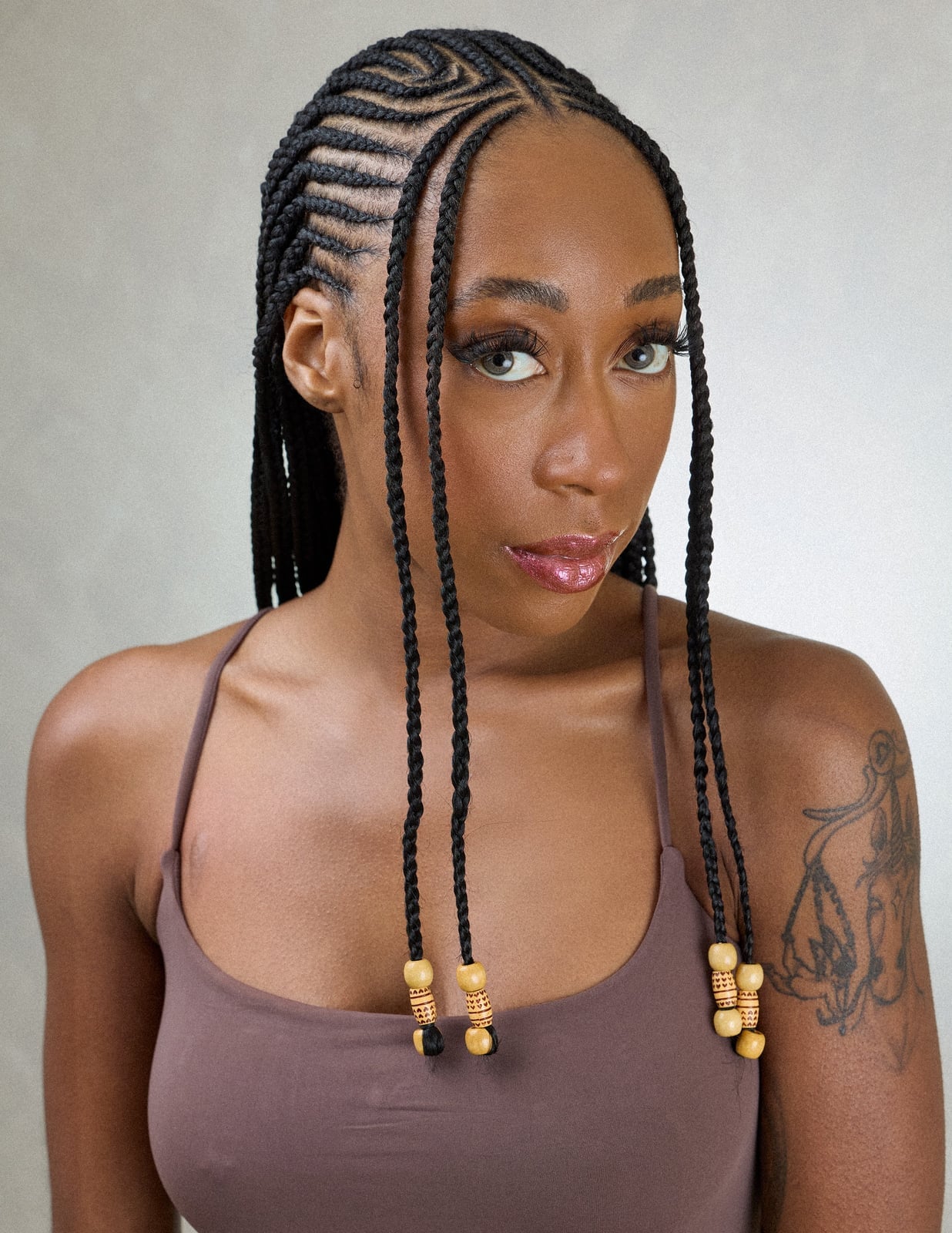
The scalp is the star here, with an intricate parting pattern that zigzags from the crown before the braids take over. The black wavy extensions reach the mid-back, and the waves add movement that keeps the detailed design from feeling too rigid. Ask your stylist for Fulani braids to mid-back with intricate scalp parting and wavy texture. Thick hair types starting at shoulder length or longer carry the pattern well. Daily wear is simple: a light serum on the wavy ends keeps them defined, and a trim every 10 to 12 weeks maintains the length. The parting stays crisp for weeks if you sleep with a satin scarf to reduce friction.
Extremely Long Mid-Back Fulani Braids
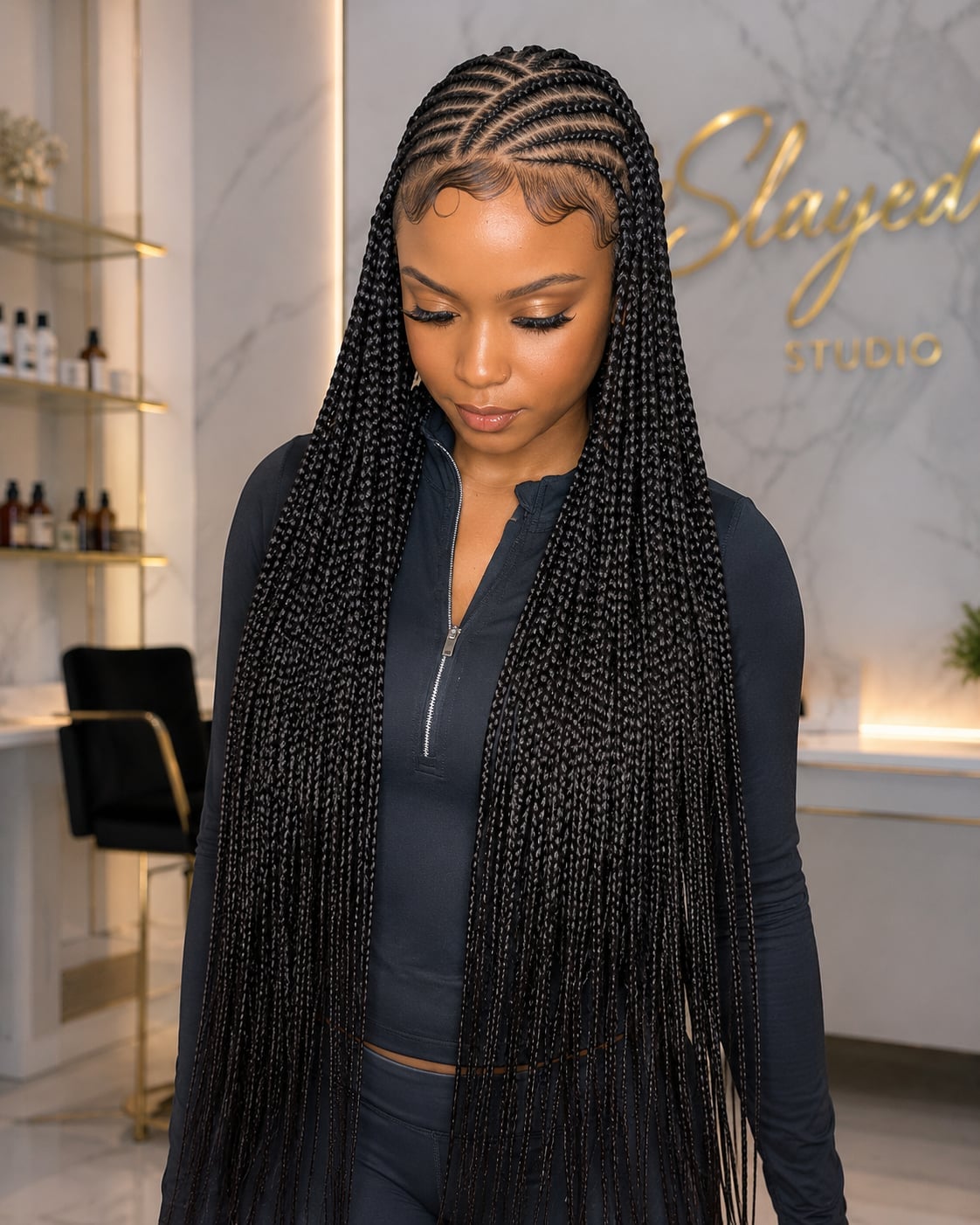
Courtesy of: luemashairandbeauty.com
Neat cornrows run back from a middle parting and feed into dense, straight black braids that fall to the mid-back, and the density is what makes this version read as a wall of hair rather than a set of individual braids. Ask your stylist for: extremely long mid-back Fulani braids, dense and straight. The uniformity is the point, and it is also the catch: every braid has to be packed to the same tension or the whole thing looks lopsided.
This is a salon job, and a long one, because braiding past the mid-back takes time. Thick hair handles the weight best; fine or low-density hair can still wear it, but the braids need enough volume at the root to support the length without pulling. The real drawback is weight. All that hair sits on the scalp for hours at a stretch, and a tight install on day one can turn into tenderness by day three, so ask for even distribution and a looser root. Trim the ends every 12 to 14 weeks to keep the length looking neat.
Collarbone Fulani Braids With Two-Tone Effect
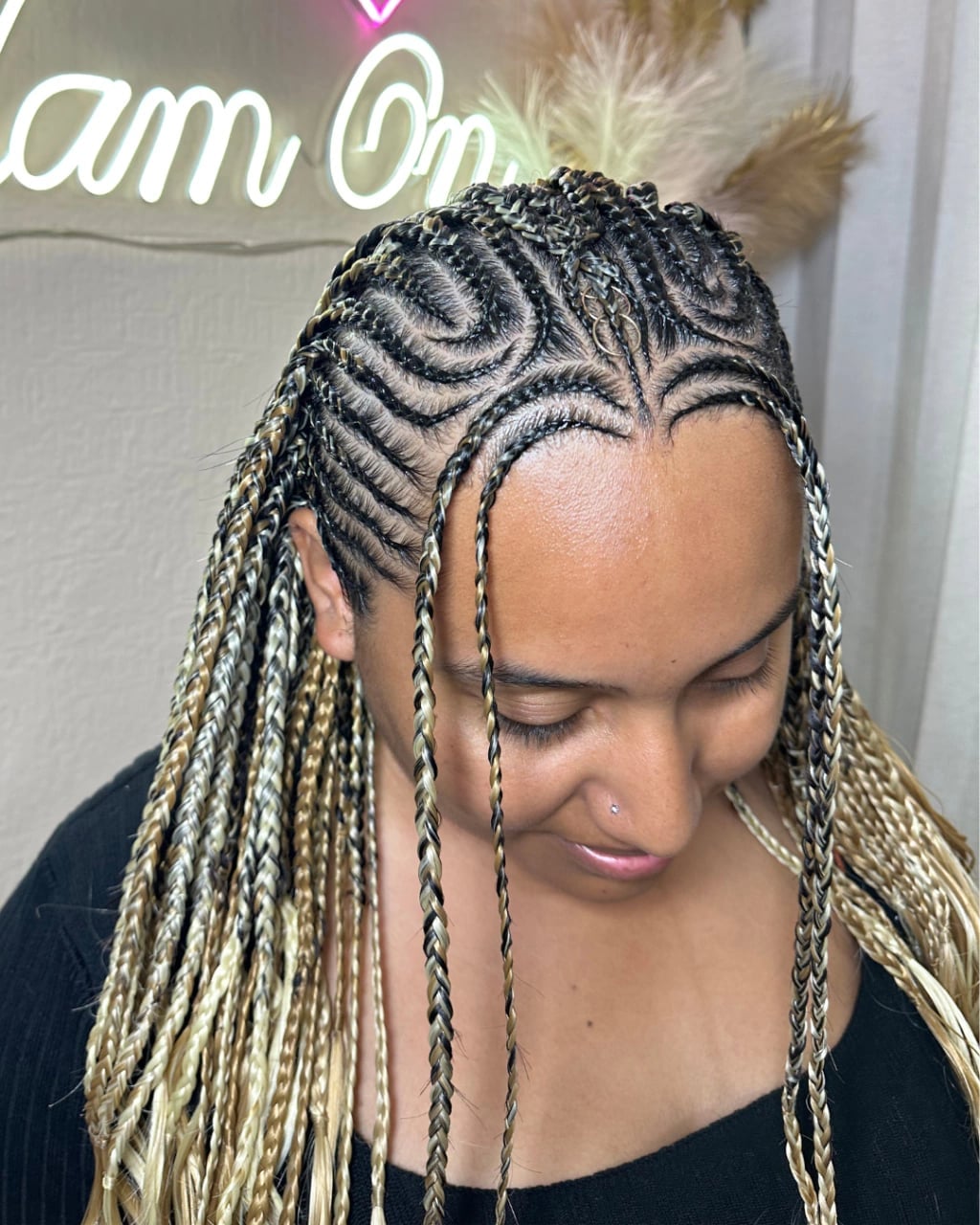
Photo credit: caribbeanbraids.com
Wondering if black and blonde can share a braid without a fight? At collarbone length, with a middle parting and an intricate scalp pattern, the contrast stays graphic instead of loud. Ask your stylist for: collarbone length Fulani braids, black and blonde two-tone. It suits medium to thick hair starting at shoulder length or longer, and the shorter cut keeps the color from overwhelming the braiding detail. This is the version that lands in summer and at casual events, where a lighter, mixed palette feels right. Use a color-safe shampoo to keep the two-tone vibrancy, and trim every 6 to 8 weeks.
Mid-Back Fulani Braids With Wavy Ends
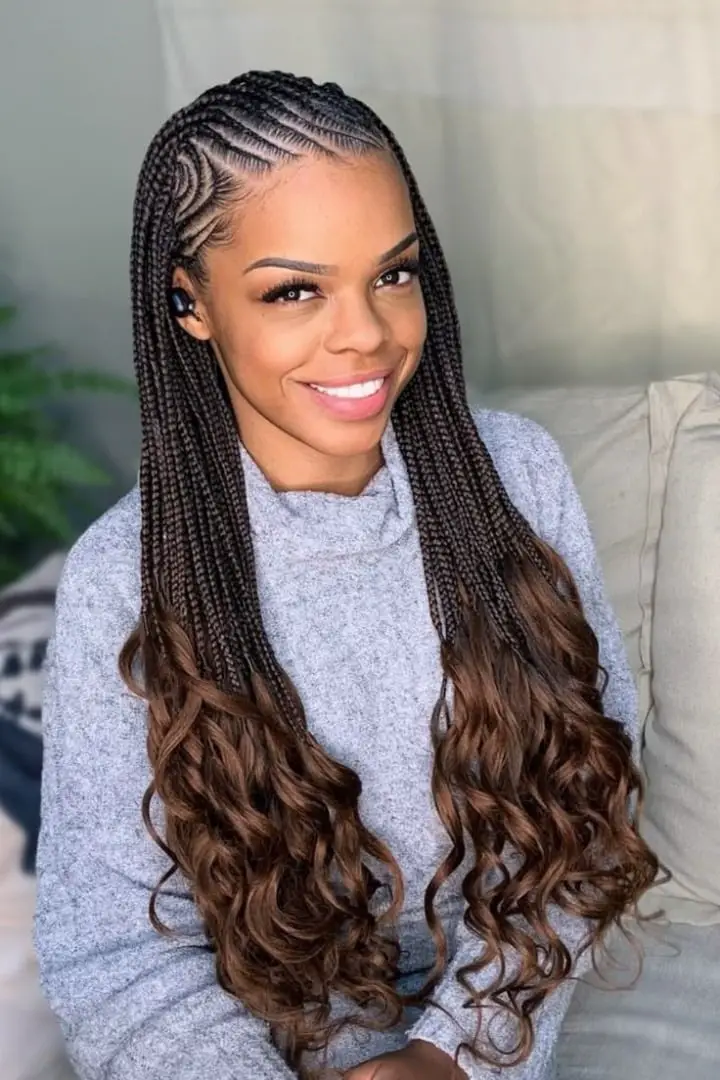
Image credit: blessedafricanbraidss.com
Decorative scalp patterns are the tell here: the cornrows are laid in a visible design before the braids drop into long, flowing waves at the mid-back, over a dark brown base with lighter brown highlights. Ask your stylist for: Fulani braids to mid-back with wavy ends and brown highlights. The scalp work is drawn first, so bring a reference for the pattern you want and expect the braider to map it out before a single braid goes in. Thick hair of mid-back length or longer carries the dimension best.
To style the finish at home:
- Work a wave-enhancing serum through the ends only, not the roots.
- Scrunch the waves while damp and let them air dry.
- Keep the scalp pattern visible by avoiding heavy product near the part.
Trim every 10 to 12 weeks to keep the wavy ends clean.
Mid-Back Fulani Braids With Voluminous Curly Ends
Source: blackbeautybombshells.com
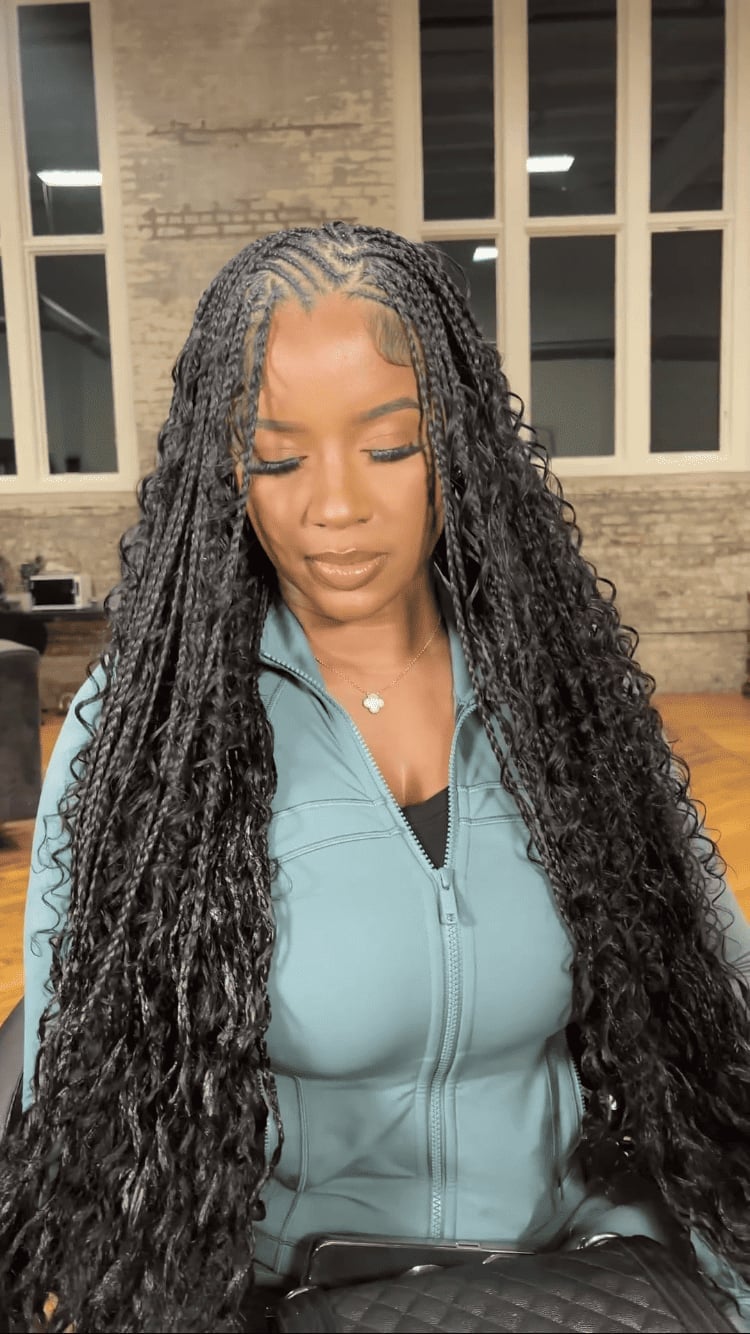
Set against the wavy version, densely packed braids open into long, thick curls, all in black. Ask your stylist for: Fulani braids to mid-back with long voluminous curly ends. Thick, wavy hair types get the fullest result, and mid-back length or longer gives the curls room to sit without crowding the scalp. Fine hair can wear it, but the curl density has to be chosen carefully or the ends swallow the braids.
This is a salon-only build, since packing the braids densely and getting the curls to sit full takes a trained hand and several hours. A conditioner on the curly ends keeps them defined instead of fuzzy, and a trim every 10 to 12 weeks keeps the shape. The upkeep is mostly moisture: dry ends on a style this full read as frizz.
Mid-Back Fulani Braids With Beads and Rings, Black
Source: bookedandbeautiful.co.za
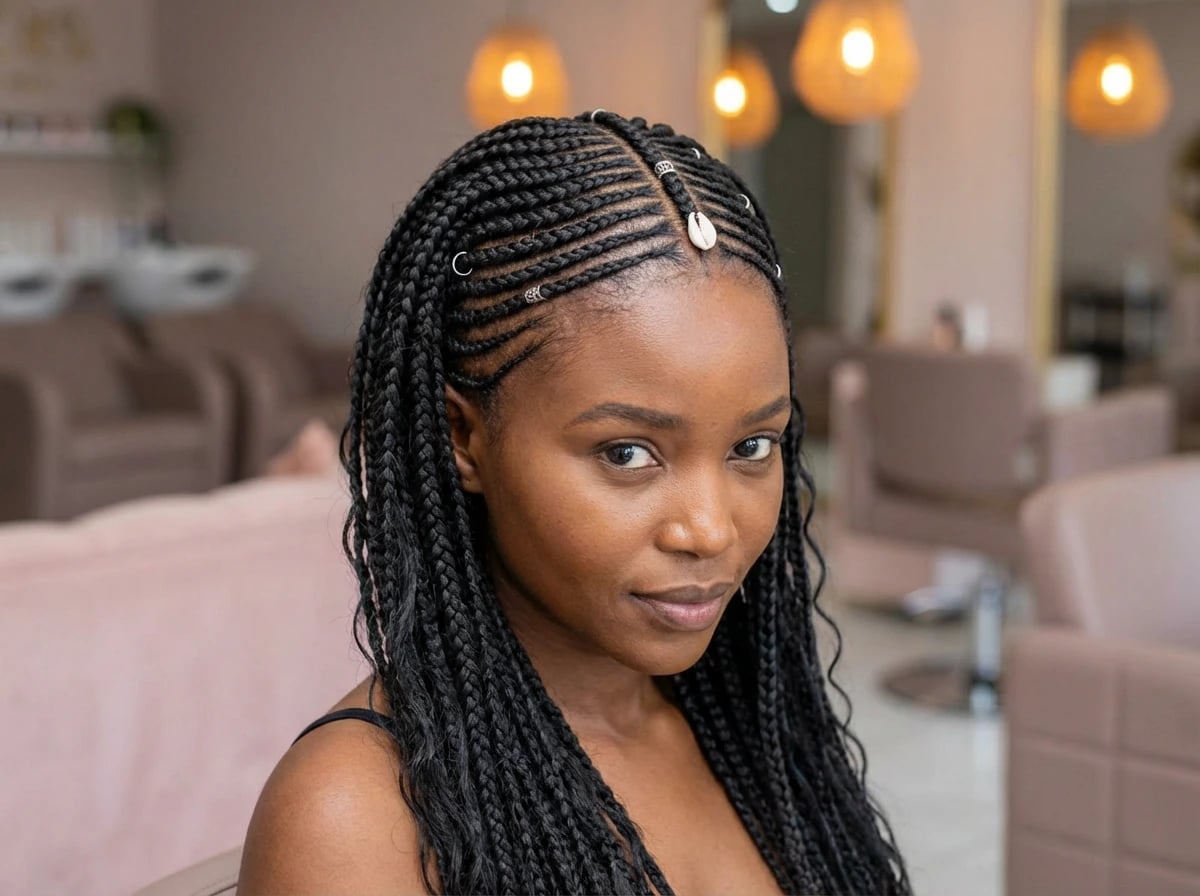
Beads and metal rings sit along black braids that reach mid-back and finish in soft waves, and a middle part keeps the scalp pattern front and center. Ask your stylist for: Fulani braids to mid-back with beads and metal rings, wavy ends. Placement matters more than quantity, so say if you want the accessories clustered near the ends or spaced up the length; a braider will usually ask, but be specific. Thick hair at mid-back length or longer holds the weight of the rings without pulling. One honest catch: metal rings with a rough seam can snag the hair around them, so check the edges are smooth before they go in. Trim every 10 to 12 weeks.
Collarbone Fulani Braids With Face-Framing Bangs
Via un-ruly.com
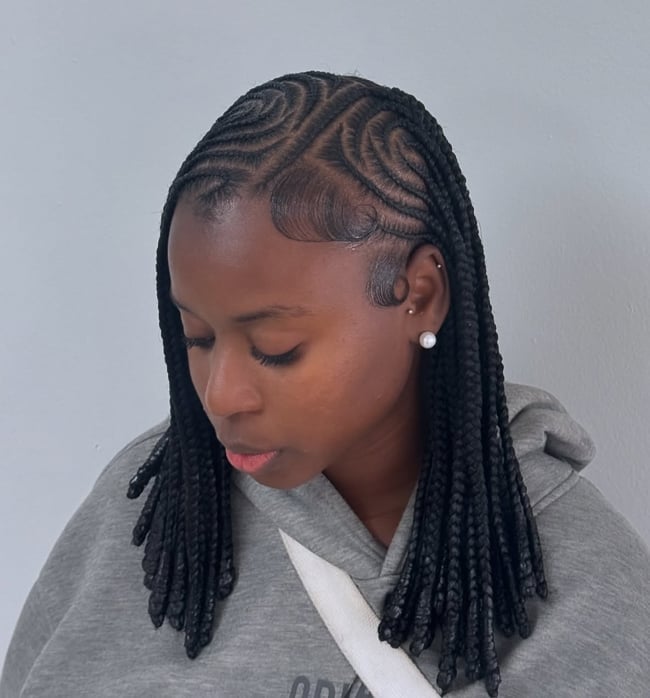
Wondering if curtain bangs work with Fulani braids? They do, and here’s the trade-off: the side parting and face-framing braids soften the forehead, while the collarbone length keeps everything neat and easy to manage. Medium to thick hair starting at shoulder length or longer suits this best. Ask your stylist for: collarbone length Fulani braids with curtain bangs and face-framing braids. Style the curtain bangs with a round brush to encourage a soft bend, and expect a trim every six to eight weeks to keep the shape.
Mid-Back Fiery Copper Fulani Braids With Undercut
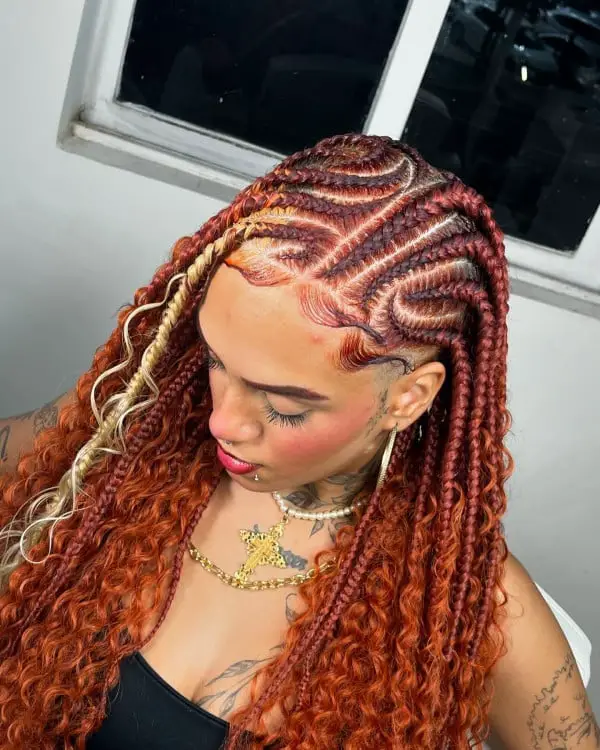
Courtesy of: fabmood.com
The undercut on one side means you’re committing to a maintenance schedule, not just a style. The fiery copper with blonde streaks fades faster than darker shades, so plan on using a color-depositing conditioner every few washes to keep the tone from turning brassy. The mid-back length and wavy, thick ends add volume, while the shaved side needs a razor every two to three weeks to stay sharp. This one is a bold statement, made for festivals or any occasion where the hair should do the talking. Ask your stylist for: mid-back Fulani braids in fiery copper with blonde streaks, undercut, and wavy ends.
Shoulder Length Fulani Braids With Curly Ends
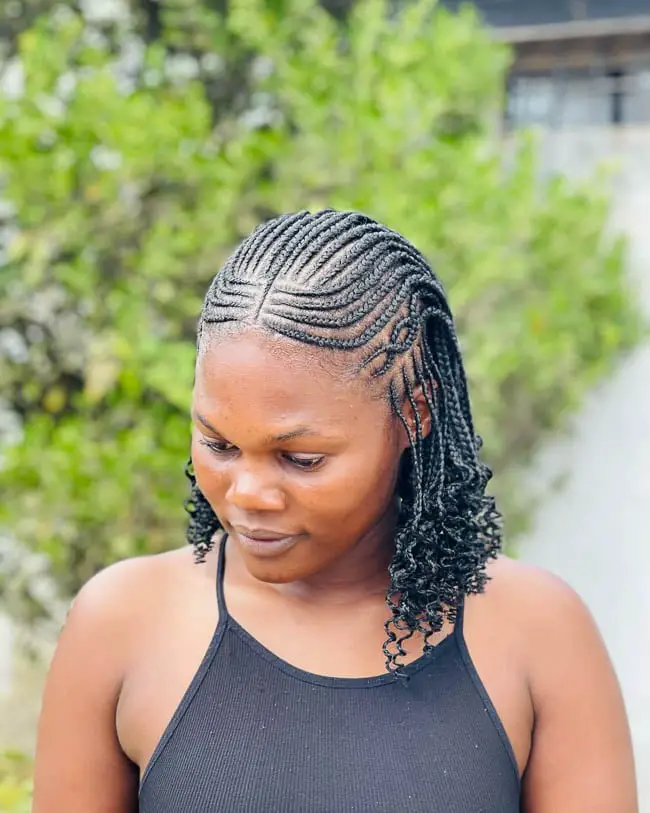
Photo credit: un-ruly.com
The technique here is a two-part build: tight cornrows radiate from the middle parting on the scalp, then the braids transition into loose, wavy curls at the ends. That contrast is what gives the style its texture, and it’s a salon job rather than a DIY project, since the cornrows need to lie flat and the curls need to blend. Shoulder length keeps the weight down, which helps the curls hold their bounce. Medium to thick hair starting at shoulder length or longer works best. Ask your stylist for: shoulder length Fulani braids with curly ends and scalp cornrows. Apply a curl cream to the ends to enhance definition, and trim every six to eight weeks.
- Cornrows on top
- Curly ends
- Middle parting
Mid-Back Brown Fulani Braids With Wavy Texture
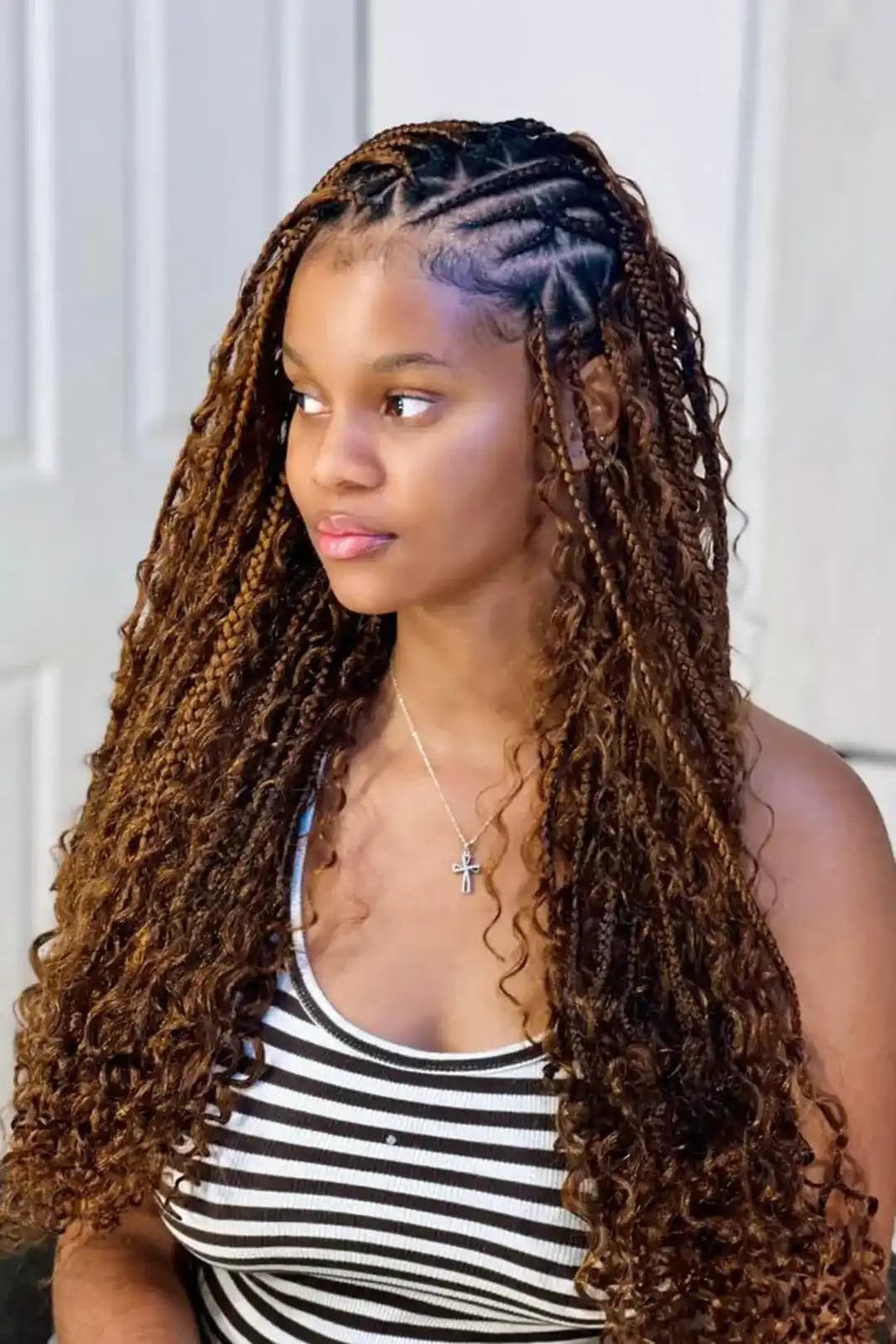
Image credit: ygwigs.com
Who actually gets away with this one? Thick hair, mostly, because the mid-back length plus the wavy ends adds up to a lot of volume, and fine hair can end up looking weighed down. The rich brown color and defined cornrows give it a classic feel, but the wavy texture at the ends is what makes it modern. The drawback: waves at the ends can frizz in humidity, so a texturizing spray helps keep them defined rather than fuzzy. Ask your stylist for: mid-back Fulani braids in brown with wavy ends and defined cornrows. Trim every ten to twelve weeks.
Shoulder Length Fulani Braids With Black and Blonde Mix
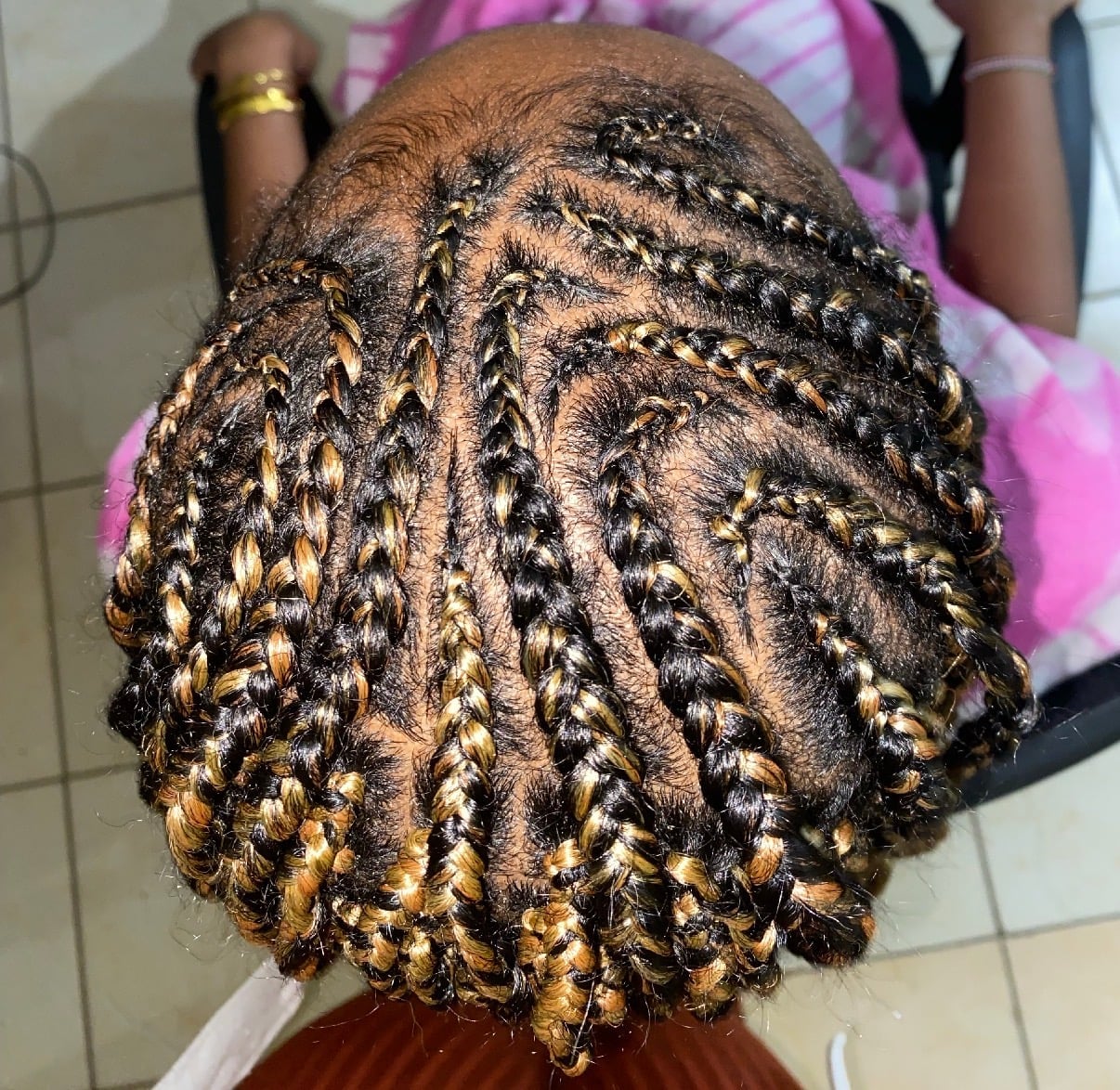
Source: braidingnairobi.com
Set this against a simple straight-back braid, and the scalp pattern is the focal point. The intricate design, built from a middle parting, is the focal point, and the black and blonde mix adds dimension so the pattern reads clearly. Shoulder length with wavy texture keeps it practical for everyday wear, and the blend of colors means you don’t have to worry about a harsh grow-out line. Medium to thick hair starting at shoulder length or longer suits this best. Ask your stylist for: shoulder length Fulani braids with black and blonde mix and wavy texture. Use a color-safe shampoo to maintain the blend.
Mid-Back Medium Brown Fulani Braids With Waves
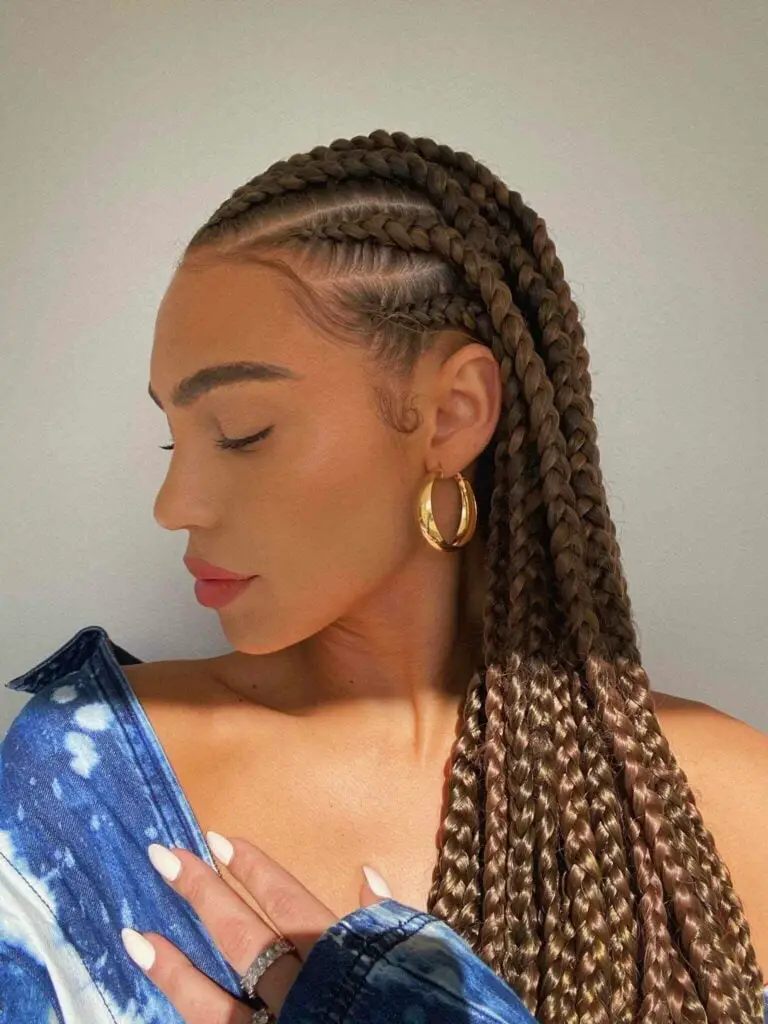
Via un-ruly.com
A clean middle parting does more work here than any accessory could, and the braid definition holds it together from scalp to mid-back. Medium brown Fulani braids with subtle waves through the length keep the color soft instead of flat, and the waves break up the grid of braids just enough. Ask your stylist for: mid-back Fulani braids, medium brown, subtle waves. Thick hair holds the braid structure well at this length, and the wave pattern needs a light oil through the mid-lengths to stay glossy instead of dusty. The parting is the part that ages first: a fresh retighten around the front and hairline every four to six weeks keeps it sharp, with ends trimmed every 10 to 12 weeks.
Mid-Back Black Fulani Braids With Geometric Scalp Pattern
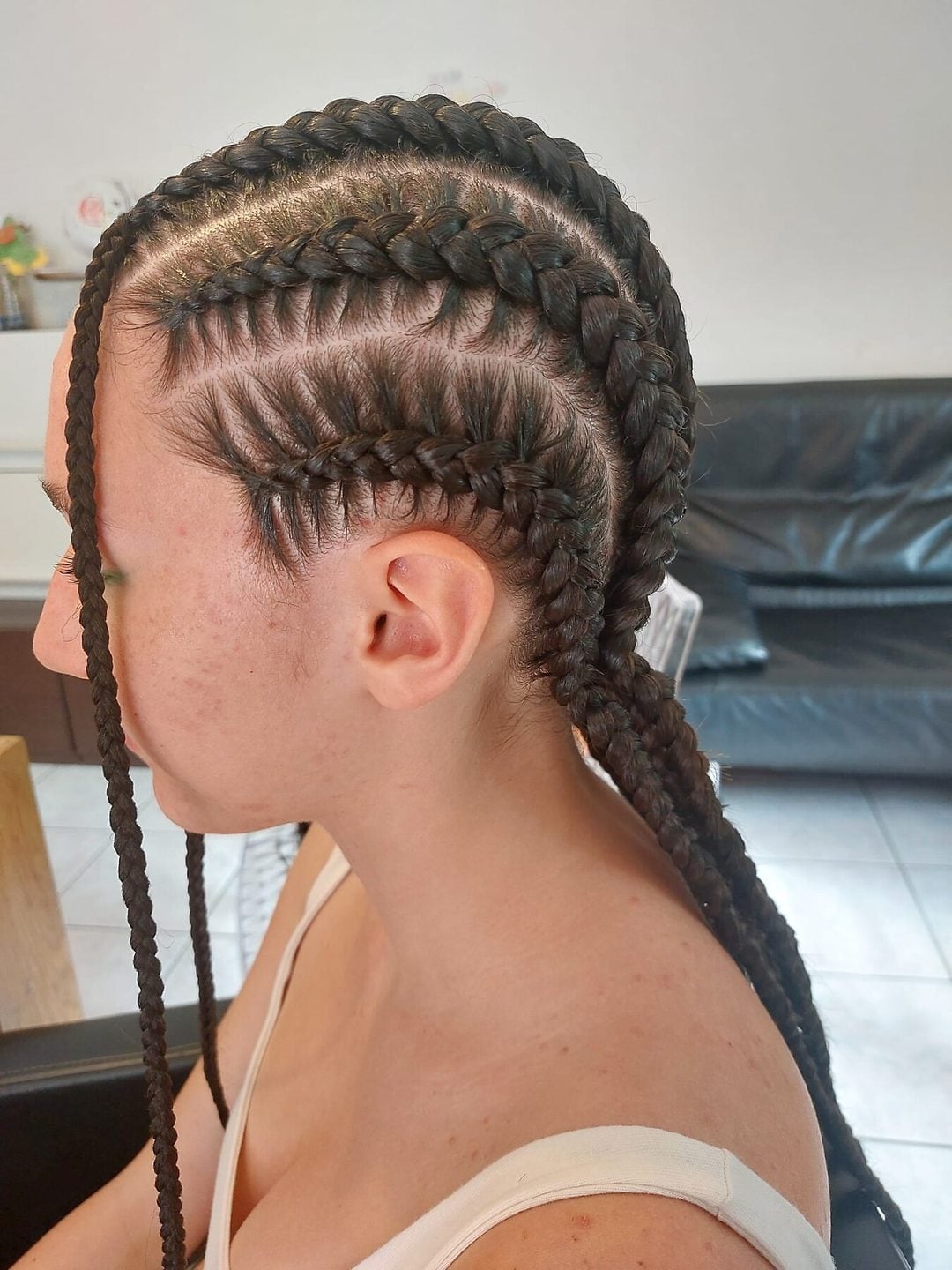
Courtesy of: komo-beauty.com
How long can a geometric scalp pattern actually survive daily life? The pattern is the whole point of this style, and it is also the first thing to blur. Black Fulani braids on thick, straight hair give the braider a clean surface for the geometry. Ask your stylist for: Fulani braids with a geometric scalp pattern. Regrowth at the part and hairline softens those lines within two to three weeks, so skip this if you want a style you can leave alone for two months. Scalp hygiene is fussier too, since heavy product dulls the pattern. Gentle cleansing and a retighten every four to six weeks keep it readable.
Final Thoughts
Choose by upkeep, not by photo. Beaded and ringed styles draw the eye but need a check that accessories stay anchored, while wavy and curly ends ask less of your mornings and hide a loosening braid better. Match the length to your routine: collarbone braids clear a collar, mid-back braids need a bonnet and a patient detangling session.
- Oil the cornrowed scalp twice a week.
- Sleep in a satin bonnet every night.
- Cleanse the scalp gently every two weeks.
- Check bead and ring anchors weekly.
- Trim stray ends at the six-week mark.
Fulani braids offer endless possibilities for personal expression and protection.
Hairstyle
20 Ginger Hair Ideas 2027: Warm & Vivid Shades
Ginger Hair Ideas 2027 featuring 20 shades from vivid ginger mid-back to rich ginger with streaks. Explore auburn. See the looks and save your favorite.
Ginger covers a wide range, from deep auburn to bright copper, and balayage has changed how the shade is built. Rather than one flat block of dye, hand-painted copper red balayage and strawberry blonde highlights keep depth moving through the mid-lengths. Warm ginger tones and natural ginger hues are the current request.
These 20 Ginger Hair Ideas run from vivid all-over ginger to auburn with lowlights, across mid-back lengths, collarbone lobs and one short shag. Fine hair that loses its warmth between appointments and a fringe that refuses to sit both get a section here. Pick a base shade, a technique and a tone to match your texture and how often you will sit for a toner.
Vivid Ginger Mid-Back Length Waves

Courtesy of: moehair.com
This shade starts with pre-lightening. A vivid ginger at this intensity cannot be built on dark hair in a single pass; the colorist lifts the base to a pale yellow first, then seals the ginger tone with a semi-permanent or direct dye. A center part with loose waves on thick, mid-back length hair lets the color register as a uniform statement rather than a dimensional one. That is the point: the color itself does the work, not highlights or lowlights.
Ask your colorist for: vivid ginger, mid-back long layers. The process takes about three hours at the salon, and a toning appointment every four to six weeks keeps the copper from shifting too warm. A smoothing serum on damp hair before air-drying protects the shine. No bangs means the color runs uninterrupted from root to end, which is the whole idea.
Rich Ginger Mid-Back Waves With Streaks

Photo credit: fabmood.com
This is what a solid ginger shade versus a dimensional one looks like. The rich ginger base sits deep and saturated, then subtle lighter streaks lift the surface. The effect is less flat than a single tone and less contrast-heavy than chunky highlights. On thick, wavy hair reaching mid-back, the streaks catch the wave bends and register as movement, not stripes.
Ask your colorist for: rich ginger with subtle lighter streaks. Loose waves keep the look relaxed. This approach suits someone who wants ginger that is multi-tonal without traveling into balayage territory. The base depth means grow-out appears as a gentle fade, not a hard root line.
Mid-Back Auburn With Strawberry Blonde Highlights
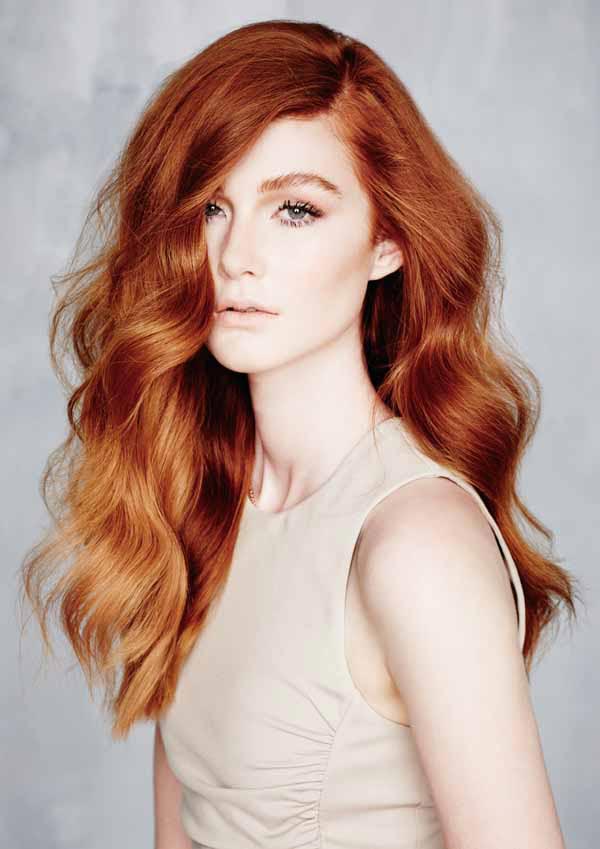
Image credit: hji.co.uk
Who should consider this combination? Anyone with a rich auburn base who wants brightness without going full copper. The strawberry blonde highlights sit on the surface layers, while auburn lowlights in the deeper sections keep the overall weight from reading as too light. Curtain bangs frame the face without committing to a solid fringe.
Ask your colorist for: auburn base, strawberry blonde highlights, auburn lowlights. The blowout with soft waves on mid-back layers shows each tone separately. Thick, wavy texture holds the separation well. Curtain bangs need a trim every six to eight weeks to stay at the right length.
Copper Red Balayage Mid-Back With Side-Swept Bangs

Source: daysinspired.com
Balayage works by hand-painting lightener onto the surface of each section. For copper red, the colorist paints lighter copper tones onto a richer base, leaving the roots untouched so the grow-out stays soft. The side-swept bangs get a lighter pass at the ends only, keeping the root line natural. Long layers on thick, mid-back length hair let the transition read clearly.
Ask your colorist for: copper red balayage, mid-back long layers, side-swept bangs. A toning appointment every six to eight weeks prevents the copper from pulling orange. Use a large round brush, directing the bangs to one side. The side-swept shape softens angular jawlines without requiring a full fringe commitment.
Warm Ginger Balayage Mid-Back Layers
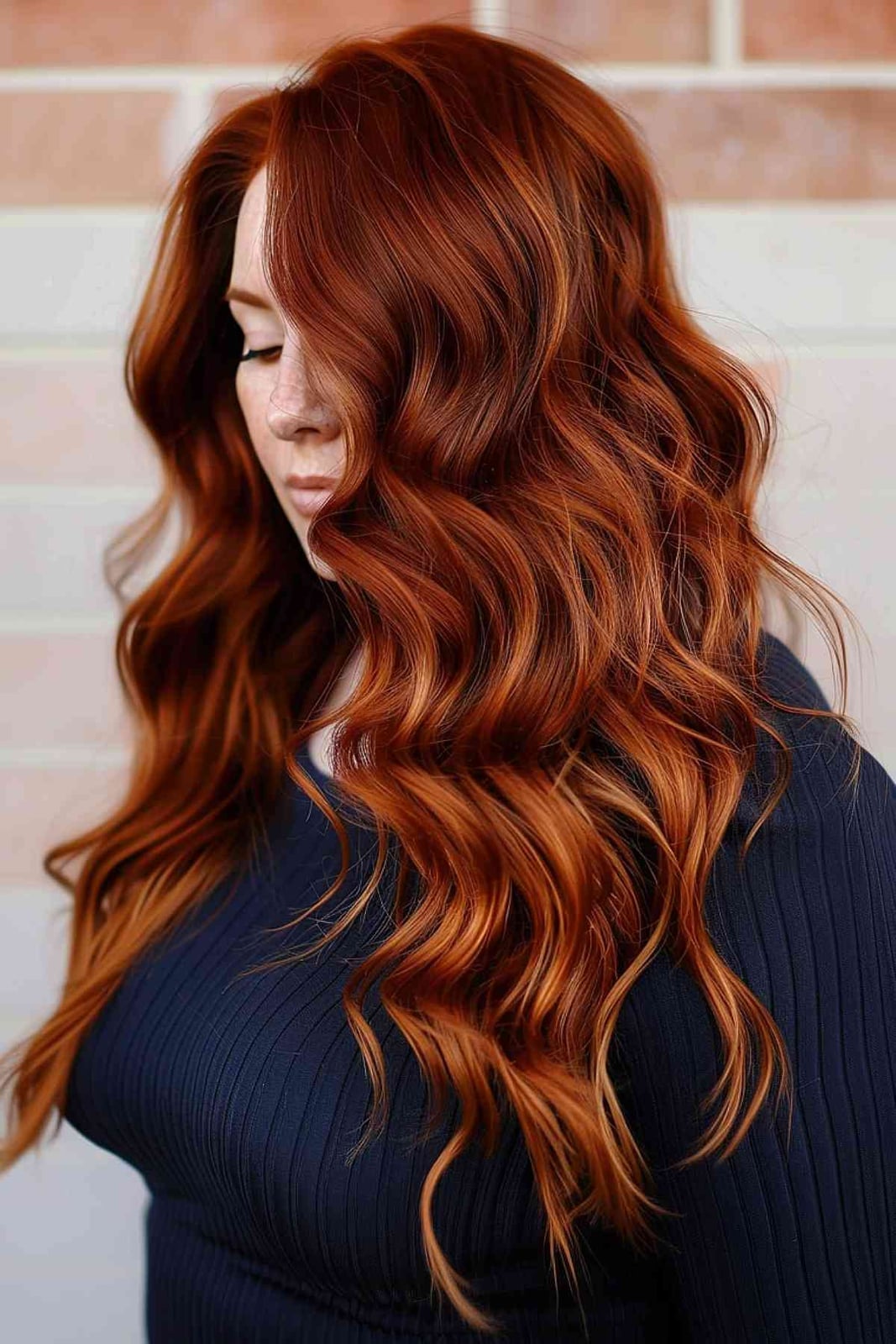
The side view here tells the story. The warm ginger balayage weaves lighter copper tones through the base, but the placement is concentrated on the mid-lengths and ends, not the crown. That distribution means the top third stays closer to the natural depth, and the dimension builds gradually. Soft waves on mid-back layers with a middle parting show the painted sections in rotation.
Ask your colorist for: warm ginger balayage, mid-back layers. The technique requires no foil, just a lightener brush and a steady hand. A texturizing spray on dry hair lifts the mid-lengths enough to expose the lighter pieces. No bangs means the balayage runs uninterrupted front to back. This is a low-commitment entry point into ginger: the base stays subtle, and the copper appears as a lift, not a change.
Copper Red Balayage Mid-Back Waves
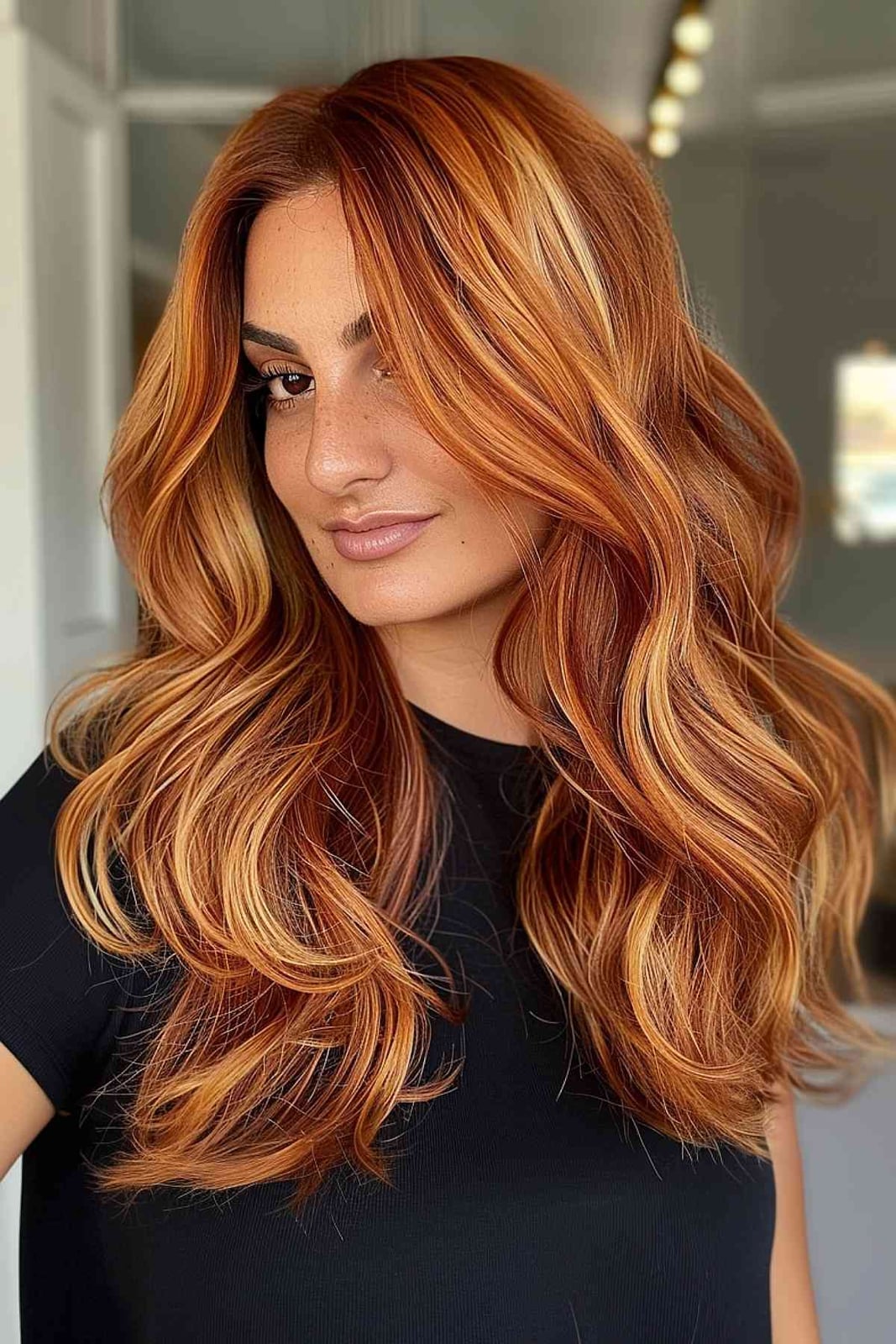
Courtesy of: latest-hairstyles.com
Bright copper highlights sit over a deeper ginger base, and the result looks lifted straight from a fall leaf pile in the best way. Thick, wavy hair cut to mid-back carries the copper red balayage without the color swallowing the shape, and loose waves through the layers keep all that weight moving. A middle part can elongate a round face, so it earns its place here. Ask your colorist for: mid-back length waves, copper red balayage. It lands hardest in autumn light and holds its own at an evening dinner, where the copper reads warm and rich.
Copper Base With Blonde Balayage Mid-Back
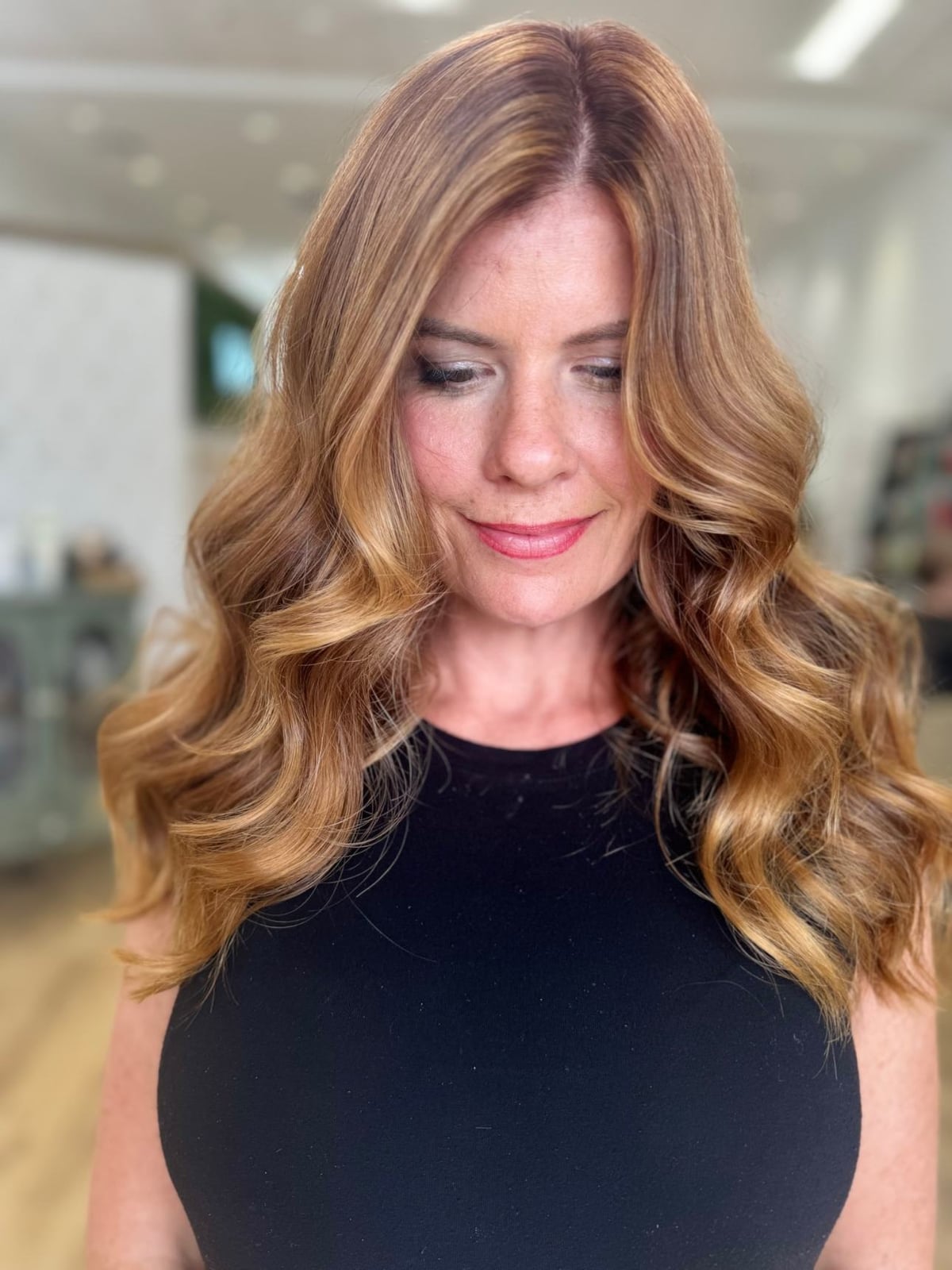
Photo credit: tidyfoxden.com
A warm copper base with blonde balayage through the lengths is one of the more technical ways to wear ginger, and it rewards a patient colorist. The base is laid down first, then the blonde is painted freehand so the lightener sits away from the root and diffuses gradually through the mid-lengths. That diffusion is the whole trick: no hard line where copper stops and blonde starts, just a soft transition that shows up best on thick, wavy hair with layers to catch it.
Mid-back length gives the balayage room to spread, and a middle part lets the lighter pieces fall where they will read. Styled as a blowout with loose waves, the warm copper and blonde tones blur into each other without competing. Ask your colorist for: mid-back layers, copper base with blonde balayage. The technique takes time in the chair, and the payoff is dimension you cannot fake with a single-process color.
Reddish Brown With Copper Undertones Collarbone

Image credit: latest-hairstyles.com
A rich reddish-brown with subtle copper undertones is the quiet version of ginger, and it suits medium-textured waves cut to the collarbone. Oval and heart-shaped faces carry this length well, and the middle part keeps the shape clean. Ask your colorist for: collarbone length waves, reddish brown with copper undertones. Because the copper stays underneath rather than on the surface, the root line grows out softly and touch-ups stretch further apart than a bright copper demands. A texturizing spray through the lengths gives the waves a lived-in finish.
Collarbone Lob With Strawberry Blonde Highlights

Source: allure.com
Strawberry blonde highlights on a ginger base land somewhere a blonde base cannot: the warmth underneath tints every highlight peach instead of gold. On this collarbone lob with curtain bangs, the highlights are woven subtly through a natural ginger base, and the soft wavy blowout shows the dimension without a stripe in sight. Medium-density waves hold the shape, and curtain bangs soften an angular face. Ask your colorist for: collarbone lob, curtain bangs, ginger with strawberry blonde highlights. This is salon work; the blend depends on placement a box cannot replicate.
Copper Red Balayage Collarbone Lob With Curtain Bangs
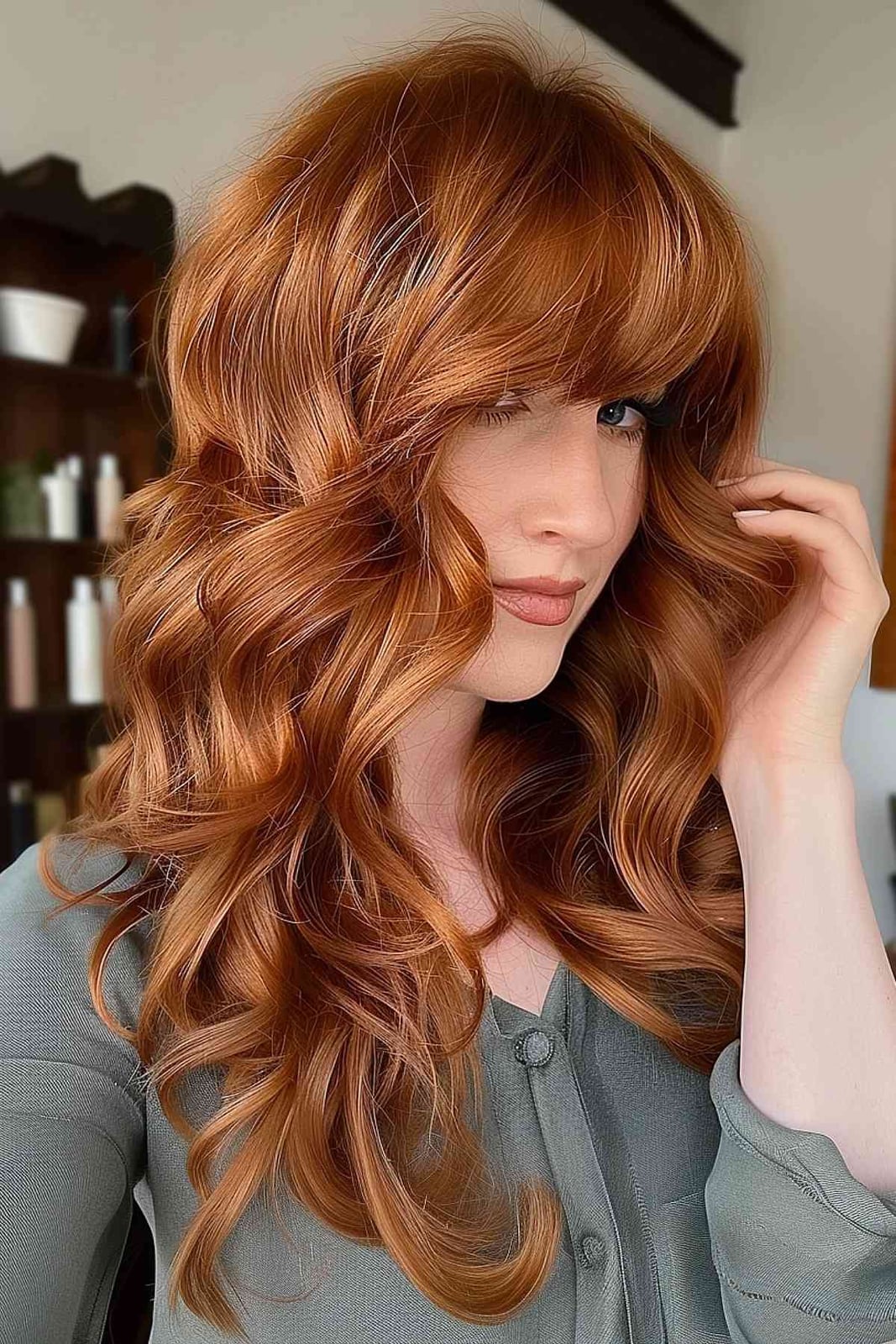
Source: latest-hairstyles.com
How do you ask for a copper red lob without walking out with an orange helmet? Bring the details, not the adjective. The cut is a collarbone lob with layers, and the curtain bangs need the most precise language: tell your stylist you want them parted in the middle, falling to the cheekbone, blended into the sides as a soft transition. For the color, ask for a copper red balayage with lighter pieces framing the face, and be clear that the root stays deeper so the grow-out stays soft. Ask your stylist for: collarbone lob, curtain bangs, copper red balayage. Thick, wavy hair holds the loose waves best. One real drawback: copper red fades faster than any brown, so plan on a toning appointment every six to eight weeks to keep the brightness from going muddy.
Vibrant Copper Red Balayage Collarbone Waves
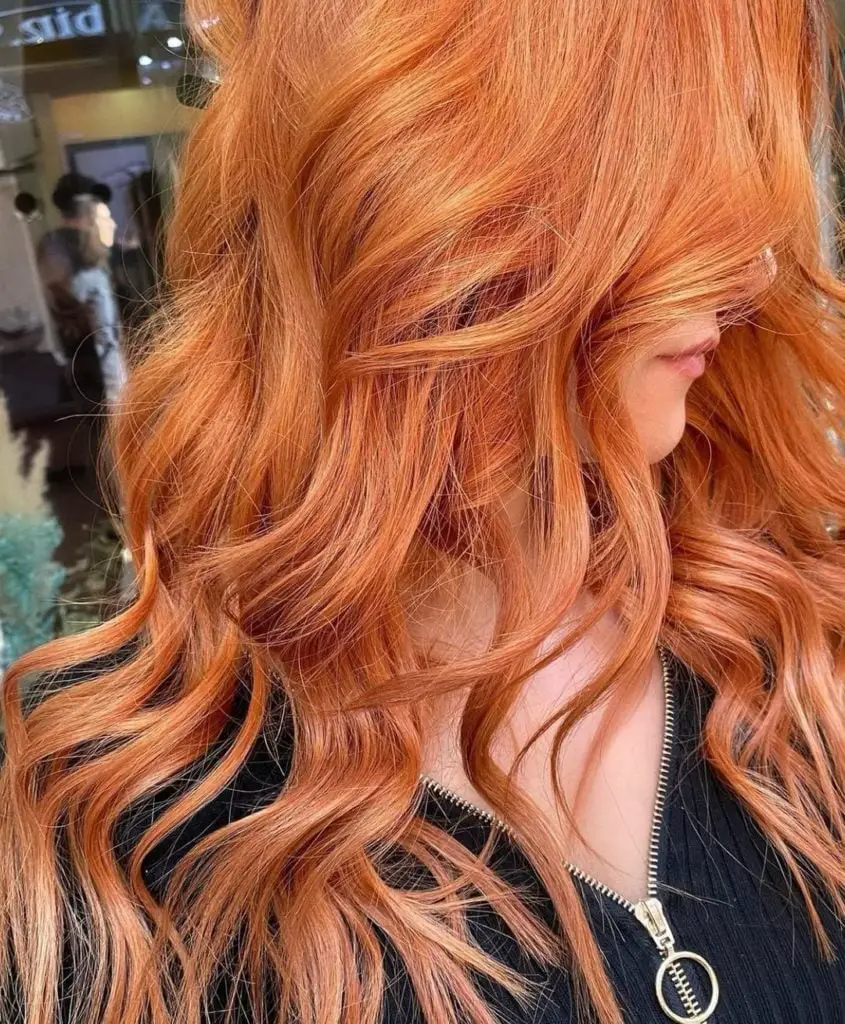
Via gustohair.com
Balayage earns its keep when the placement follows the cut, and this collarbone-length layered shape gives the colorist plenty of surface to work with. Lighter copper pieces sit through the mid-lengths and ends, blended into a darker copper red base so the grow-out line stays soft for months. Thick, wavy texture carries that contrast best; fine hair can take the same placement in a gentler lift. Ask your colorist for: collarbone length layers, vibrant copper red balayage. A side parting adds volume and asymmetry, which suits square and round faces. Expect a salon session of two to three hours, and a gloss every six to eight weeks to keep the copper from going flat.
Copper Red Lob With Face-Framing Bangs

Courtesy of: epichairdesigns.com.au
Medium-density wavy hair holds that shape without fighting it, and the bangs soften a square jawline. Ask your stylist for: collarbone lob, face framing bangs, copper red color. The upkeep is the real story. Copper red fades faster than any other shade, so a toning appointment every four to six weeks keeps it from drifting toward orange, and the bangs need a trim every three to four weeks to stay off the brow. A flat iron on low heat gives the outward flick.
Vivid Ginger Copper Shoulder Length Waves

Photo credit: fabmood.com
Wondering whether a vivid ginger copper shade is too much for everyday? Shoulder length is the buffer. The color is intense and bright, with subtle lighter strands running through it for dimension, and loose waves with a middle part keep the whole thing from reading as a solid block of orange. Medium-density wavy hair holds the bend without extra product. Ask your colorist for: shoulder length waves, vivid ginger copper color. Suitability comes down to commitment more than coloring: this shade shows regrowth at the part within a few weeks, so a root touch-up every four to six is part of the deal. If warm tones already live in your natural color, the lift is shorter and the fade gentler.
Vivid Ginger Shoulder Length With Curtain Bangs

Image credit: daysinspired.com
Curtain bangs split at the middle and sweep outward, which gives a vivid ginger shoulder-length cut a built-in frame and a clear shape for October. The color runs rich and warm with subtle variation through the waves, and the bangs are the brightest part. Medium-density wavy hair keeps the shape; a round brush at the root is what holds the bangs swept to each side. Ask your stylist for: shoulder length waves, curtain bangs, vivid ginger color. It lands for holiday parties and the office equally, since the bangs look polished without a full blowout. Book the color three hours out and a bang trim every three weeks.
Vivid Ginger Mid-Back Air Dried Curls

Source: howtobearedhead.com
Air-dried curls on mid-back hair only work when the cut and the color are built for them. The vivid ginger shade runs through the whole length with lighter, brighter pieces woven in, so the dimension survives without a round brush. Thick, wavy texture is the starting point; fine hair air dries flat and needs a diffuser to fake the same body. Ask your colorist for: mid-back length, vivid ginger color, air dried loose curls.
The salon work is in the placement. Lighter pieces go where the curl pattern opens, usually through the mid-lengths and ends, and a darker ginger base at the root keeps the grow-out line from showing at six weeks. Ask for layers cut dry so the curl clumps fall where they will actually sit. At home, a curl cream on damp hair and a middle part left alone is the whole routine; the color needs a gloss every six to eight weeks, and a trim every ten to twelve keeps the ends from weighing the curl down. This one is a salon job twice over.
Auburn Braid With Ginger Highlights
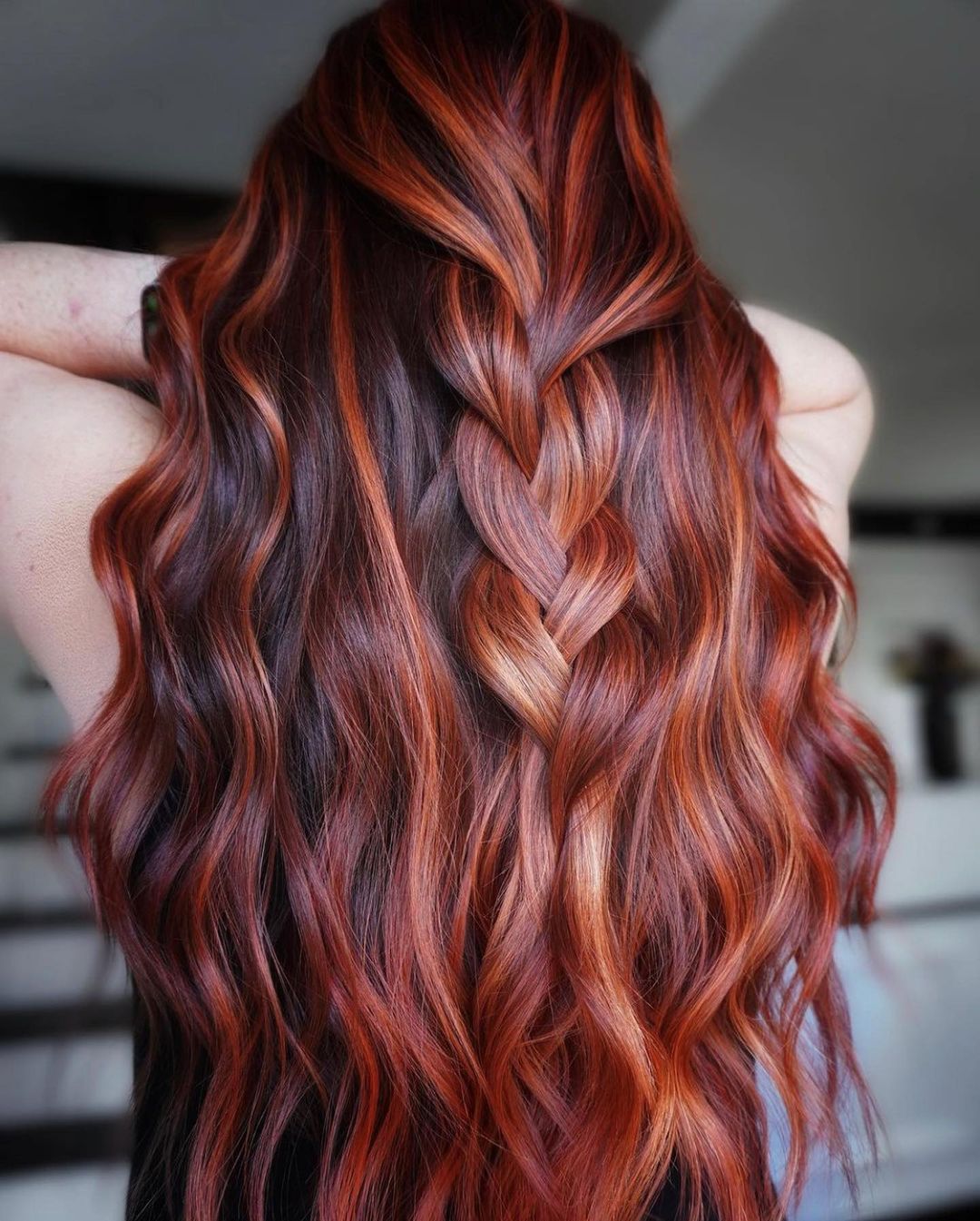
A solid-color braid is clean, but a braid built from auburn with ginger highlights and lowlights is something else entirely. The back view shows how the interplay of deep auburn base and lighter ginger pieces creates a braid that looks woven rather than just plaited. Thick, wavy hair of about mid-back length has the heft to show off that color dimension.
Ask your colorist for: auburn with ginger highlights and lowlights. A fishtail or Dutch braid pulls those tones apart so you see each ribbon of color. The braid itself holds all day, but keep a small clear elastic in your bag in case the end frays. A trim every eight weeks keeps the ends healthy enough to braid cleanly.
Vivid Ginger Mid-Back Waves Back View, Wavy
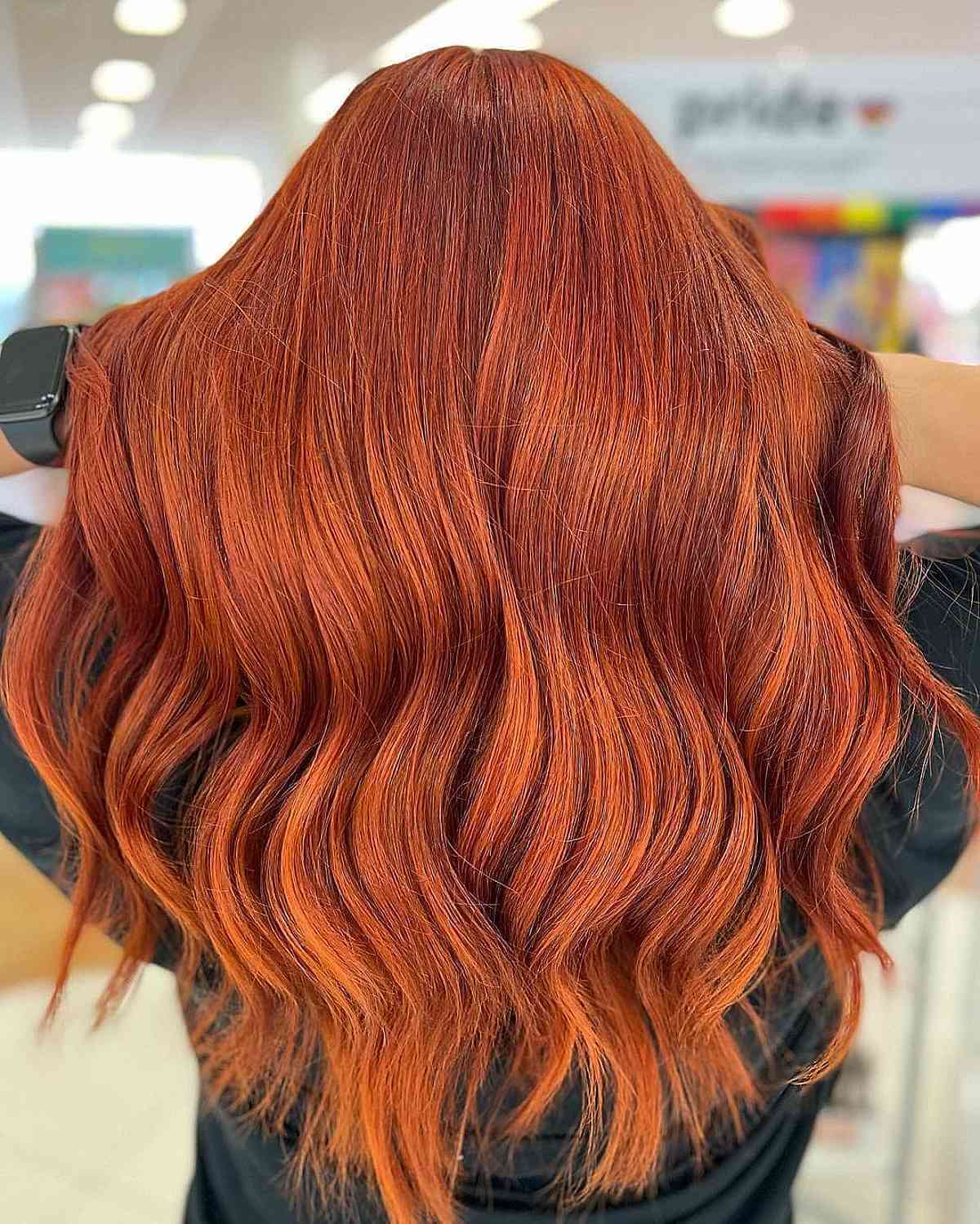
Courtesy of: latest-hairstyles.com
Vivid ginger at mid-back length is a lot of color, and the back view is where you see if it really lands. When the hue is uniform and the undertones run warm, the whole silhouette looks like one saturated block of ginger. Thick, wavy texture helps the color appear dense and bright.
Ask your colorist for: vivid ginger color. This shade sits at full intensity from root to end, so there is no fade-out to soften the grow-out. A gloss treatment every four to six weeks keeps the tone bright and prevents that dusty look ginger can take on. Soft layers in the cut keep the waves from forming a heavy triangle.
Vivid Ginger Mid-Back Waves Orange Undertones
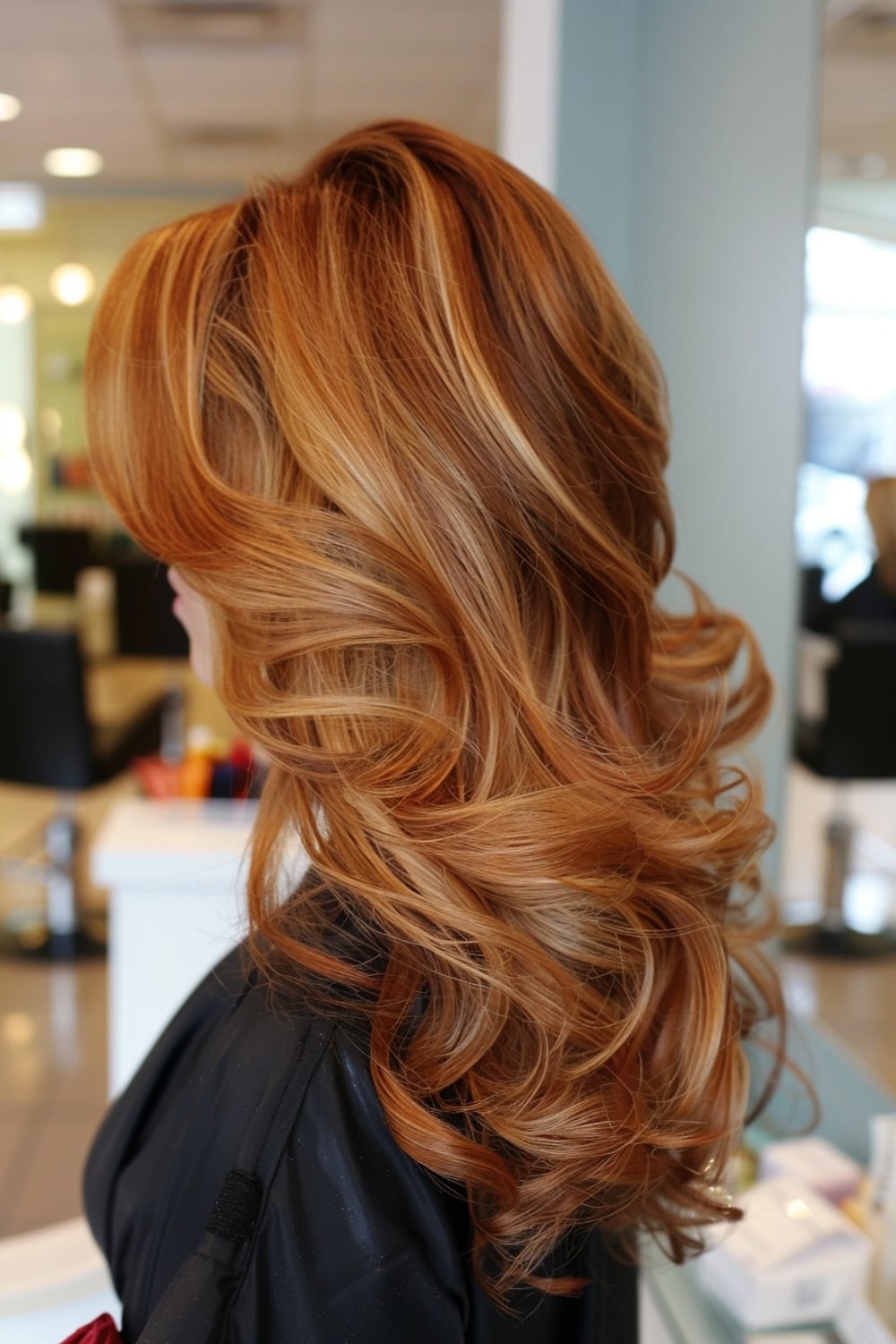
Photo credit: momooze.com
Want a ginger that reads more flame than copper? Ask your colorist for: vivid ginger with orange undertones. The back view makes it clear: this is not a shy auburn. The orange lean gives the color a brightness that catches even indirect light. One real drawback is that orange undertones fade faster than warm copper ones, so a color-depositing conditioner every other wash is not optional. A solid-color application means you cannot hide a grown-out root with a shadow, so plan on a root touch-up every four weeks.
Short Shag Vivid Ginger With Highlights

Image credit: fabmood.com
Ask your stylist for: short shag, ear length, short bangs. At home, work a texture paste through the ends to separate the layers and define the waves. The side parting helps the short bangs blend rather than sit as a separate piece. A trim every six weeks keeps the shag shape sharp.
Uniform Ginger Mid-Back Straight Hair
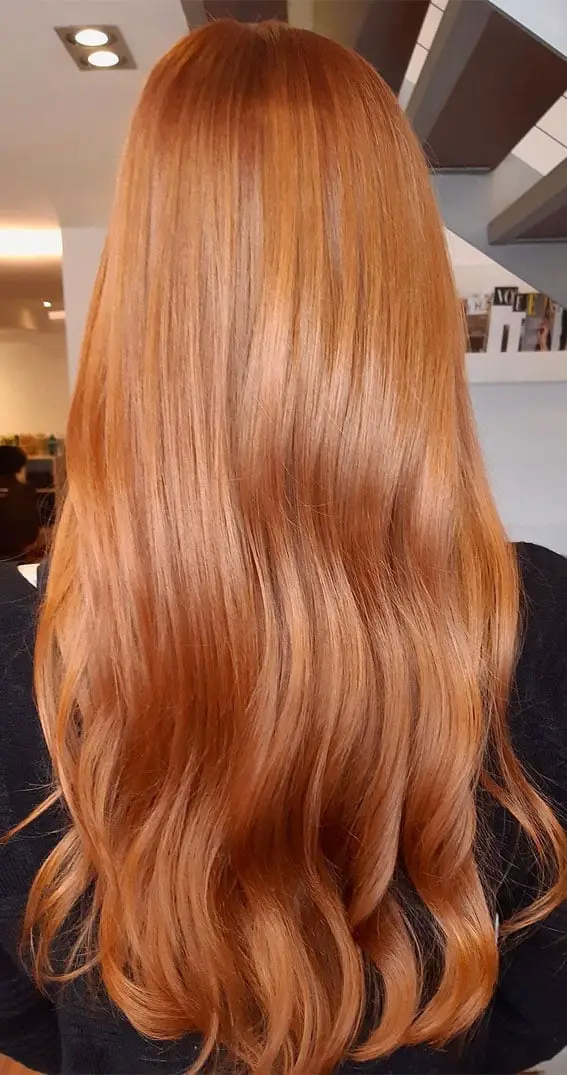
Via fabmood.com
Uniform ginger on straight, thick hair is a commitment to one color and one finish. From the back, the mid-back length shows every inch of that solid ginger shade, with no highlights to break it up. The look is clean and graphic, but it leaves no room for error on tone.
Ask your colorist for: uniform ginger color. Straight hair reflects light evenly, so any brassiness shows immediately. A purple shampoo once a week keeps the ginger from tipping into orange. A flat iron with a heat protectant gives the smooth, polished finish the style needs. The grow-out is high contrast, so a root touch-up every three to four weeks keeps the line clean. A trim every eight weeks maintains the hemline.
Final Thoughts
For a softer result, choose balayage over a warm base, with copper or strawberry blonde pieces painted through the mid-lengths. For a bolder statement, go vivid and uniform, especially with a blunt cut that shows the color off at the ends.
- Run a color-depositing conditioner through every two to three washes.
- Tone every six to eight weeks, before brassiness settles in.
- Spray heat protectant before any hot tool.
- Trim ends every eight to ten weeks to keep the line clean.
Ginger rewards a little upkeep with a lot of character.
-

 Makeup Trends2 years ago
29 Harley Quinn Makeup Ideas: Iconic Looks for Every Occasion
-

 Hairstyle2 years ago
Round Face Haircuts Ideas 2025: 29 Flattering Styles to Try
-

 Hairstyle2 years ago
25 90s Layered Hair Ideas to Inspire Your 2025 Look
-

 Fashion2 years ago
27 Every Day Spring Outfits Inspiration for 2025
-

 Hairstyle2 years ago
29 Long Layered Haircuts Ideas for 2025
-

 Hairstyle2 years ago
64 Fall Hair Color Trends to Elevate Your Style in 2024
-

 Hairstyle2 years ago
Choppy Bob Haircuts 2025: 29 Stylish Ideas
-

 Hairstyle2 years ago
27 Medium Length Haircut with Layers Ideas for 2025