
Hairstyle
20 Trendy Partial Highlights 2027 for a Fresh Look
Trendy Partial Highlights 2027 offering blonde and caramel shades on brown bases, perfect for chin bobs and collarbone lobs. Get the details for each look.

Partial highlights place lighter pieces around the face and through the top layers, leaving the underlayer and root area closer to your base shade. The technique has drifted away from chunky stripes toward lived-in color, soft face-framing layers and a glossy natural finish.
Here are 20 Trendy Partial Highlights ideas that run from a chin bob to mid-back waves, in ash, caramel, copper and pink. Some need a salon appointment and a toning rhythm; a few are a low-commitment first step. It suits fine hair that needs dimension to sit up, grown-out color with a visible line, and anyone tired of a fringe that will not sit.
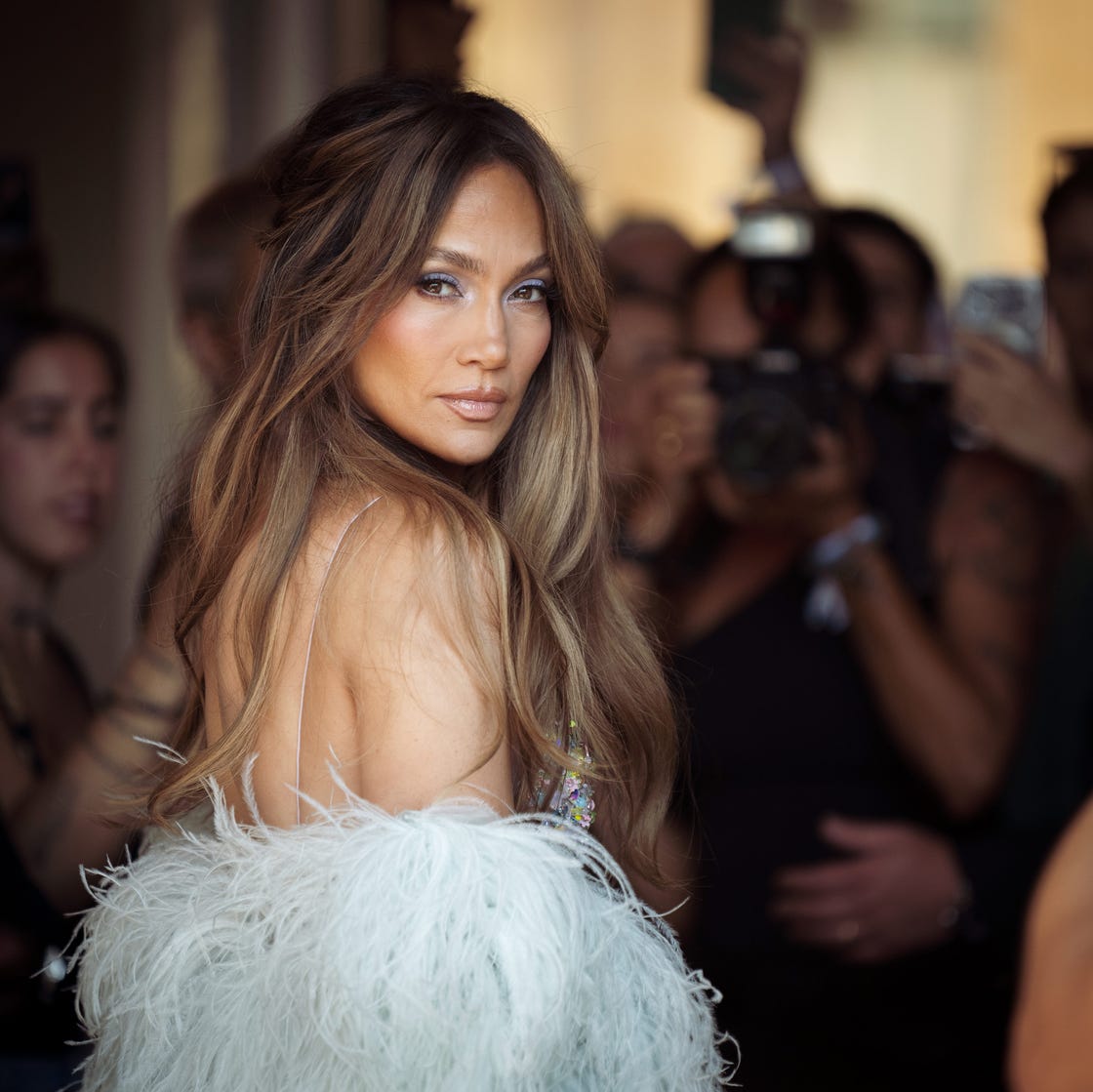
Mid-Back Length Waves With Blonde And Caramel Partial Highlights
Courtesy of: harpersbazaar.com
The trick here is that the highlights aren’t one uniform shade. A medium brown base is lifted with both blonde and caramel pieces, so the color reads layered rather than striped. The wispy bangs and middle part keep the look soft instead of severe, which matters when you have long, thick hair that can otherwise feel heavy.
This cut suits thick, wavy hair that reaches at least mid-back. Ask your colorist for: mid-back length with long layers, wispy bangs, blonde and caramel partial highlights. A texturizing spray on dry hair defines the waves without weighing them down. Plan for a trim every eight weeks to keep the layers from losing their shape.
Mid-Back Waves With Blonde Partial Highlights And Side Part
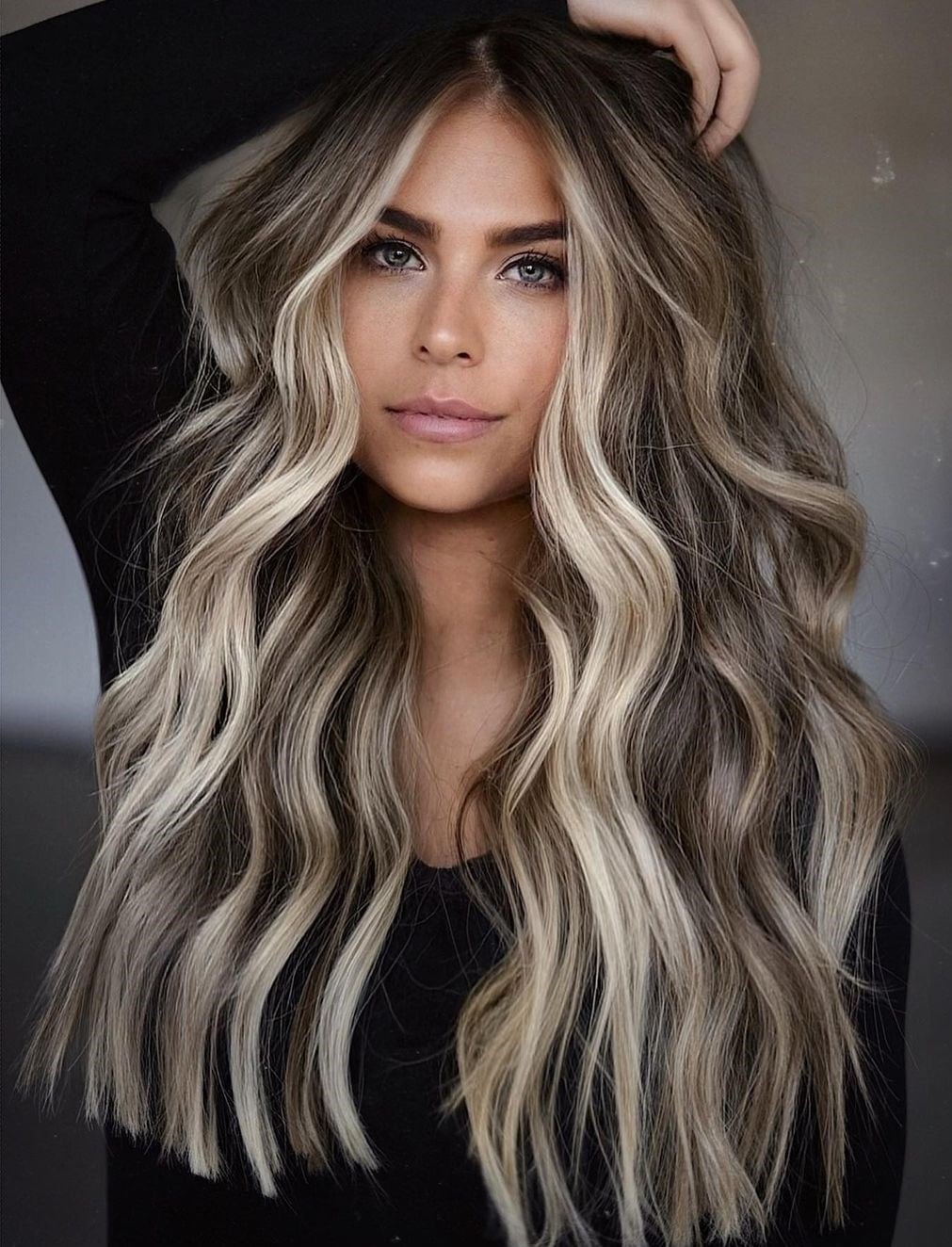
Photo credit: hadviser.com
Who actually benefits from a side part at mid-back length? Anyone with thick, wavy hair who wants more volume at the crown without adding layers. The medium brown base and blonde highlights here are placed to catch light on the surface, so the hair looks fuller even when it’s air-dried. A side part also breaks up the symmetry of long hair, which keeps the look from reading as flat.
Fine hair at this length can struggle with highlights pulling it down, so this is better suited to medium or thick textures. Ask your colorist for: mid-back length with layers, side part, blonde partial highlights on brown base. A flexible hold hairspray keeps waves in place without stiffness. Trim every six to eight weeks to maintain the shape.
Textured Bob With Face-Framing Blonde Partial Highlights
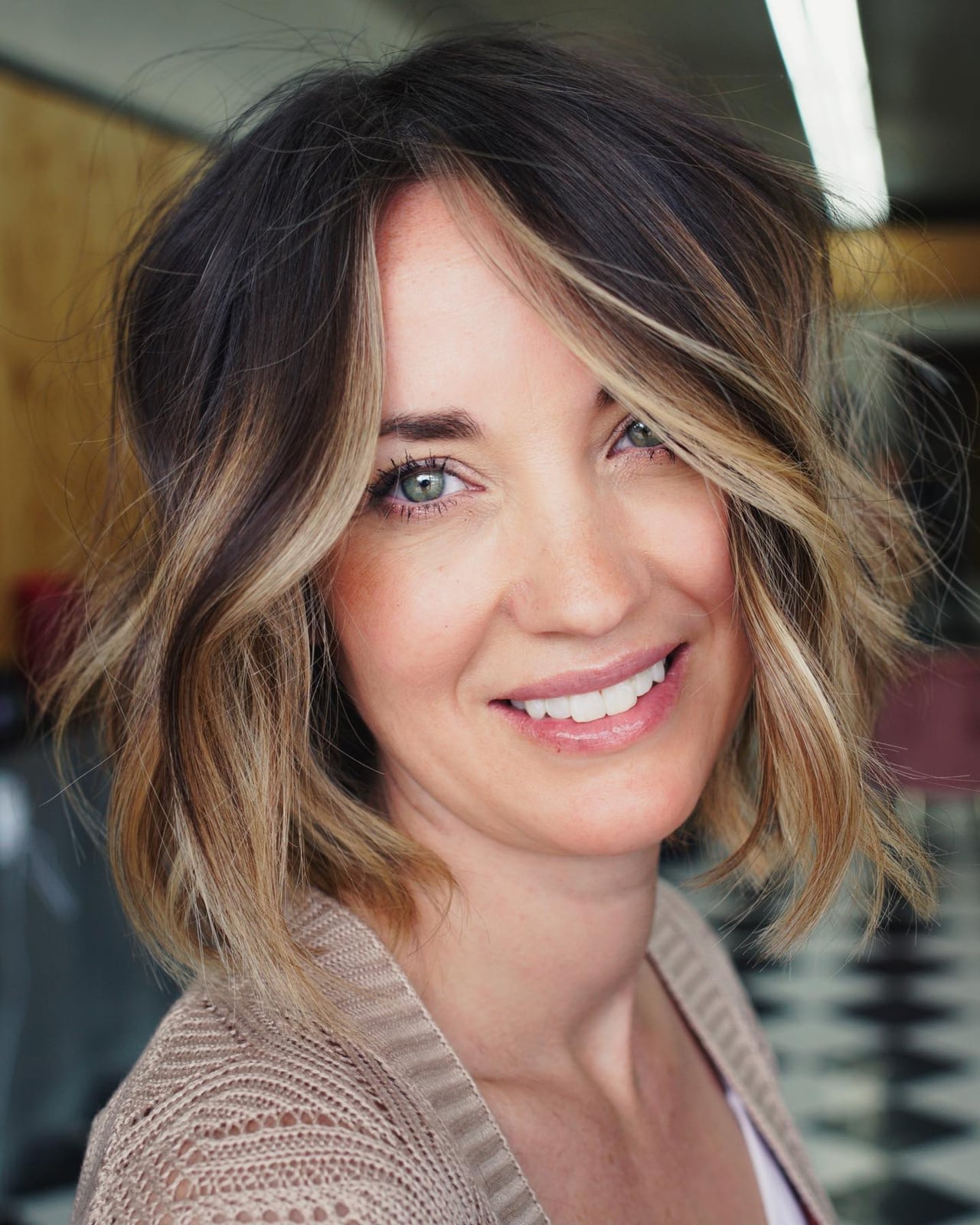
Image credit: therighthairstyles.com
A chin-length bob with side-swept bangs is already a short haircut. Add face-framing blonde highlights on a brown base and the contrast draws attention to the jawline. The difference between this and a solid bob is that the light pieces create texture where there isn’t much length to work with. The highlights need toning every four to six weeks to stay bright against the dark base, and the bob itself requires a trim at the same interval or the shape gets heavy fast. Ask your colorist for: textured chin bob, blonde face-framing partial highlights, side-swept bangs.
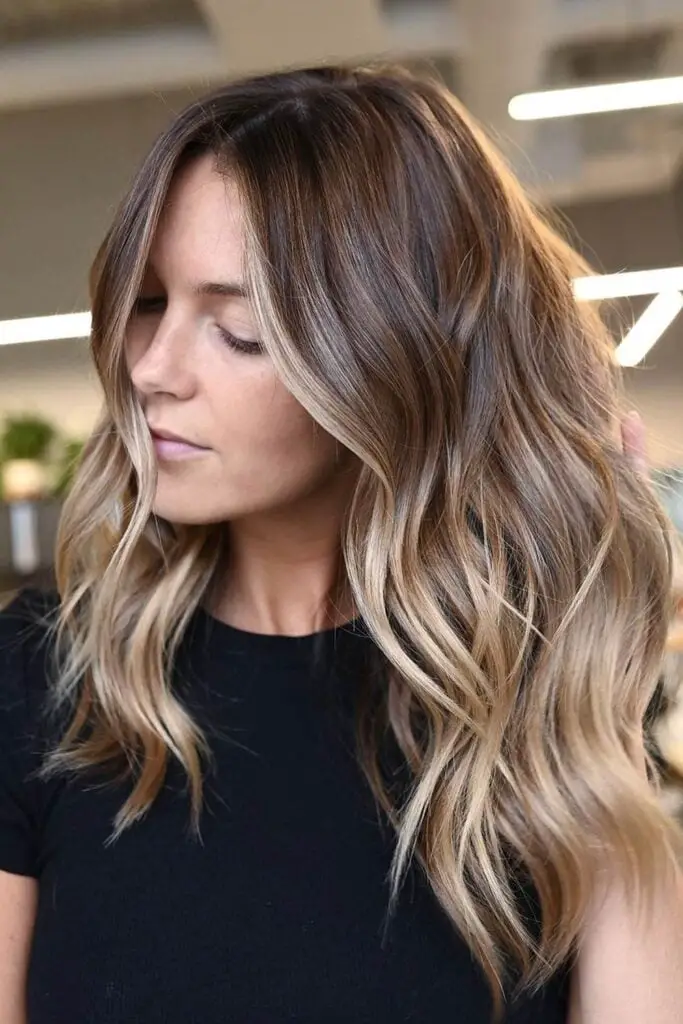
Collarbone Lob With Curtain Bangs And Blonde Partial Highlights
Source: glaminati.com
The face-framing highlights here are woven through the curtain bangs and into the collarbone length itself, so the color moves with the hair rather than sitting in one spot. On a dark brown base, the blonde pieces stay subtle enough that the grow-out won’t scream for attention by week six.
Ask your colorist for: collarbone length lob, curtain bangs, subtle blonde partial highlights on dark brown. This is a good choice for summer or fall, when you want lightness without a full bleach session. Use a round brush to direct the curtain bangs away from the face while blow-drying.
Wavy Collarbone Layers With Dark Brown And Blonde Partial Highlights
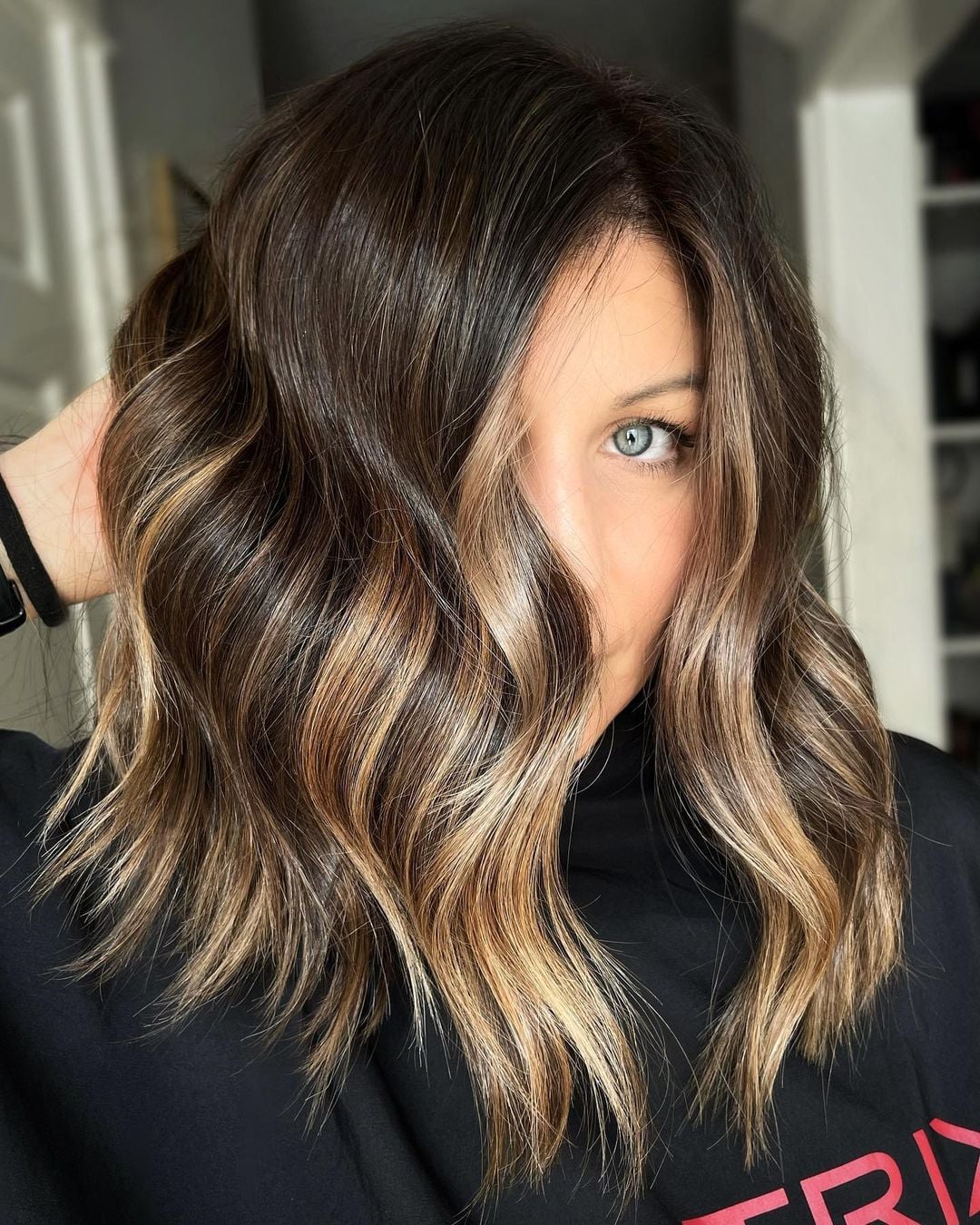
Via hadviser.com
A wavy blowout on collarbone-length layers takes about fifteen minutes with a diffuser, provided the hair is already thick and wavy. The dark brown base with blonde partial highlights is placed to hit the ends, so the roots stay dark and the dimension shows in the wave pattern. The curtain bangs need a quick brush to keep them from falling flat against the forehead. Ask your colorist for: collarbone length layers, dark brown base with blonde partial highlights, curtain bangs. Trim every six to eight weeks to prevent the layers from blending into one block.
Angled Bob With Ash Blonde Partial Highlights
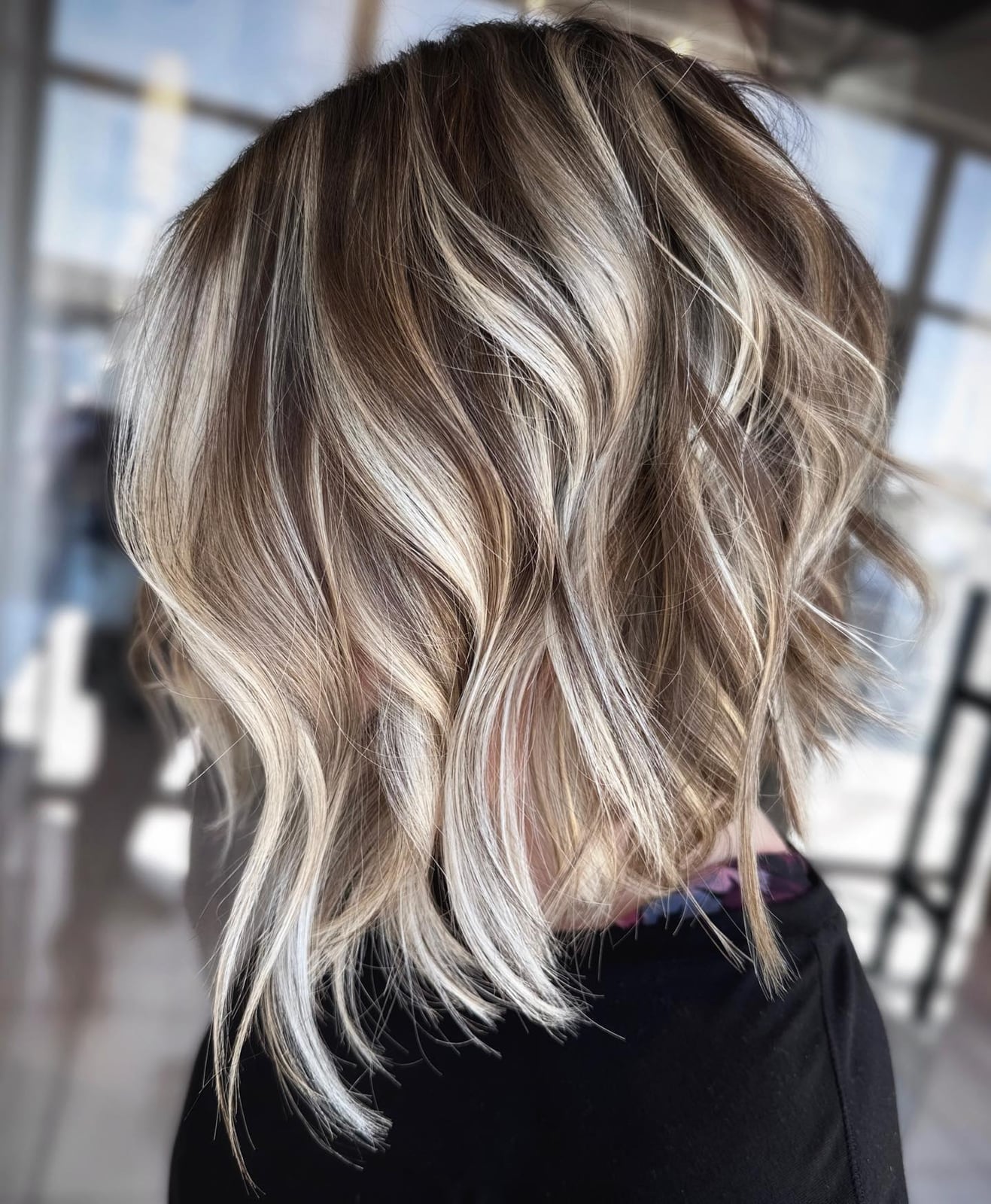
Courtesy of: therighthairstyles.com
The design of an angled bob relies on the contrast between a longer front and a shorter back, and the ash blonde partial highlights here lean into that geometry. The dark blonde base gets broken up by cooler-toned pieces that hit the surface of each wave, so the cut reads as textured rather than blunt. Medium density hair holds this shape best; oval, heart, and square faces all benefit from the forward angle. Ask your colorist for: angled bob, dark blonde base with ash blonde partial highlights, messy waves. This is a salon-only project. The placement of each highlight needs to follow the cut’s diagonal line, and the toner requires a bowl appointment rather than a box.
Collarbone Bob With Ash Blonde And Lighter Blonde Partial Highlights
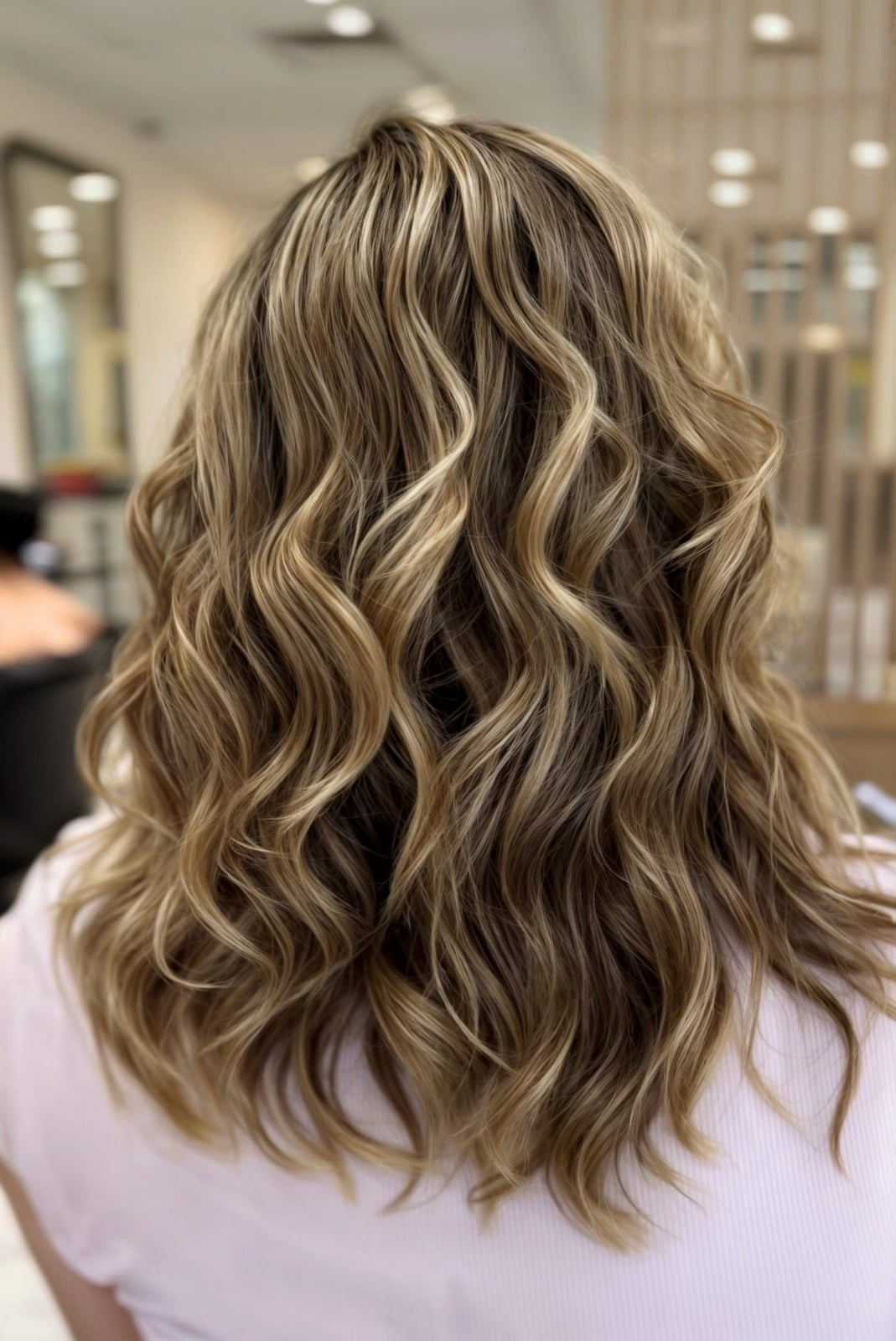
Photo credit: ariannahairsalon.com
This is not a single-process ash blonde situation. The collarbone-length bob keeps a cool ash blonde base, then adds lighter blonde partial highlights that sit on top of the curl pattern for a layered effect. Spring is the natural season for this kind of lift, the lighter pieces catch more daylight, and the ash tone stops the blonde from drifting into honey territory. A middle parting keeps the weight centered, which works for most face shapes. Ask your colorist for: collarbone length bob, ash blonde base with lighter blonde partial highlights, loose curls. The result reads as a deliberate two-tone rather than an overgrown single process, which is exactly what you want when the weather shifts.
Angled Bob With Subtle Blonde Partial Highlights And Side-Swept Bangs
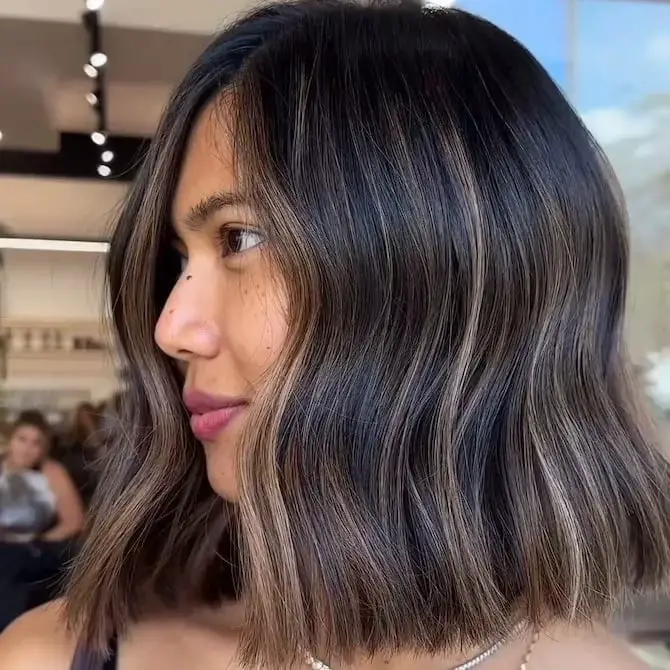
Image credit: wella.com
The subtle blonde partial highlights on a dark brown base are doing something smart here: they add dimension without announcing themselves. On an angled bob that reaches the collarbone, the side-swept bangs create a diagonal line that draws attention across the face, so square and heart shapes get a softer edge. The trade-off is visibility. Subtle highlights on dark brown mean the contrast is low, which looks natural but also means the color work can feel invisible if your hair is in a ponytail. Ask your colorist for: angled bob to collarbone, dark brown base with subtle blonde partial highlights, side-swept bangs. If you want people to notice the highlights from across the room, this is not the one.
Mid-Back Waves With Caramel Partial Highlights On Dark Brown
Source: hastehair.com
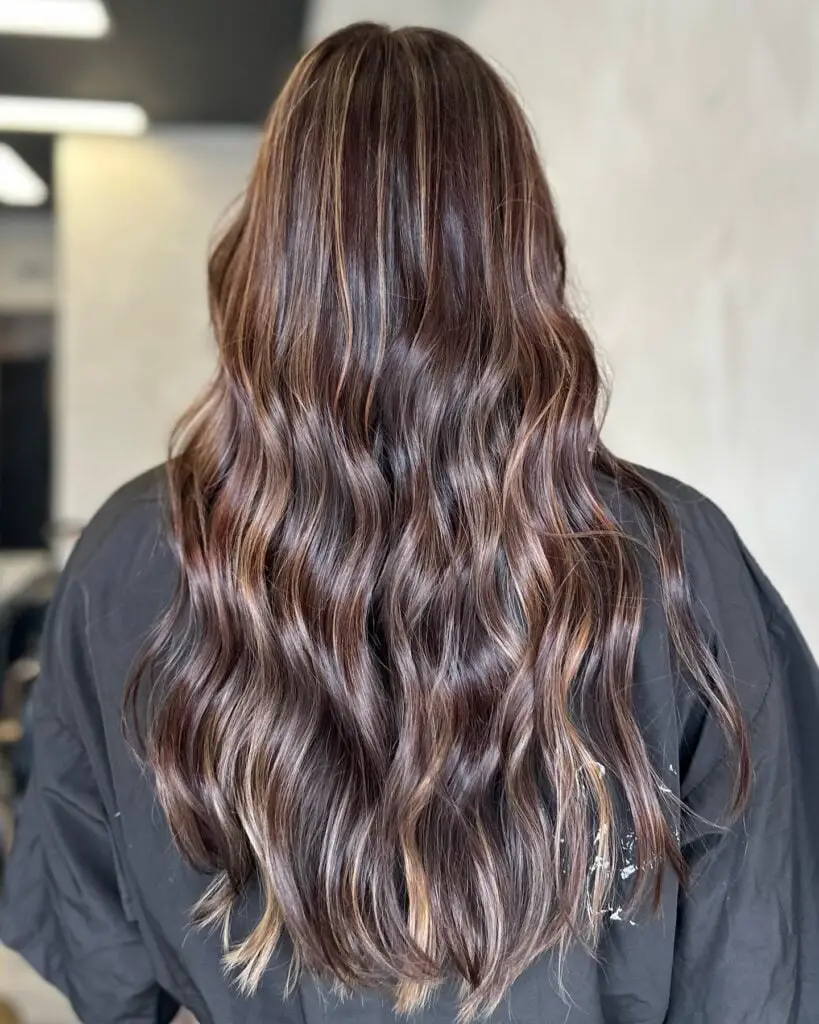
Does thick, wavy hair ever look bad with caramel highlights? Not really, but the placement matters. Here the caramel partial highlights are woven through the ends of a dark brown base, so the warmth sits below the root area and the overall effect stays dimensional. A middle parting works for oval and long faces, and the loose waves give the caramel room to show at different angles.
Upkeep is straightforward: a smoothing serum keeps the wave pattern defined and the gloss intact, and a trim every eight weeks prevents the ends from thinning out. Ask your colorist for: mid-back length, dark brown base with caramel partial highlights, loose waves. The thicker your hair, the more the caramel has to grab onto, which is the point.
Collarbone Layers With Ash Blonde Partial Highlights
Source: shampoolounge.com
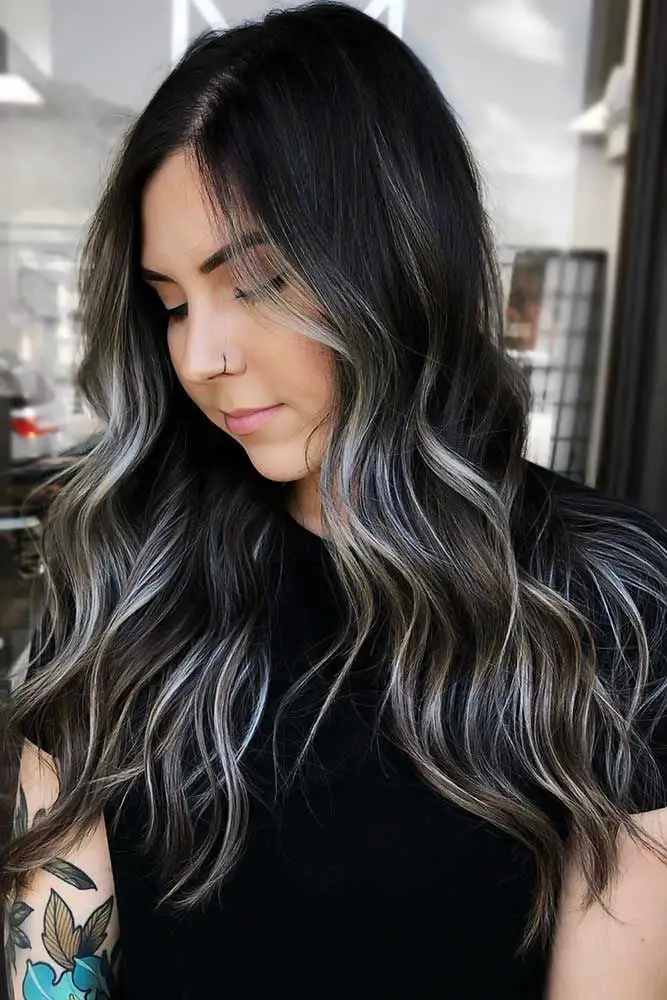
The technique here is about placement, not volume. Ash blonde partial highlights are concentrated around the face-framing pieces of a collarbone-length layered cut, so the dark blonde base stays darker toward the back. That means the lightness lands where it gets the most attention, around the jaw and cheekbones. Face-framing pieces soften square and round faces by breaking up the perimeter line.
The styling steps are simple: apply mousse at the roots before blow-drying, then use a round brush to shape the front sections toward the back. Ask your colorist for: collarbone length layers, dark blonde base with ash blonde partial highlights, face-framing pieces. The layers do the work of distributing the color, so you are not fighting the cut.
Shoulder Length Waves With Pink Partial Highlights
Via hastehair.com
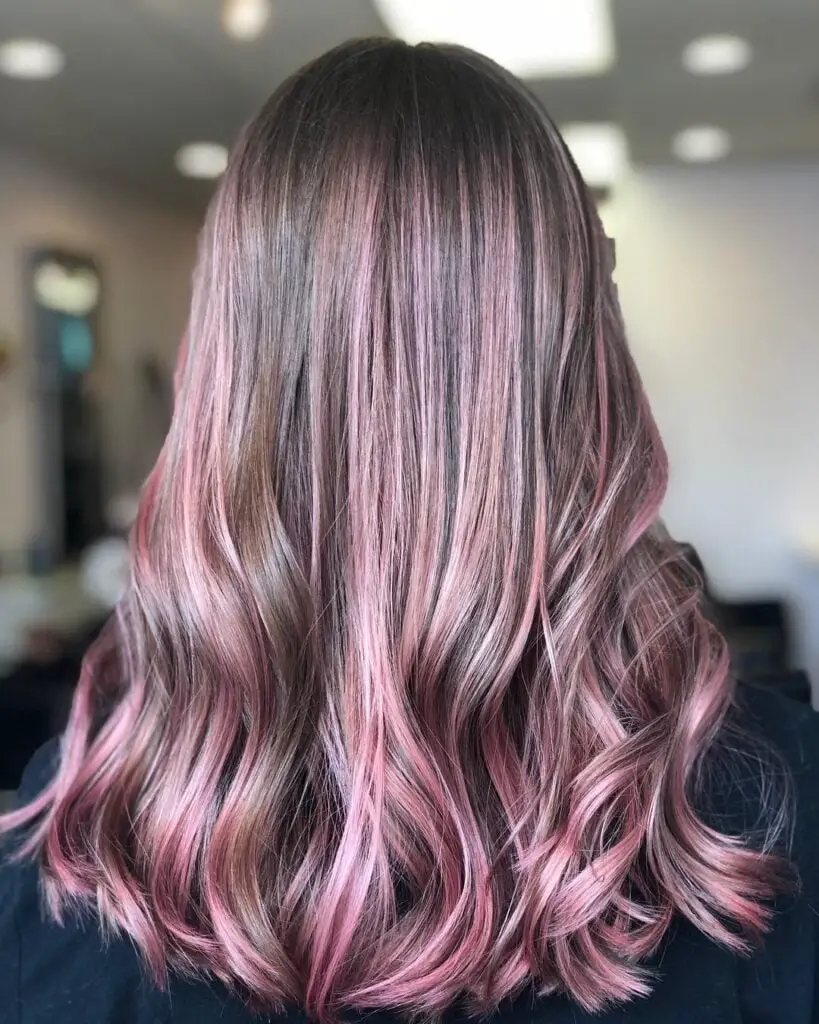
Pink highlights are not a subtle nod to color, but they also do not require a full commitment to bubblegum all over. On a brown base at shoulder length, the pink acts as a deliberate accent. Ask your colorist for: shoulder length waves, brown base with vibrant pink partial highlights. This is a salon-only project: the pink needs lifting before application, and that is not a DIY job. The finish works for a festival or a Tuesday, depending on how you wave it.
Mid-Back Layers With Blonde Partial Highlights On Dark Brown
Courtesy of: latest-hairstyles.com
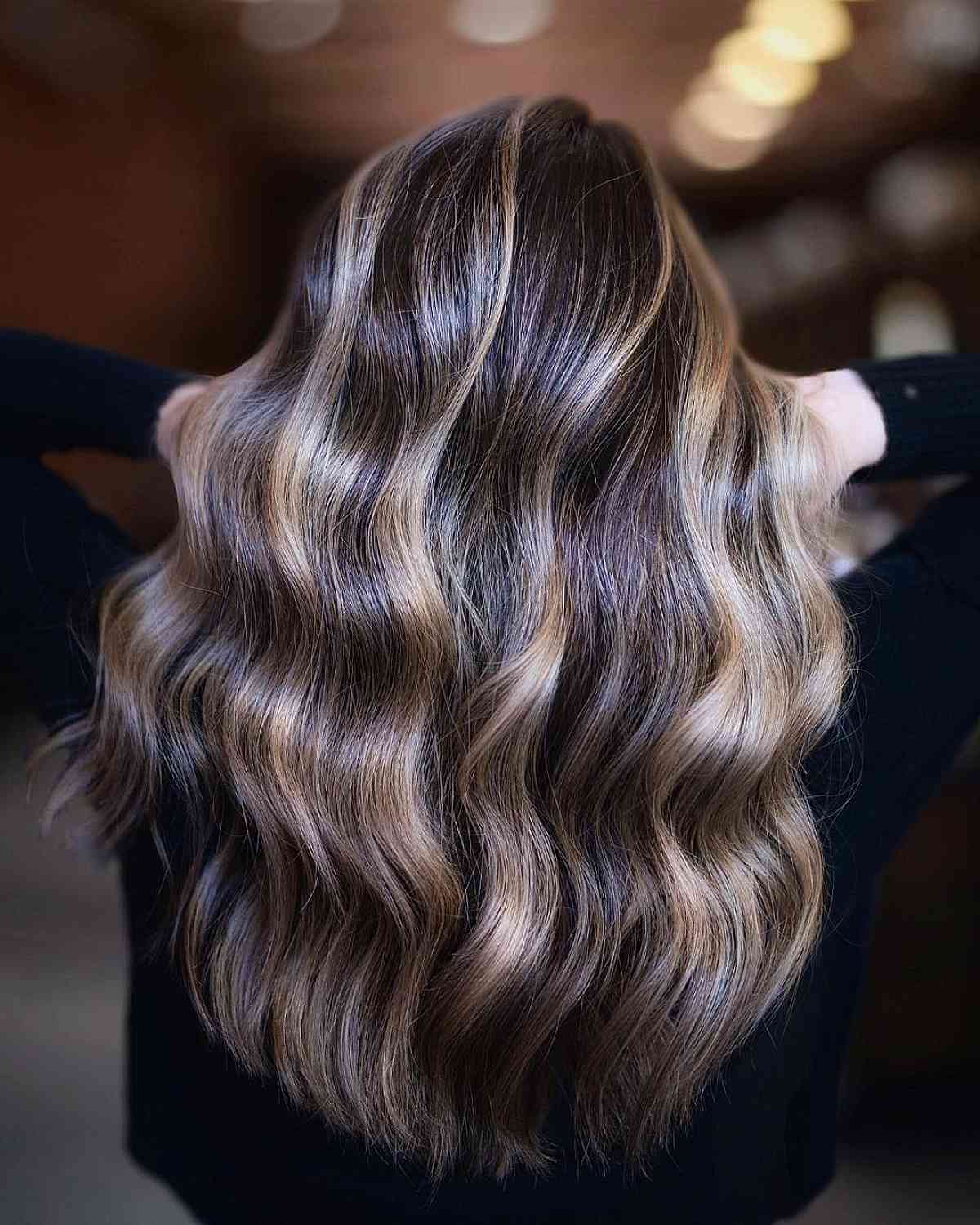
Blonde on dark brown is a high-contrast design, and that contrast is exactly what makes the grow-out visible. The blonde pieces sit against a dark base, so the root line shows sooner than it would on a lighter canvas. For thick, wavy hair at mid-back length or longer, the layers help the blonde blend into the waves rather than sitting as a stripe.
Ask your colorist for: mid-back length layers, dark brown base with blonde partial highlights. A toning gloss every six to eight weeks keeps the blonde from pulling brassy against the brown. Trim the ends every eight weeks to maintain the shape through the layers.
Mid-Back Layers With Copper And Blonde Partial Highlights
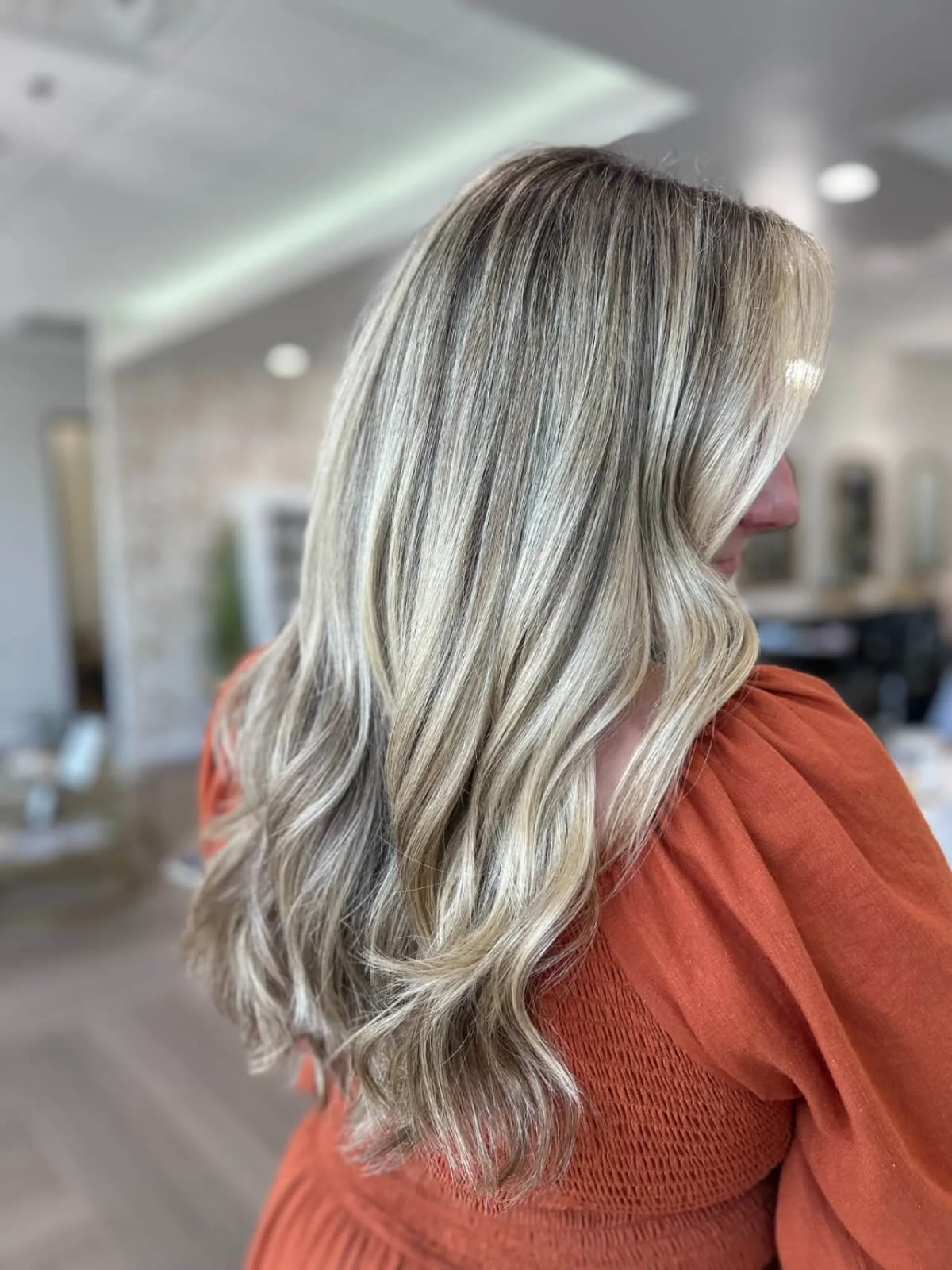
Photo credit: blondefaithsalon.com
A warm, dimensional effect without brassiness comes from combining copper and blonde highlights on a dark brown base, exactly as shown here. The copper adds richness near the root, while the blonde keeps the ends from falling flat. Thick, wavy hair at mid-back length or longer carries both tones through the movement.
Ask your colorist for: long layered mid-back hair, dark brown base with copper and blonde partial highlights. Be specific about the placement: you want the copper concentrated toward the root and the blonde lighter at the ends. A color-depositing conditioner in a warm copper tone helps maintain the blend between salon visits.
Collarbone Lob With Curtain Bangs And Deep Brown Base
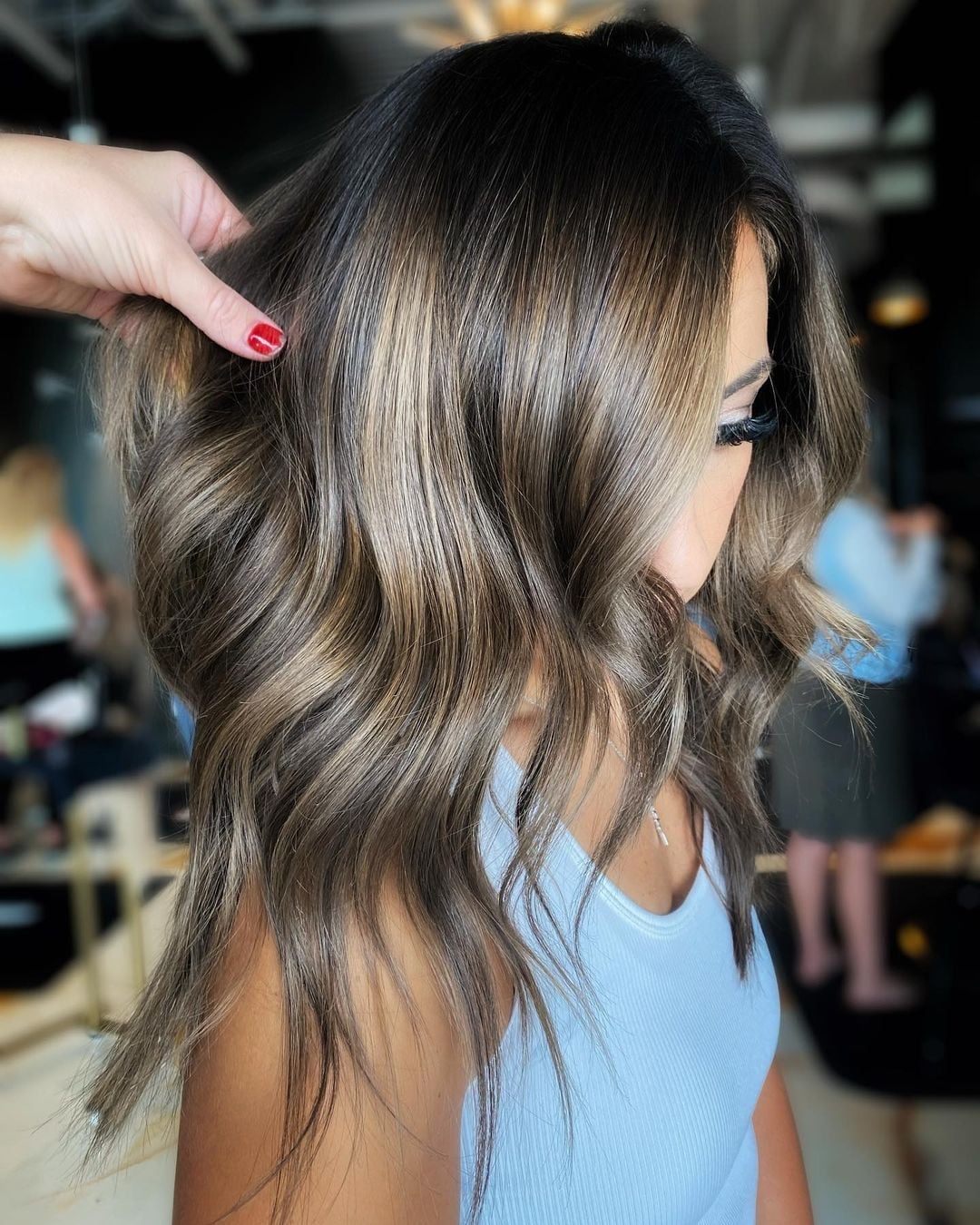
Image credit: hadviser.com
The placement of the blonde highlights here is not random. They are concentrated around the face, which means the curtain bangs catch the light every time you turn your head. The deep brown base keeps the overall look grounded, so the blonde does not wash out the cut. This works well on thick, wavy hair at collarbone length, where the layers and bangs have enough weight to hold their shape.
Ask your colorist for: collarbone length lob, deep brown base with blonde partial highlights, curtain bangs. The face-framing pieces should start a few inches from the root to avoid a harsh line. Curtain bangs need a trim every six to eight weeks to stay at the right length for the part.
Mid-Back Layers With Dark Brown And Blonde Dimensional, Close-Up Take
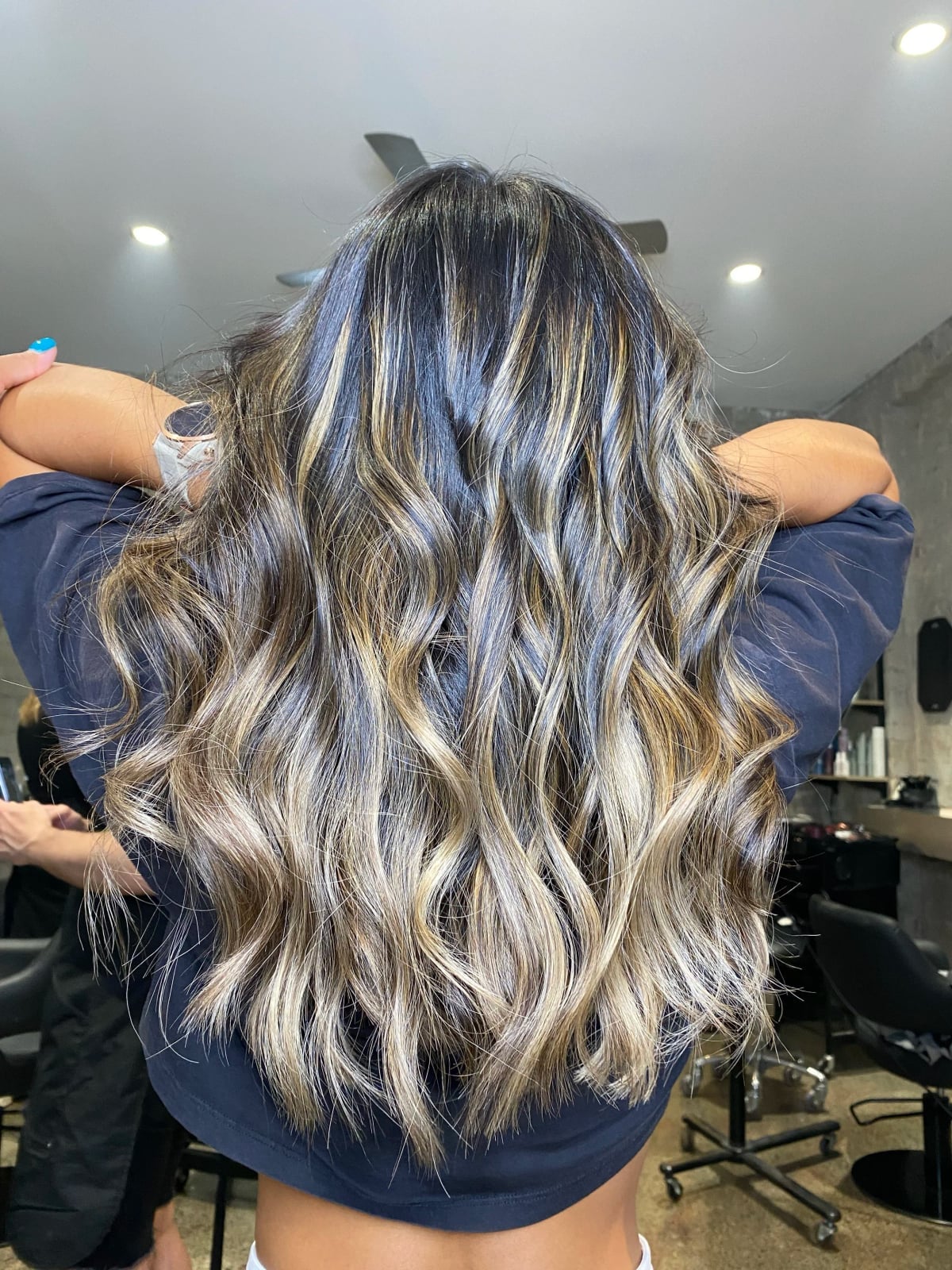
Source: allaboutsalon.com.au
The dimensional blend here is the selling point, but it is also the part that requires the most precision. Blonde highlights on a dark brown base can look streaky if the colorist does not weave them finely enough. On thick, wavy hair at mid-back length or longer, the layers help diffuse the transition, so the blonde looks like depth instead of stripes.
Ask your colorist for: mid-back length layers, dark brown base with blonde dimensional partial highlights. This level of blend needs a colorist who understands how to place highlights for movement, not just coverage. If your hair is very fine, the contrast may look harsher than intended. A middle part suits oval and long faces here, as the highlights fall evenly on both sides.
Long Layered Dark Brown With Caramel Partial Highlights
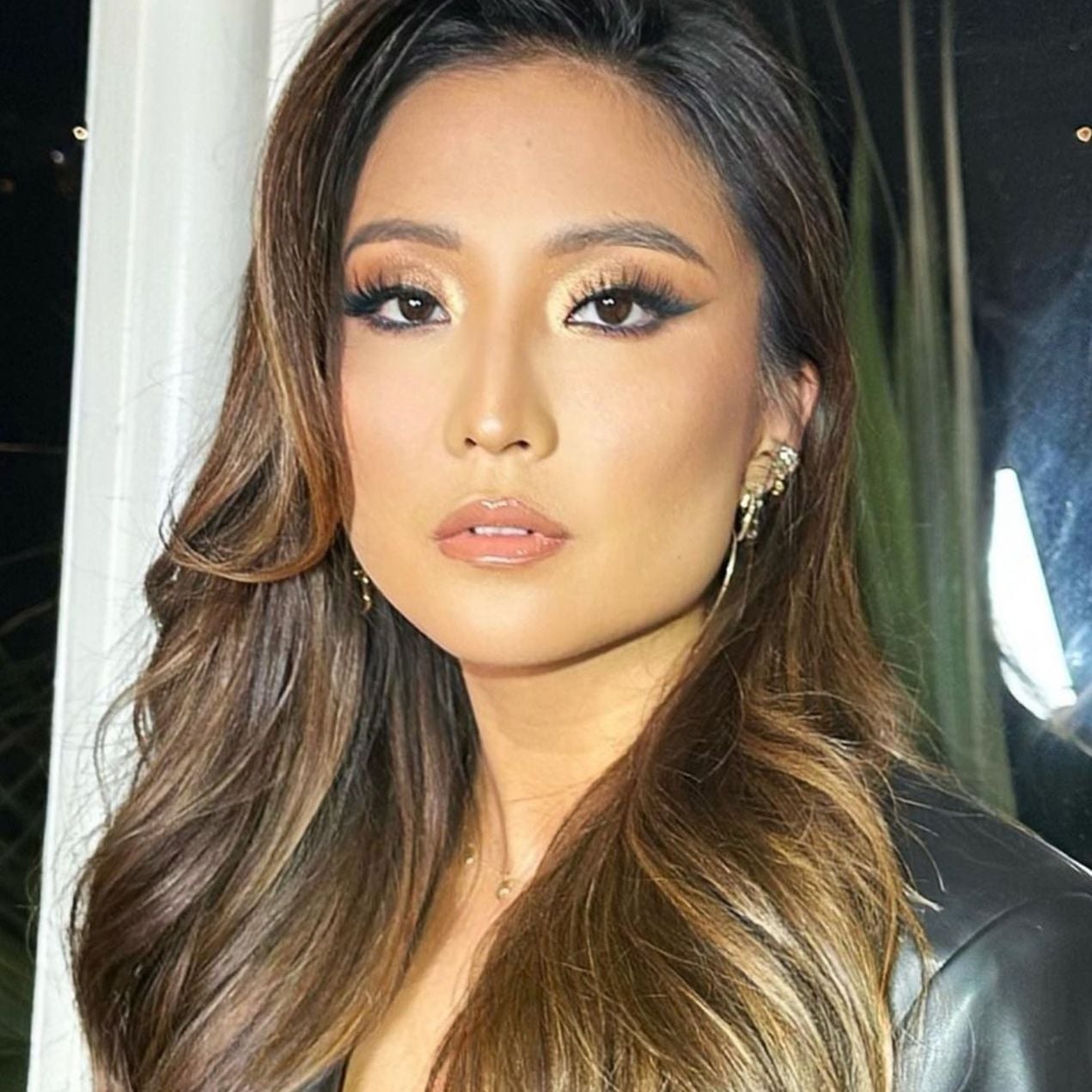
Via glamour.com
Will caramel highlights read too warm against a dark brown base? Not when they run through long layers instead of sitting in a solid band. The caramel lifts the mid-back length and catches on the face-framing layers, while the curtain bangs keep the front soft. It suits thick, wavy hair with the density to carry both the color and the layers, and a middle parting lets the bangs fall cleanly on most face shapes. Fine hair can wear it too, though the layers need to stay long so nothing thins at the ends.
Ask your colorist for: long layered mid-back hair, dark brown base with caramel partial highlights, curtain bangs. The bangs are the piece that ties the warm tone to the front, so decide on them before the foils go in. A texturizing spray on the ends gives the waves some grip, and a trim every eight weeks keeps the layers from collapsing into a heavy block.
Mid-Back Curly Blonde With Lighter Blonde Partial Highlights
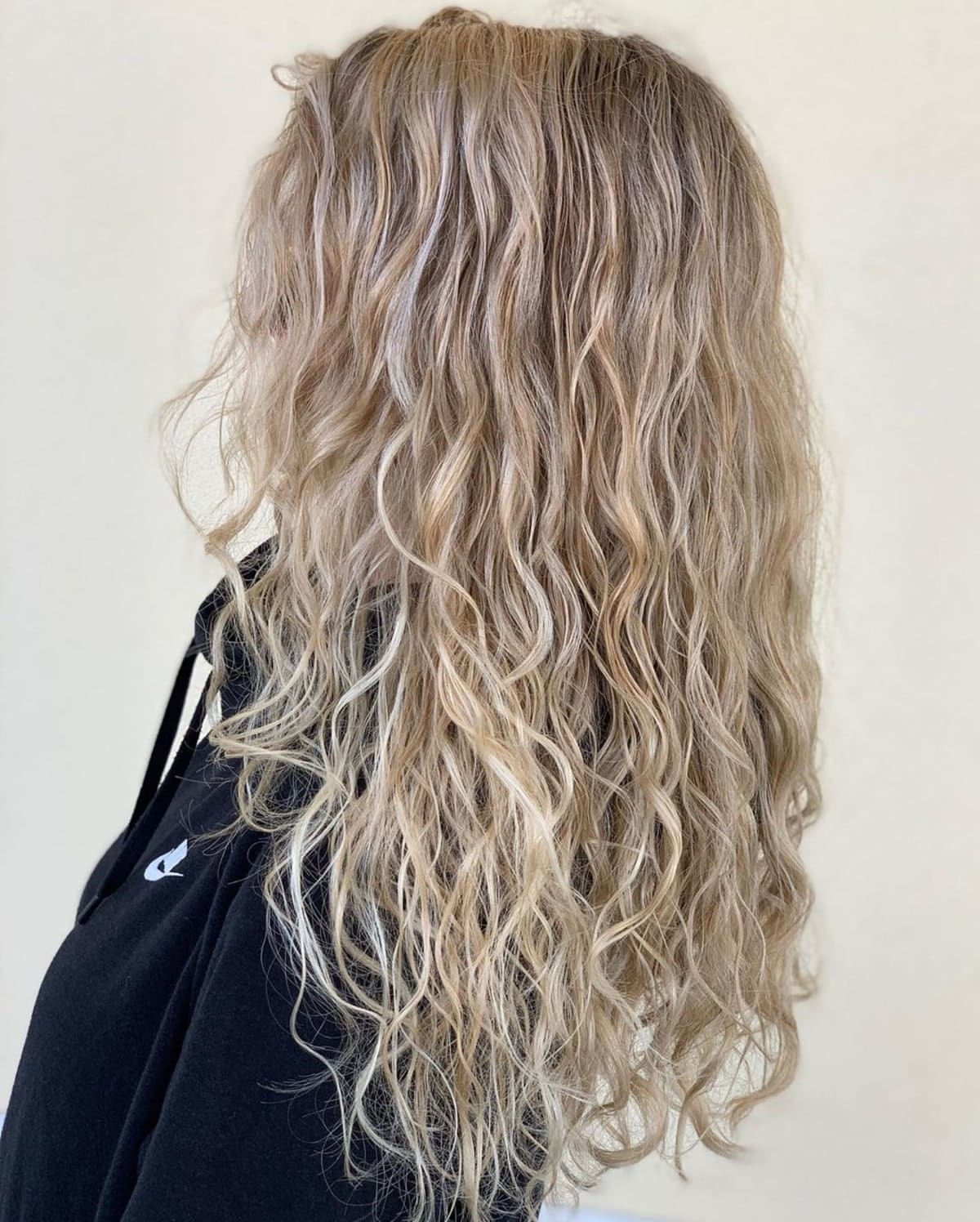
Courtesy of: latest-hairstyles.com
Highlights in curly hair live or die by placement, and this one puts the lighter blonde pieces inside the curl pattern rather than across the surface. The blonde base stays mid-back with layers, so the lighter blonde partial highlights show up where the curls turn and cluster. That is why the dimension holds from a side view and not just under direct light. Thick, curly hair of mid-back length or longer carries it best; looser textures can wear it too, but the contrast reads softer.
Ask your colorist for: mid-back length layers, blonde base with lighter blonde partial highlights, natural curls. Air-drying is the honest test of the color, since a diffuser attachment on low heat keeps the curl definition intact and lets the highlights sit where they were placed. Curly hair usually stretches to a trim every ten to twelve weeks, and a dry cut keeps the layers honest once the curls spring back up.
Mid-Back Wavy Layers With Ash Blonde Highlights
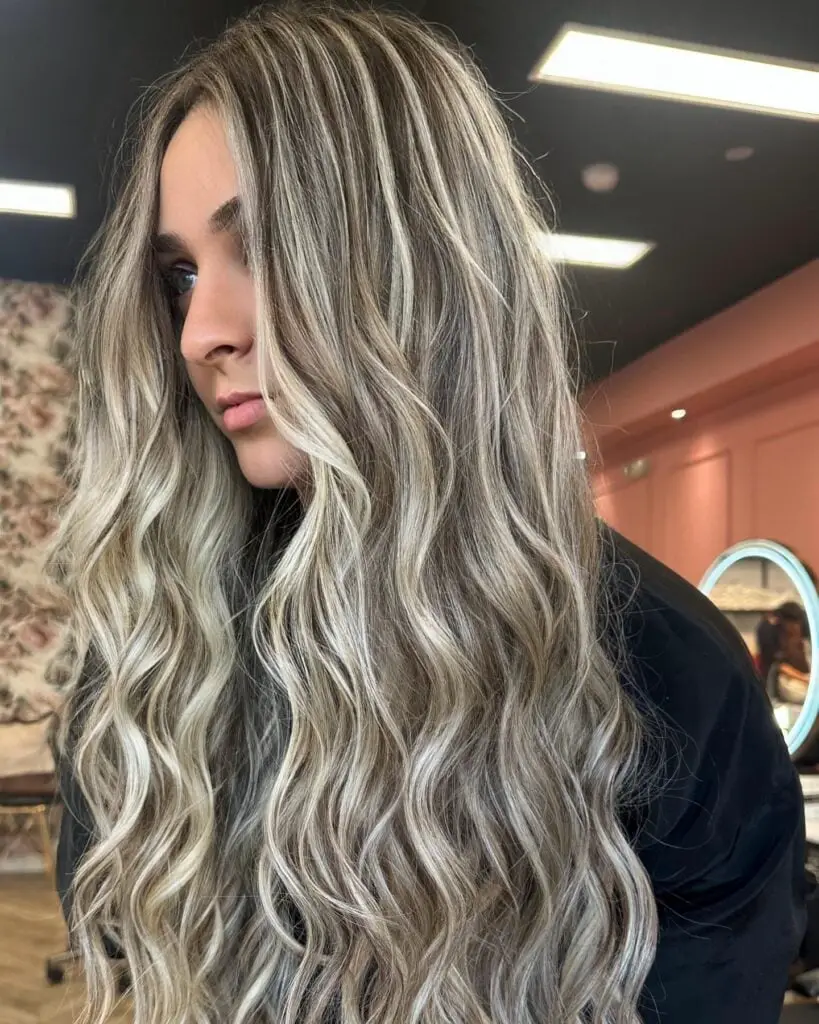
Photo credit: hastehair.com
Ash blonde highlights on a dark blonde base read cooler than most partial work, and that is exactly why this one lands in autumn: the tone matches the season’s gray light instead of fighting it. The layers start around the face and run through mid-back, with curtain bangs and a middle parting keeping the front open. Thick, wavy hair wears the wavy blowout well, and the ash tone shows up clearly against the darker base without going flat. Ask your stylist for: mid-back length layers, dark blonde base with ash blonde partial highlights, curtain bangs.
Mid-Back Loose Curls With Blonde Dimensional Highlights
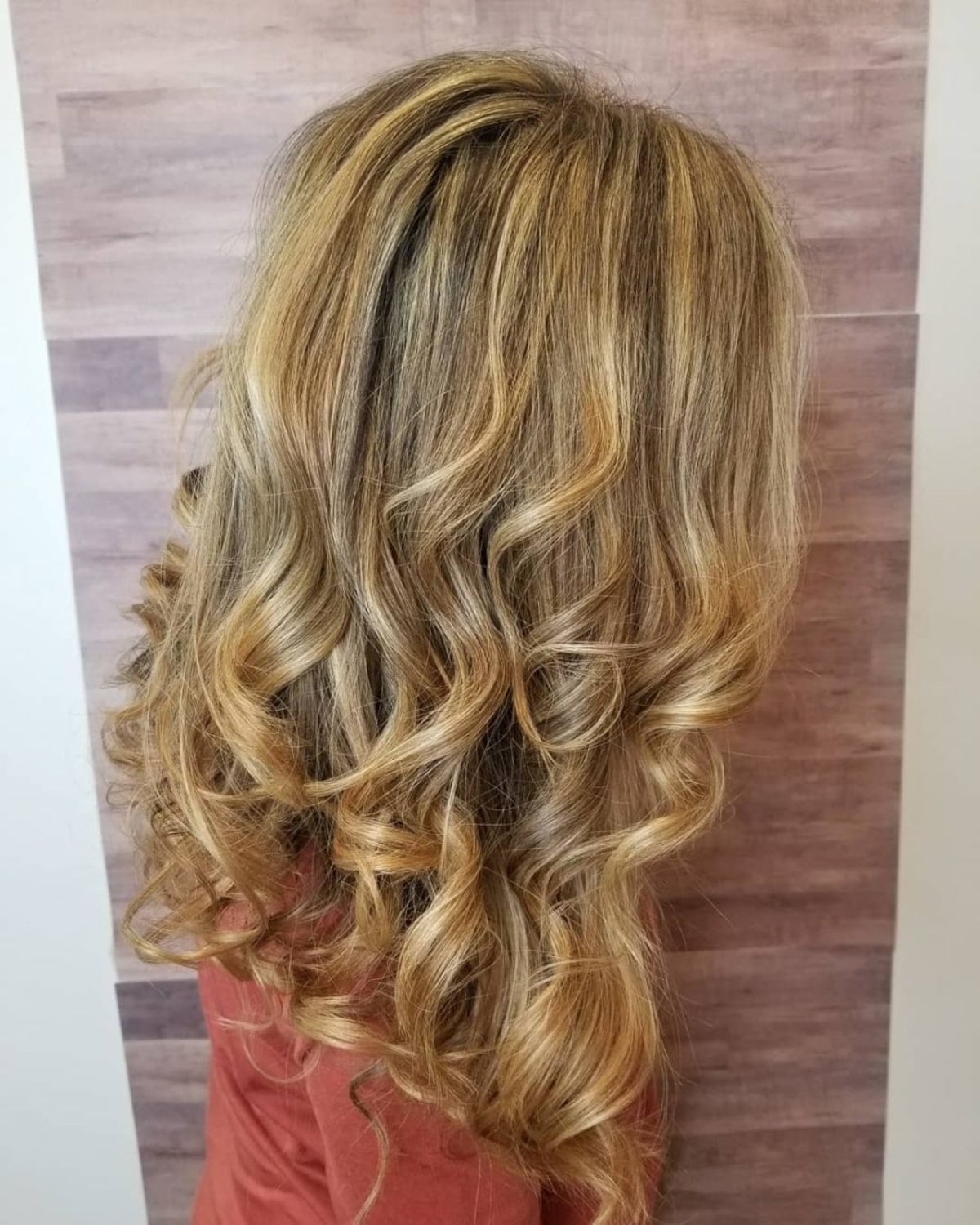
Image credit: latest-hairstyles.com
Can you get dimensional blonde highlights at home? You can buy the supplies, and that is about where the good news ends. The dimension here comes from lighter blonde pieces placed inside a blonde base so the two tones meet in soft transitions, not hard lines. Doing that on mid-back length with long layers means sectioning the whole head, judging how the color will process over an existing base, and matching the tone of every piece. One uneven band and the loose curls show it from the side. Medium density wavy hair carries the finish well; fine hair can go patchy fast without a pro hand.
Ask your colorist for: mid-back length with long layers, blonde base with lighter blonde dimensional partial highlights, loose curls. If you want to shape the finish at home, scrunch in a curl cream and let it air dry, which keeps the curl pattern soft and the highlights visible. Book the salon for the color and keep the styling to yourself. A trim every ten to twelve weeks maintains the long layers.
Collarbone Angled Lob With Bright Blonde Partial Highlights
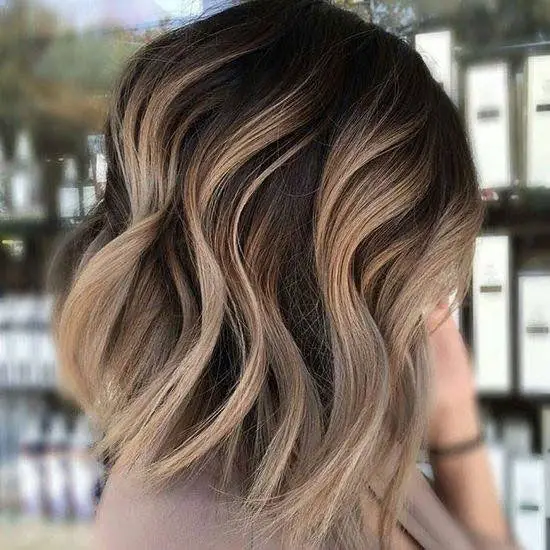
Bright blonde partial highlights on a dark blonde base give this collarbone angled lob its contrast, and contrast is the part that needs maintenance. Curtain bangs and a middle parting put the brightest pieces right at the front, where roots show first. Expect a salon visit every six to eight weeks for a trim, plus a toning appointment in between to keep the blonde from drifting warm. Purple shampoo helps at home; it does not replace the toner. If you want low upkeep or you skip toning, pass on this one and stay closer to your base. Ask your colorist for: angled lob to collarbone, dark blonde base with bright blonde partial highlights, curtain bangs.
Final Thoughts
Match the contrast to your nerve: highlights one or two shades lighter than your base read as a subtle shift, while a strong ash or copper placement around the face is a visible change. Fine hair holds a cleaner line with fewer, wider pieces.
- Tone every six to eight weeks to keep cool or warm tones on course.
- Wash with color-safe shampoo and conditioner to slow fading.
- Deep condition weekly to counter dryness from lightening.
- Trim split ends every ten to twelve weeks.
Partial highlights offer a versatile way to experiment with color.
Hairstyle
20 Highlights on Blonde Hair 2027 for a Fresh Look
Highlights on Blonde Hair 2027. See 20 ideas including light blonde with bright highlights and ash blonde on a dark blonde base.
Highlights on blonde hair add dimension by placing lighter pieces through a base shade, and the current move is toward lived-in color that grows out without a hard line. Soft face-framing layers and curtain bangs keep the shape from looking solid as the tone shifts.
You get 20 ideas here, from low-upkeep balayage blends to bright, contrast-rich streaks, across collarbone, mid-back and bob lengths. It covers fine hair that falls flat, a grow-out line that shows too soon and a fringe that refuses to sit, with the base shade, technique and tone spelled out for each.
Light Blonde With Bright Highlights Collarbone Lob
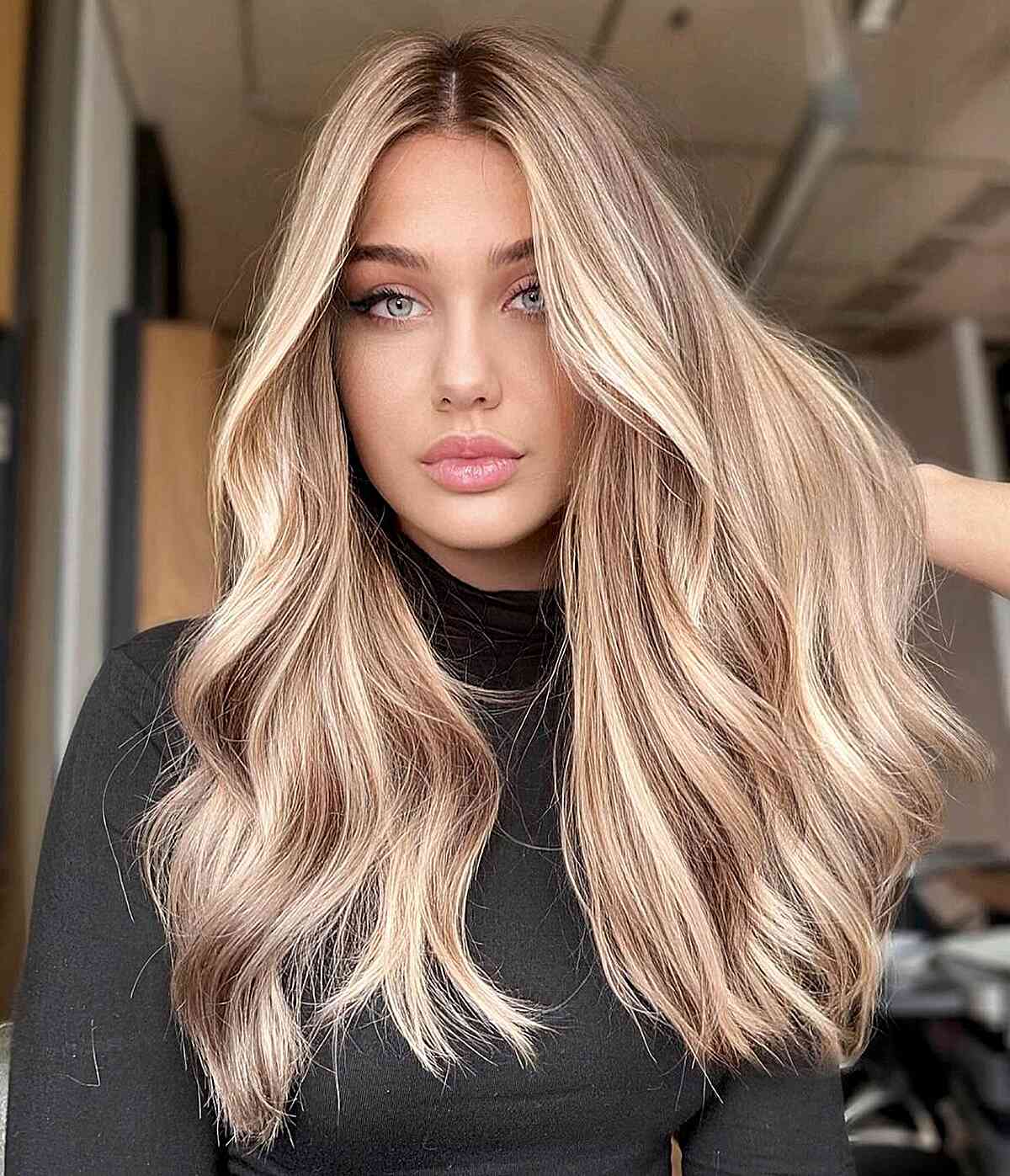
Courtesy of: latest-hairstyles.com
Bright highlights sit on a light blonde base and stop right at the collarbone, which is the point where a lob keeps its swing instead of dragging. The layers do the work here: on thick, wavy hair they break up the bulk so the wave reads as soft rather than triangular. This length is a good match for oval and heart-shaped faces, and a center parting keeps the front balanced. Thick, wavy hair is the starting point; on fine hair the same cut collapses by midweek. Ask your stylist for: collarbone lob, soft layers, bright highlights. A large barrel curling iron gives the soft wave, and a trim every six to eight weeks holds the baseline.
Ash Blonde Highlights on Dark Blonde Base Mid-Back Length
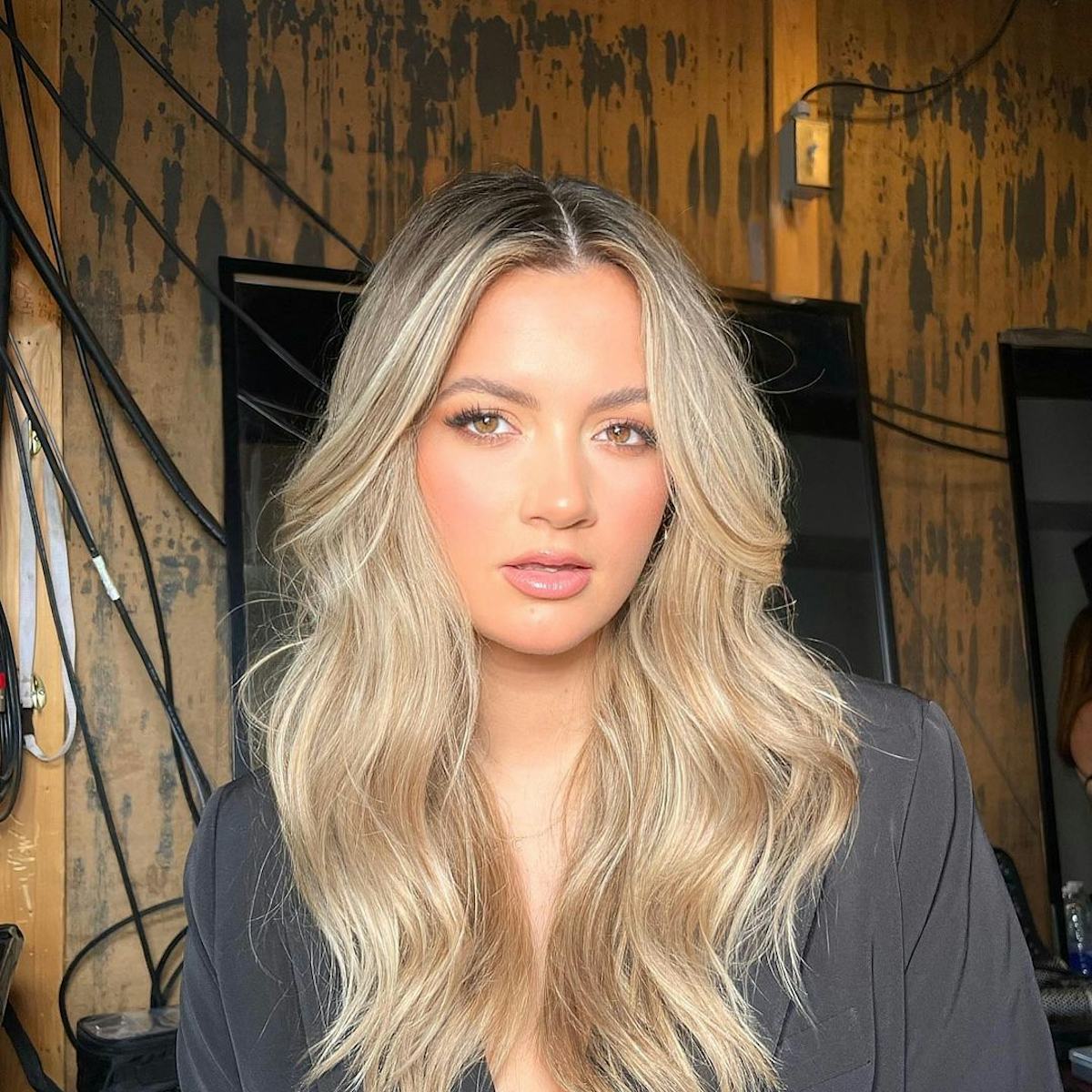
Photo credit: thezoereport.com
Ash blonde highlights on a dark blonde base are the quiet version of going lighter: the two tones sit close enough that regrowth never announces itself. The technique is what makes it work. Fine sections of ash blonde are woven through the darker base rather than painted on top, so the contrast stays low and the color reads as lived-in from the first week. On fine, wavy hair at mid-back length, that low contrast adds depth without chopping the length into stripes. Ask your colorist for: ash blonde highlights on dark blonde base, lived-in effect.
Upkeep is lighter than the shade suggests. A gloss every eight weeks keeps the ash tone from drifting warm, and air drying with a curl-enhancing cream brings out the loose wave without heat. Fine hair at this length needs a trim every eight to ten weeks to keep the ends from thinning out. The middle parting stays clean because the highlight placement follows it. Budget about three hours in the chair for the first appointment.
Short Bob Ash Blonde With Lighter Highlights
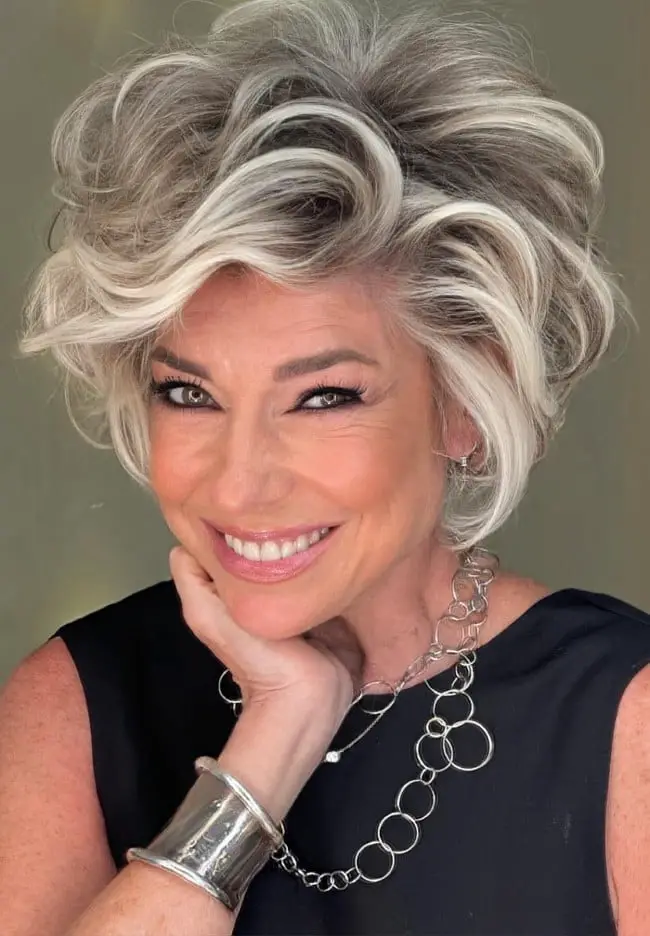
Image credit: fabmood.com
Wondering if a short bob can carry highlights without looking busy? On fine, wavy hair it can, provided the highlights are lighter than the ash blonde base and the curls do the separating. The side-swept bangs and the volume at the sides suit long faces, and the ear length keeps the shape sharp. Ask your stylist for: ash blonde bob, lighter highlights, side-swept bangs, voluminous curls. A volumizing mousse and a diffuser get the curl up, and the bob needs a trim every four to six weeks to hold its line.
Chin Length Honey Blonde Bob With Highlights
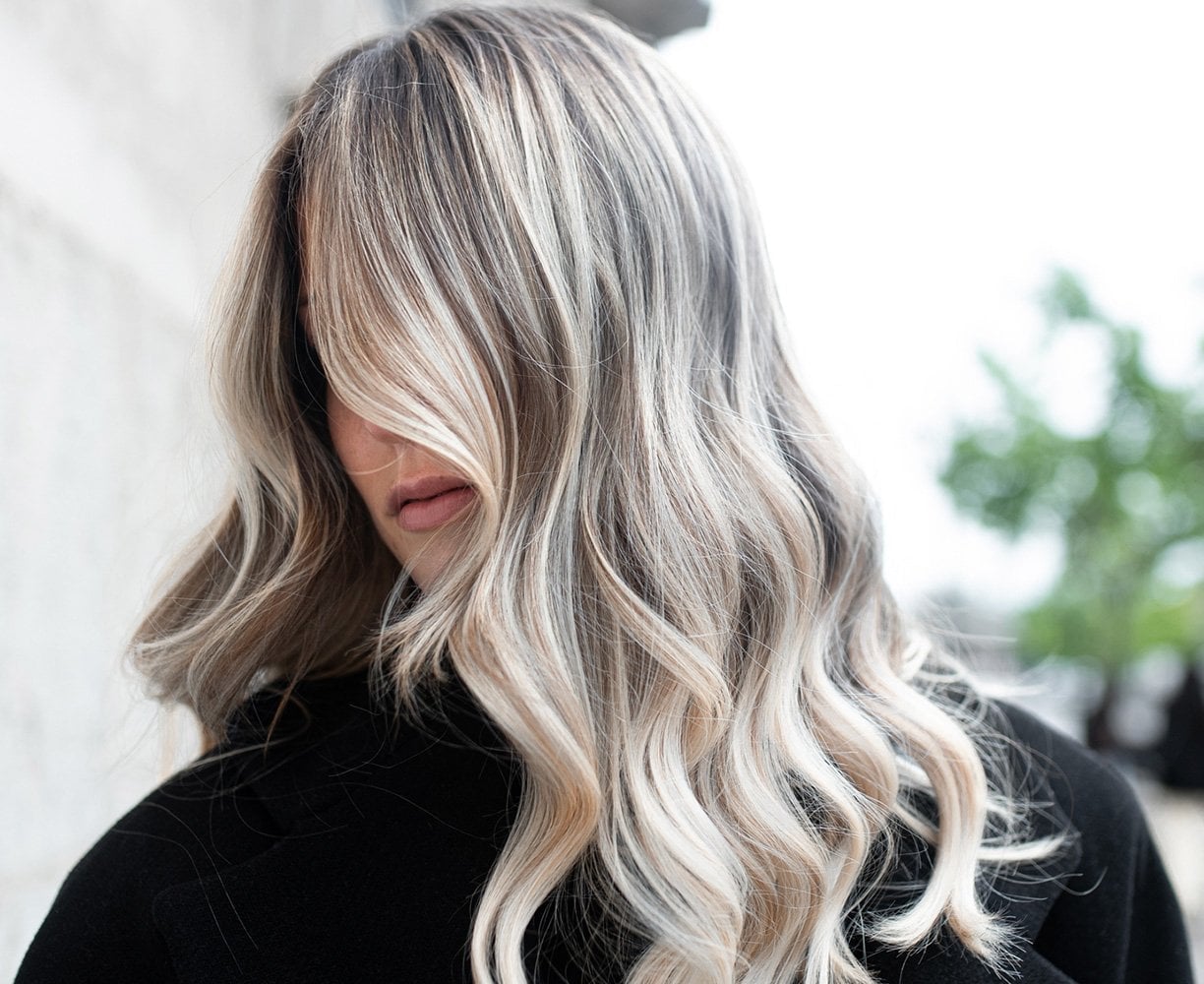
Source: garnierusa.com
A chin-length bob in honey blonde with subtle blonde highlights is a placement job more than a color job: the highlights sit where the wavy blowout turns, so the tone shifts as the hair moves. Fine, wavy hair holds the shape, and bangs swept to one side keep the front from going flat. Oval and square faces carry this length well. Ask your stylist for:
- chin-length bob
- honey blonde base
- subtle blonde highlights
- side-swept bangs
Light Blonde With Face-Framing Highlights Collarbone Lob
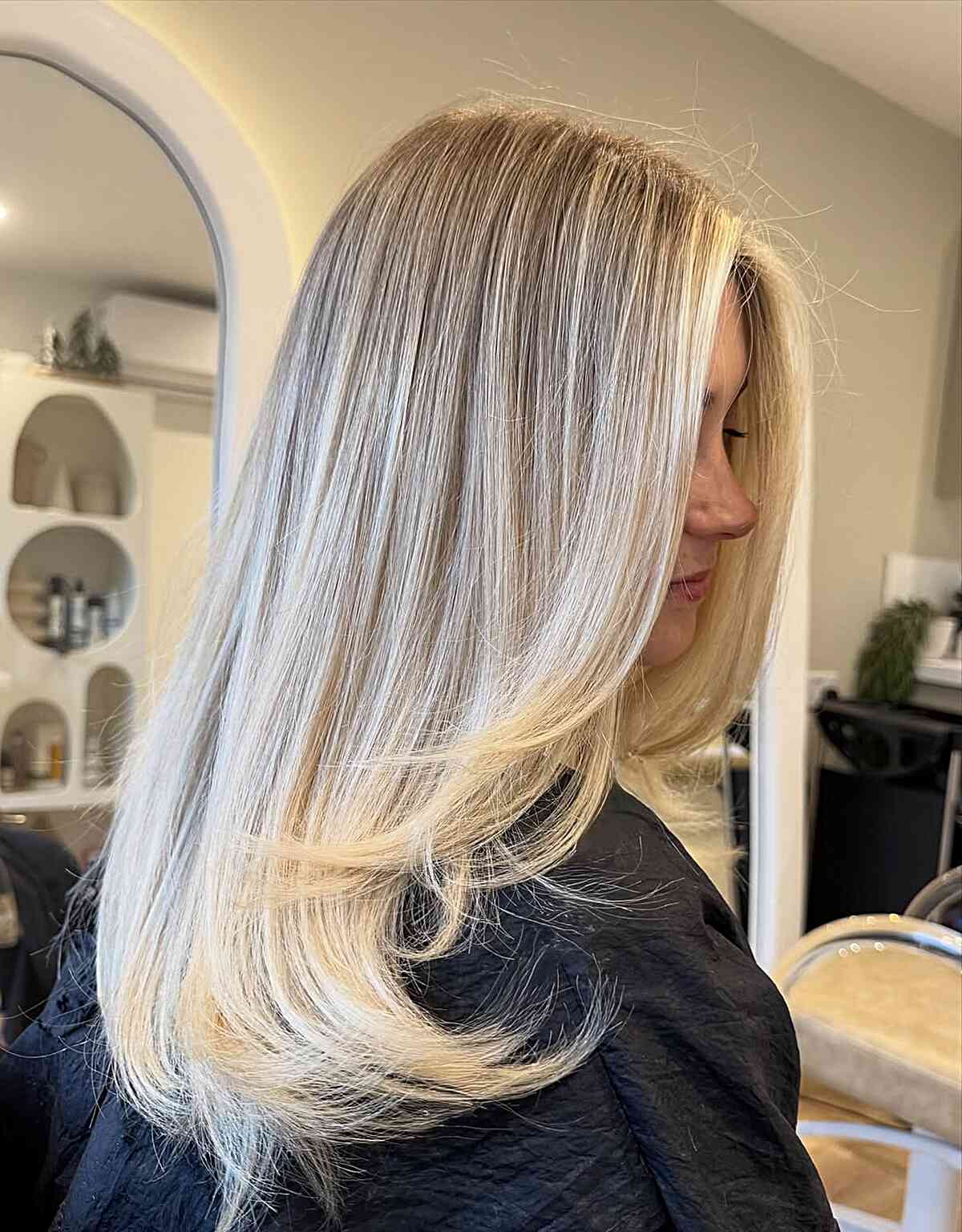
Face-framing highlights are placed on the sections that fall forward of the parting, which is why they show up in a front view and disappear in a ponytail. On a light blonde base, the added blonde pieces lift the front without changing the overall shade. Thick, straight hair at collarbone length carries the smooth blowout well, and the layers around the jaw soften square and round faces. Ask your colorist for: light blonde base, face-framing highlights.
Upkeep splits into two rhythms. The baseline needs a trim every six to eight weeks, and the highlights want a gloss every six to eight weeks as well to keep the tone from going brassy. A flat iron on medium heat gives the smooth finish; thick, straight hair holds it without much product. The middle parting keeps the framing symmetrical, so the highlight placement stays where it was put.
Platinum Blonde Shoulder Length Straight Hair
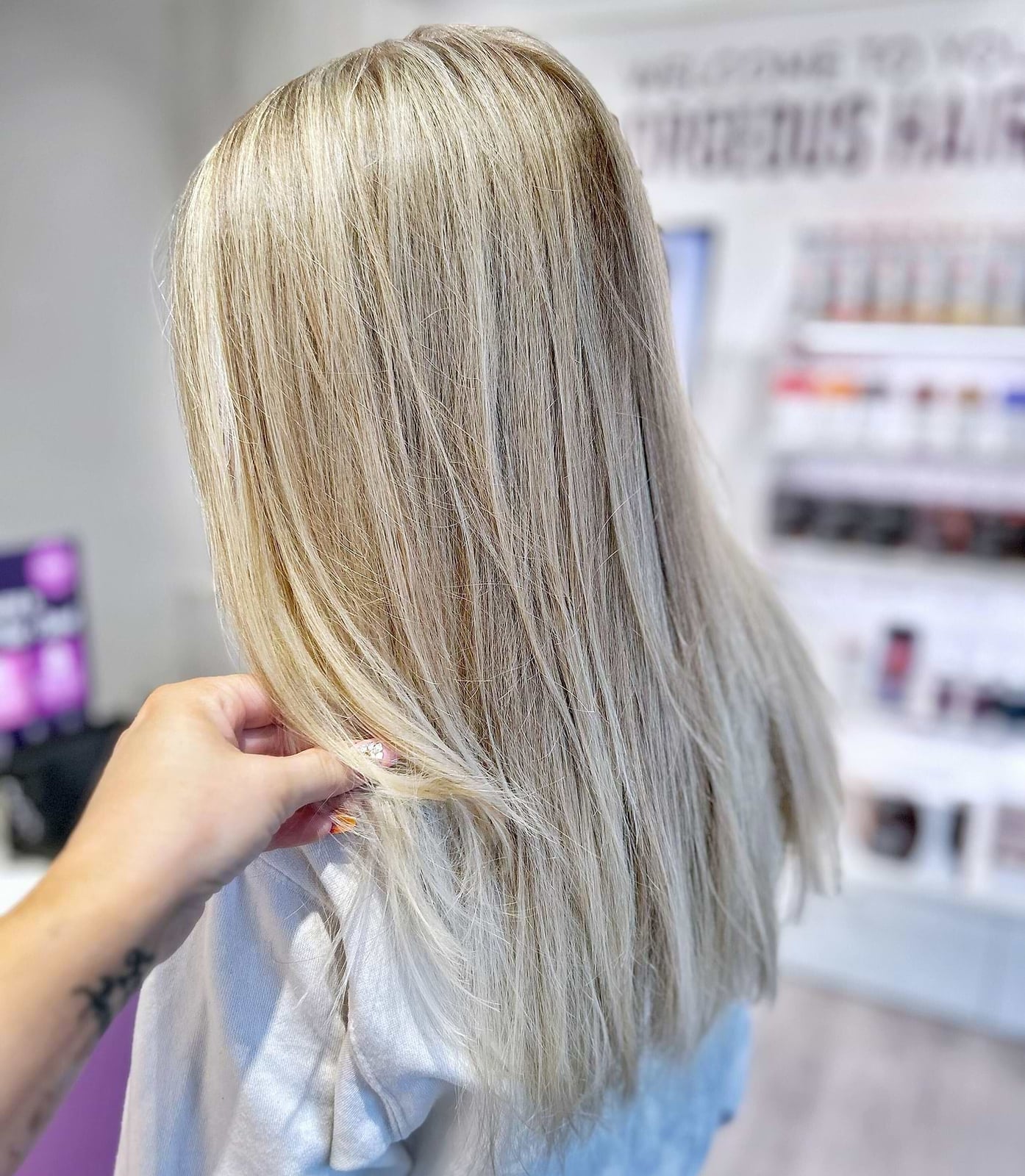
Courtesy of: madison-reed.com
A bright platinum is a statement where a soft ash blonde is a mood, and that distinction matters before you sit down. Shoulder length straight hair in a uniform platinum blonde, built from highlights across medium-density strands with a middle parting, shows every tonal shift, so the tone has to be right. Ask your colorist for: platinum blonde shoulder length, bright cool tone. The real drawback is the root line: this level of lift needs a toner refresh every four weeks or the base drifts warm and the whole thing looks tired. Fine hair can go flat under that much processing, and medium density straight hair holds the shape better. Expect a long first appointment and a standing calendar reminder.
Beige Blonde With Highlights Mid-Back Waves
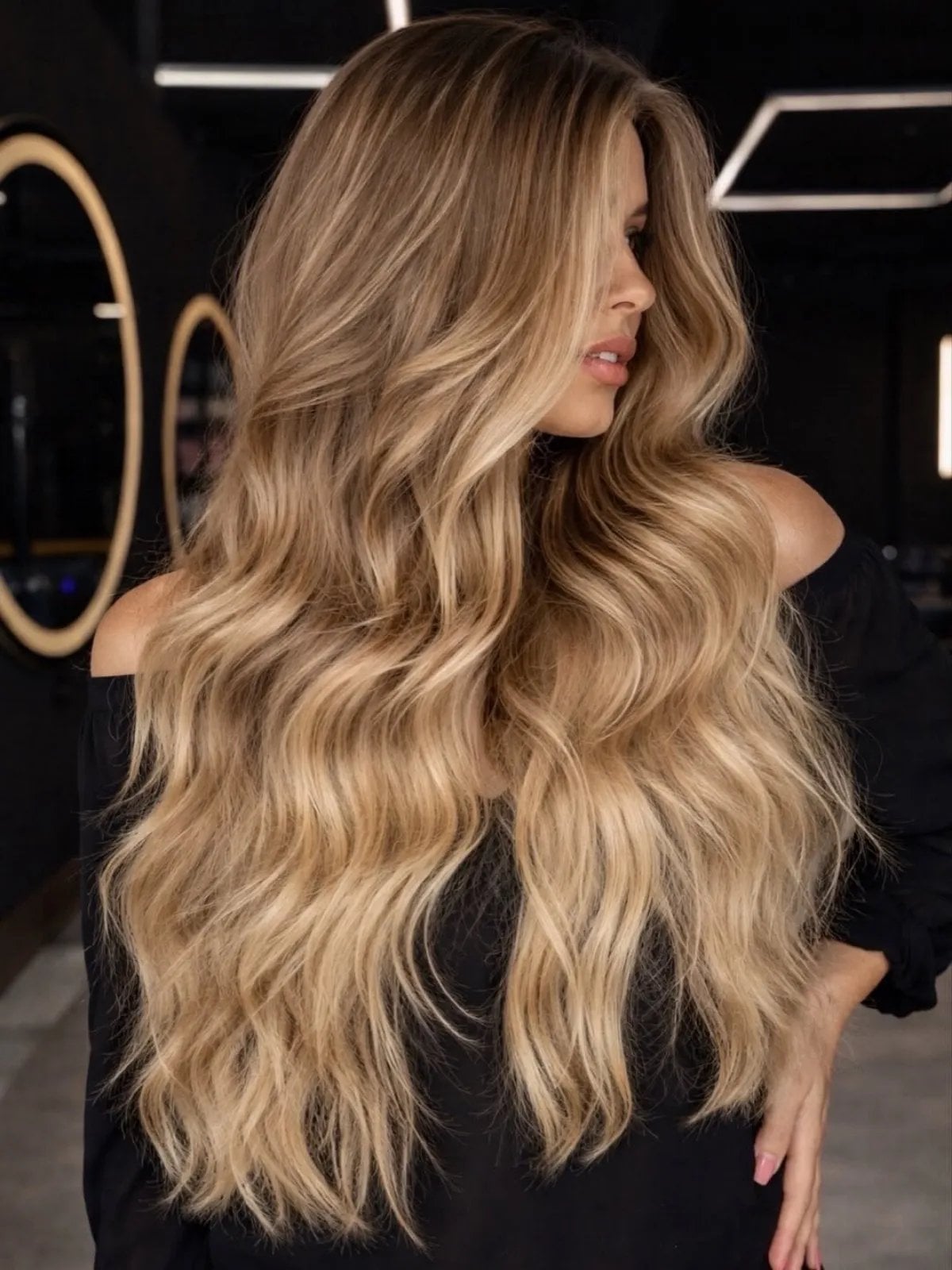
Photo credit: wella.com
A beige blonde base with visible highlights through thick, wavy mid-back length does something a solid color cannot: it keeps the volume from reading as one flat mass. The side parting and the blowout give the layers somewhere to move.
Compare that with a single-process beige blonde. Solid color on this much thick, wavy hair can look heavy and a little helmet-like, and regrowth shows as a hard line within weeks. Highlights break up the surface, so the beige stays dimensional and the grow-out softens. Who should pick which: if the hair is fine or you want low maintenance, solid color wins on ease; if the texture is thick and wavy and you want movement, the highlighted version earns its keep. Length matters too, since mid-back hair carries highlights further before they look busy. Ask your colorist for: beige blonde with visible highlights, mid-back length. A trim every six to eight weeks keeps the wavy ends from dragging the shape down. For a wedding or a dressed-up dinner, this is the one that photographs with depth.
Light Blonde With Subtle Highlights Collarbone Length, Styled In Soft
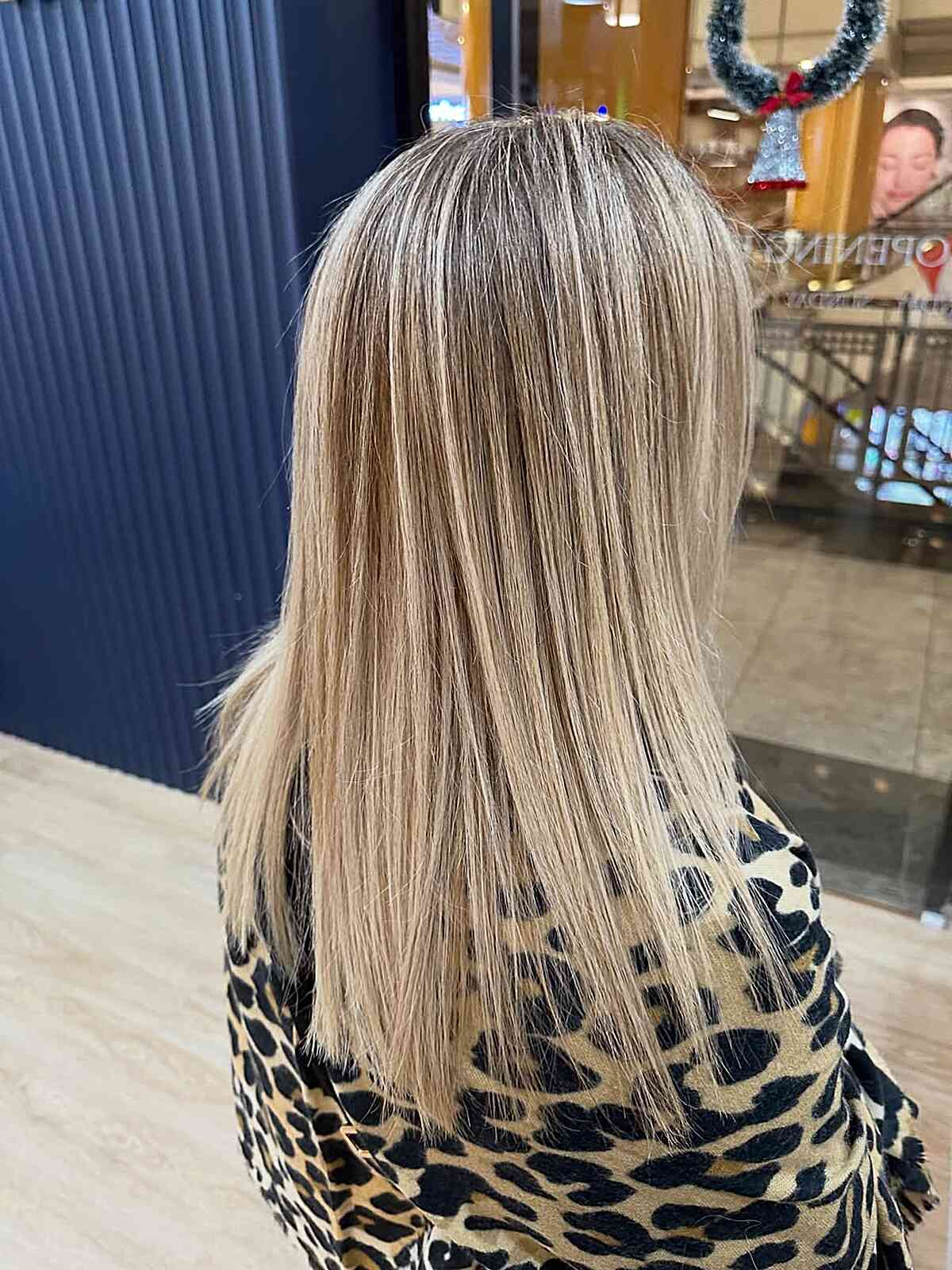
Image credit: latest-hairstyles.com
What do you actually say at the salon if you want highlights that look natural? Start with the base: a light blonde that stays close to your natural depth, with subtle blonde highlights woven through the hair. On thick, straight hair, that placement keeps the color dimensional without turning the blowout into a skunk stripe. The collarbone length and middle parting do the rest, and the curtain bangs frame the face without a heavy fringe. Ask your colorist for: light blonde with subtle highlights, collarbone length, curtain bangs. The subtle version is a salon job, since matching the base and the highlight tone takes a colorist’s eye; a box kit cannot feather the line. Expect roughly three hours in the chair, then a blowout on the bangs to keep them from falling flat.
Butter Blonde With Highlights Mid-Back Waves and Curtain Bangs
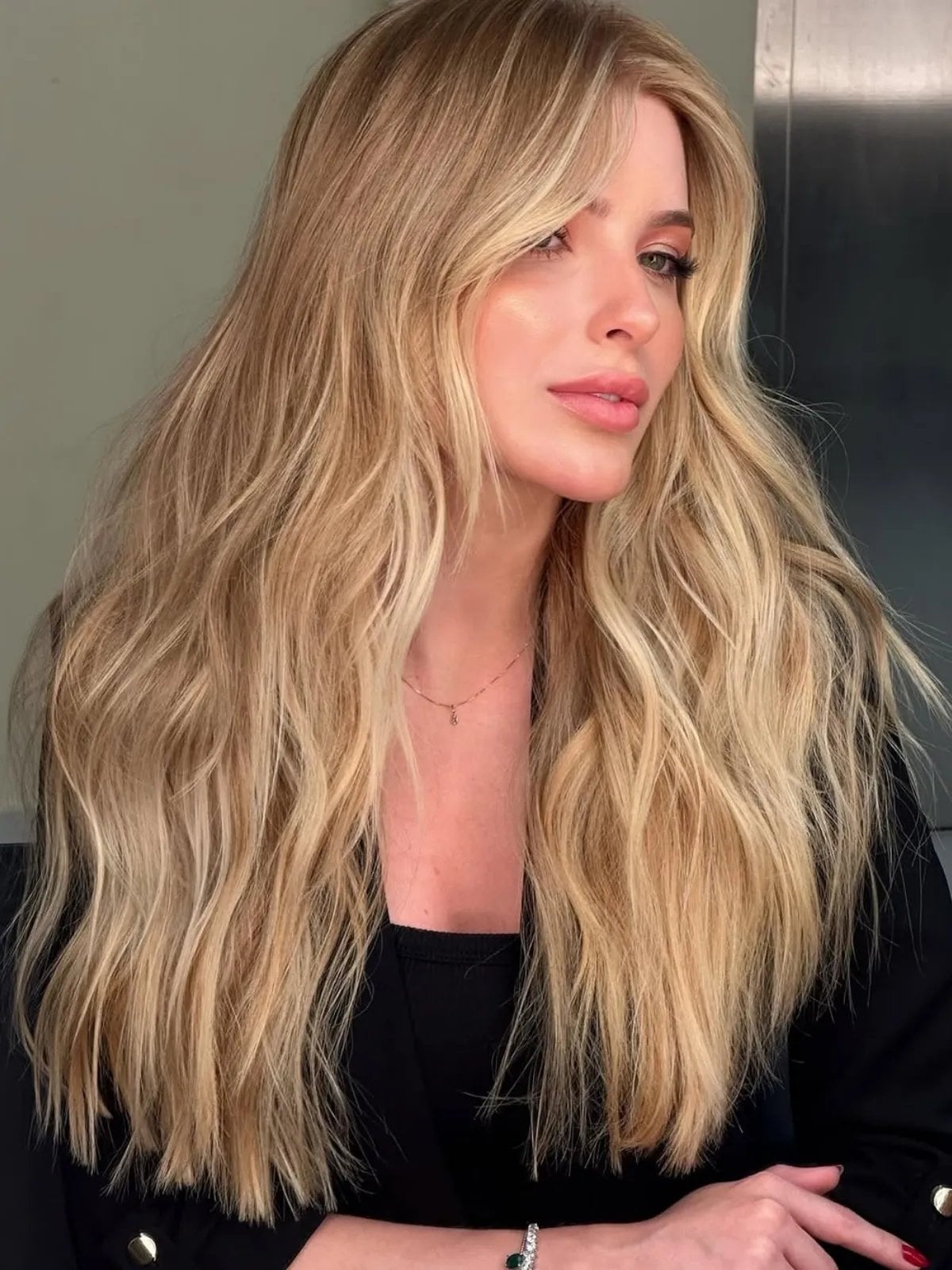
Source: wella.com
Butter blonde with subtle highlights on thick, wavy mid-back length is a shade that shows its work in a blowout, and the curtain bangs are doing the heavy framing. The face-framing layers around a middle parting mean the front pieces hold their shape even on day three.
How it wears: thick, wavy hair at this length takes a blowout well but drops volume at the root within a day, so a volumizing spray at the crown before drying is standard practice. The curtain bangs need a round brush and a few minutes of attention each morning, or they fold the wrong way. Trim the baseline every six to eight weeks to keep the wavy ends from looking stringy, and book a toner refresh around the same interval to stop the butter from sliding toward yellow. Ask your colorist for: butter blonde with subtle highlights, mid-back length. Ask your stylist for: face-framing layers, curtain bangs. Fine hair will lose the wave faster; thick hair keeps it.
Light Blonde With Copper Undertones Mid-Back Waves
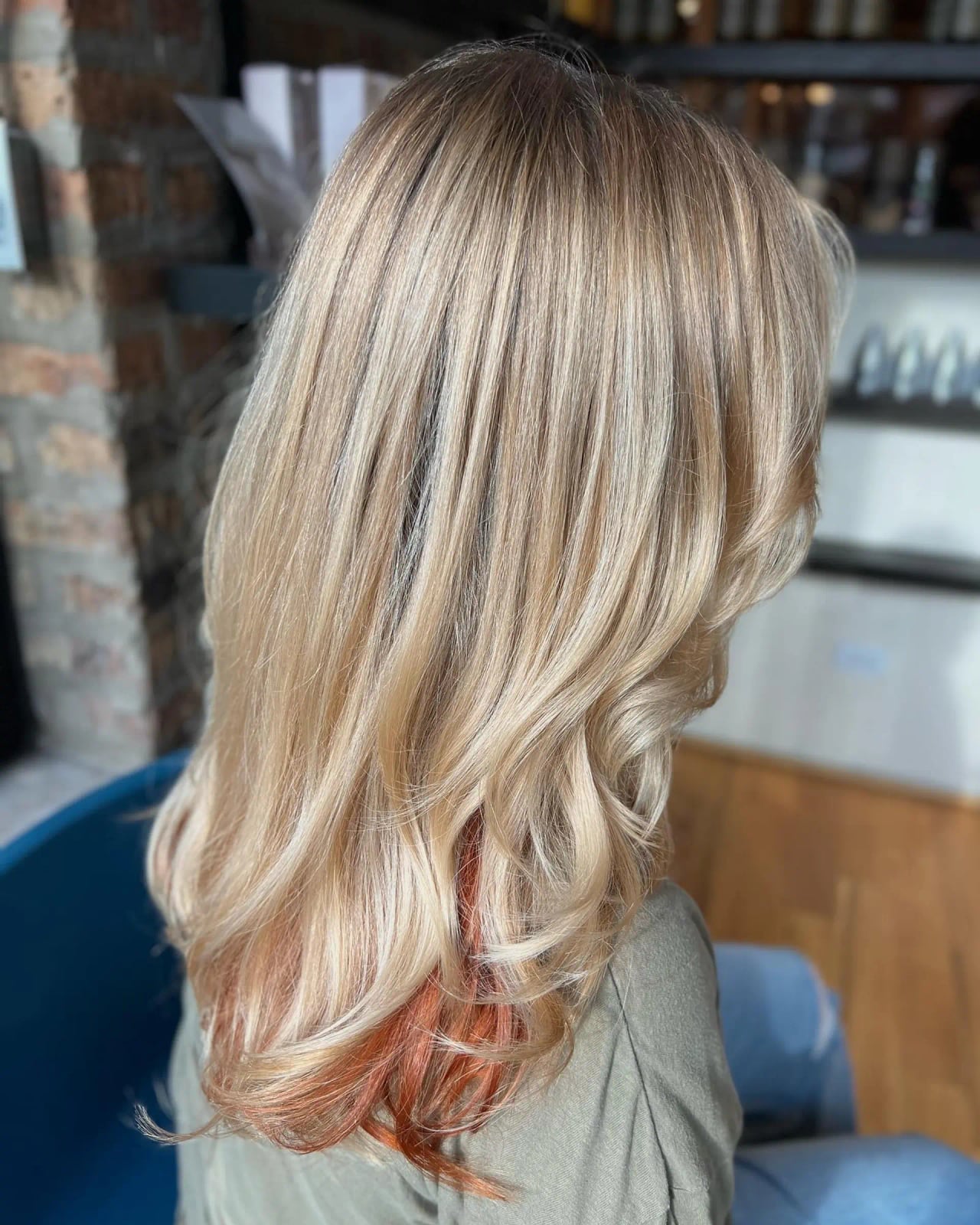
Source: kiri-me.com
The copper here sits underneath the blonde, not on top of it, which is why the light blonde highlights on this thick, wavy mid-back length look warm without turning orange. A side part with loose waves lets the undertone catch at the bends of the hair.
Technically, that means the colorist lifts the highlights to a light blonde first, then tones with a copper-leaning formula so the warmth lives in the toner, not the lift. Going straight in with a copper dye over a blonde base is how you get brass. Subtle copper undertones also need a different maintenance rhythm than cool blondes: a color-depositing conditioner every week or so keeps the tone from fading out, and a toner refresh every six to eight weeks holds the line. Ask your colorist for: light blonde with subtle copper undertones and highlights, mid-back waves. Thick, wavy hair carries the tone well because the bends scatter light. On fine hair the copper reads stronger, so ask for a lighter hand.
Ash Blonde Highlights On Dark Base Collarbone Length
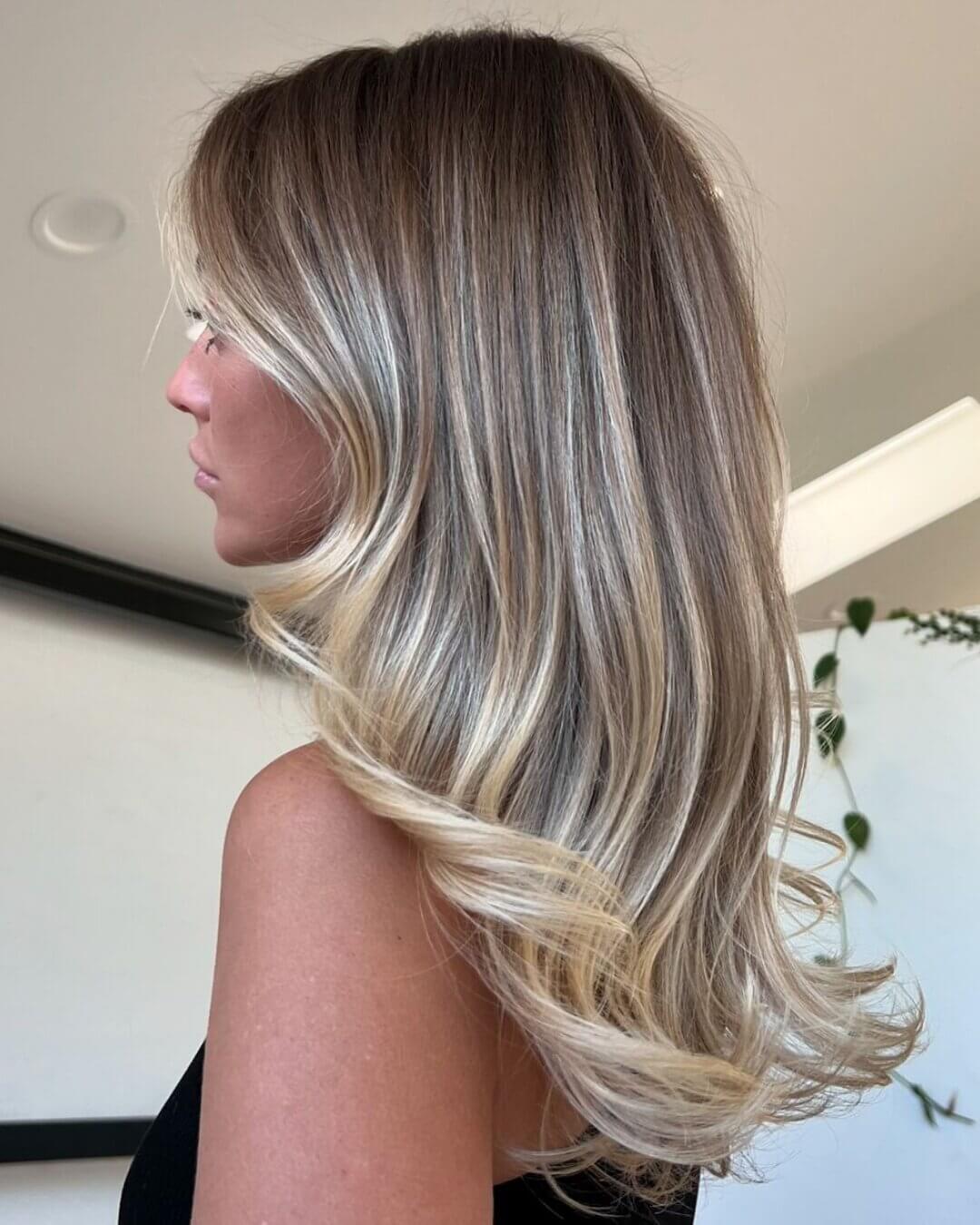
Via redken.com
Can thick, wavy hair carry ash blonde highlights without turning into a gray cloud? Yes, when the dark blonde base stays visible between the foil sections and the toner is kept cool, not silver. Collarbone length keeps the weight in check, and face-framing layers plus curtain bangs break up all that density around the jaw. Ask your colorist for: ash blonde highlights on dark blonde base, collarbone length, curtain bangs. A middle parting lets the curtain bangs fall on both sides, which softens a square face without hiding it. If your hair is fine rather than thick, pass on this much contrast: the dark base will swallow the ash pieces. Thick, wavy hair holds the blowout shape with a round brush, and a trim every six to eight weeks keeps the ends from going stringy.
Blonde Highlights On Dark Base Collarbone Length With Wavy Blowout
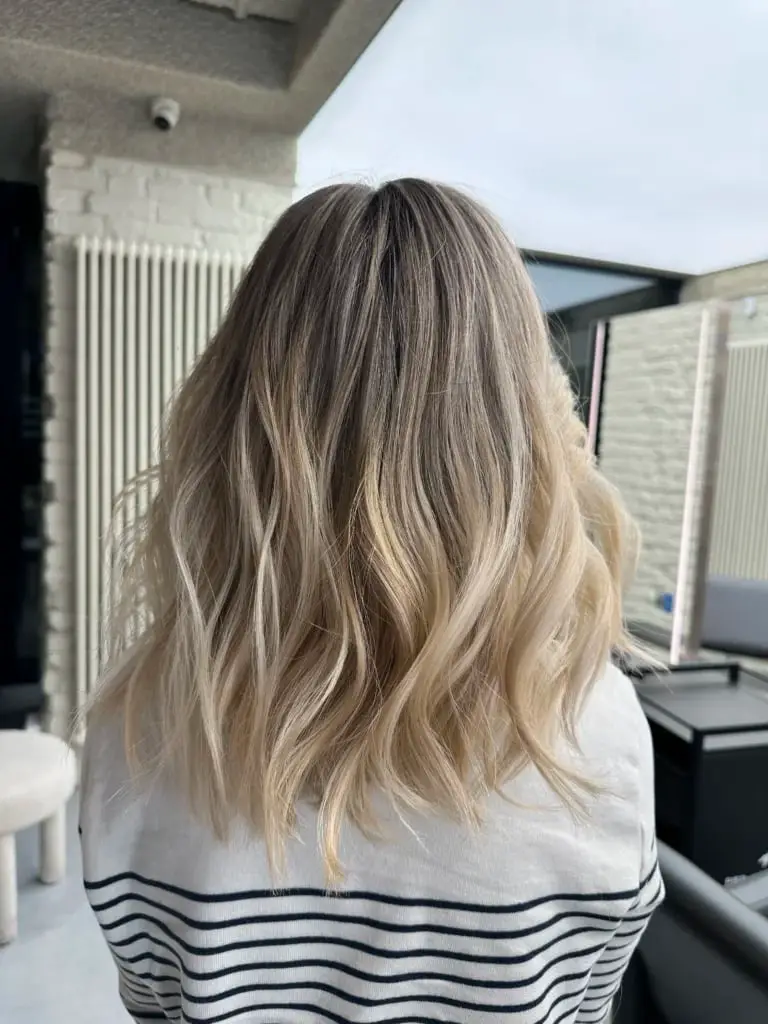
Courtesy of: p-de-p.co.uk
Dimensional highlights live or die by placement, and this collarbone cut shows why: the blonde pieces sit where the loose waves bend, so the darker base reads as depth instead of a root line. From the back, the middle parting splits the color evenly and the medium-density waves do the rest. Ask your colorist for: blonde highlights on dark base, collarbone length, loose waves. This is a salon job. Foil placement that follows the wave pattern takes a trained eye, and a DIY cap kit will give you stripes at the crown and nothing at the ends. The real cost is time: expect a long appointment and a toner refresh every six weeks to keep the blonde from drifting warm. Wavy, medium-density hair needs little styling after that, which is the trade you are making.
Golden Blonde With Highlights Collarbone Length
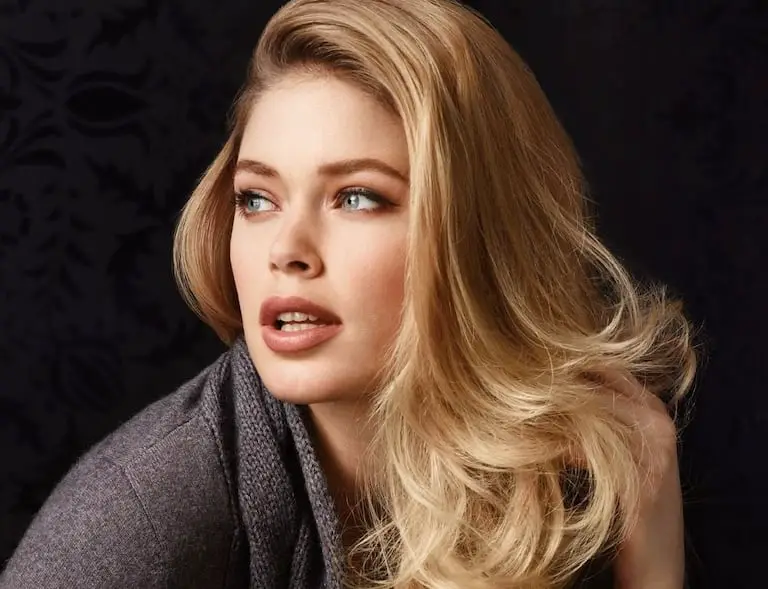
Photo credit: arya.salon
The shine here comes from a golden blonde base with subtle highlights woven through, not from a gloss alone. Fine, wavy hair at collarbone length reflects light best when the color stays close to the base shade, so the highlights give warmth instead of stripes. Ask your colorist for: golden blonde with subtle highlights, collarbone length, soft waves. Say subtle twice. Fine hair shows every hard line, and a highlight that sits two shades lighter will look painted on. A side part and a soft wavy blowout give the cut its shape, and the gloss comes from keeping the cuticle smooth, which is a toning job, not a styling one. Layers through the ends stop fine hair from hanging flat, and a trim every six to eight weeks keeps the collarbone line clean.
Golden Blonde Balayage Highlights Collarbone Length With Curtain Bangs
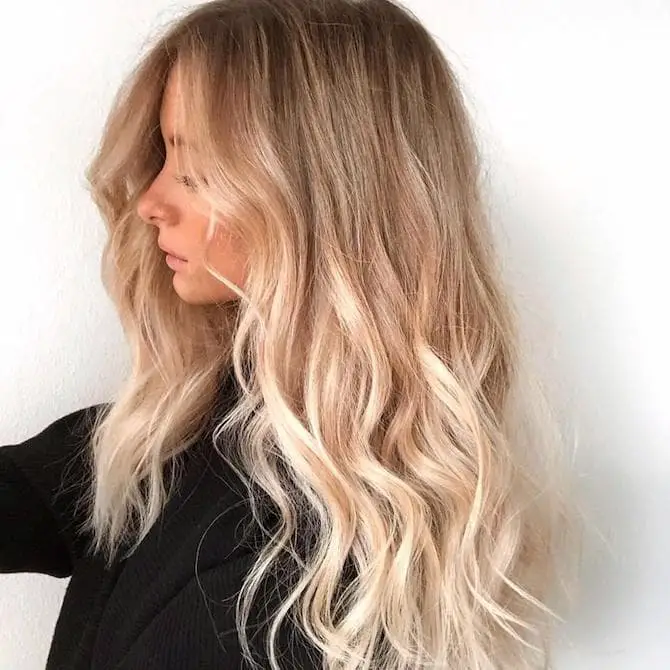
Image credit: uk.wella.professionalstore.com
Balayage is painted on the surface of the hair, freehand, which is why the golden blonde here fades gradually instead of starting at a hard line. The colorist works from mid-length down, saturating the ends and feathering the stroke upward, so the darker root melts into the gold. On medium-density, wavy hair at collarbone length, that placement follows the natural bend of the wave and looks sun-kissed rather than salon-striped. Curtain bangs get a lighter touch: a few fine strokes at the front, because a heavy sweep there would break the blend.
Ask your colorist for: golden blonde with balayage highlights, collarbone length, curtain bangs. The middle parting lets the bangs split and frame a round face without adding width at the cheeks. Balayage grows out softly, so you can stretch toning to eight or ten weeks, though the bangs need a trim every six to eight. A wavy blowout with a round brush keeps the curtain shape from collapsing. Skip this if you want uniform brightness from root to tip: balayage is built on shadow, and fighting that shadow means more appointments, not fewer.
Blonde Highlights Blend Collarbone Length Air Dried
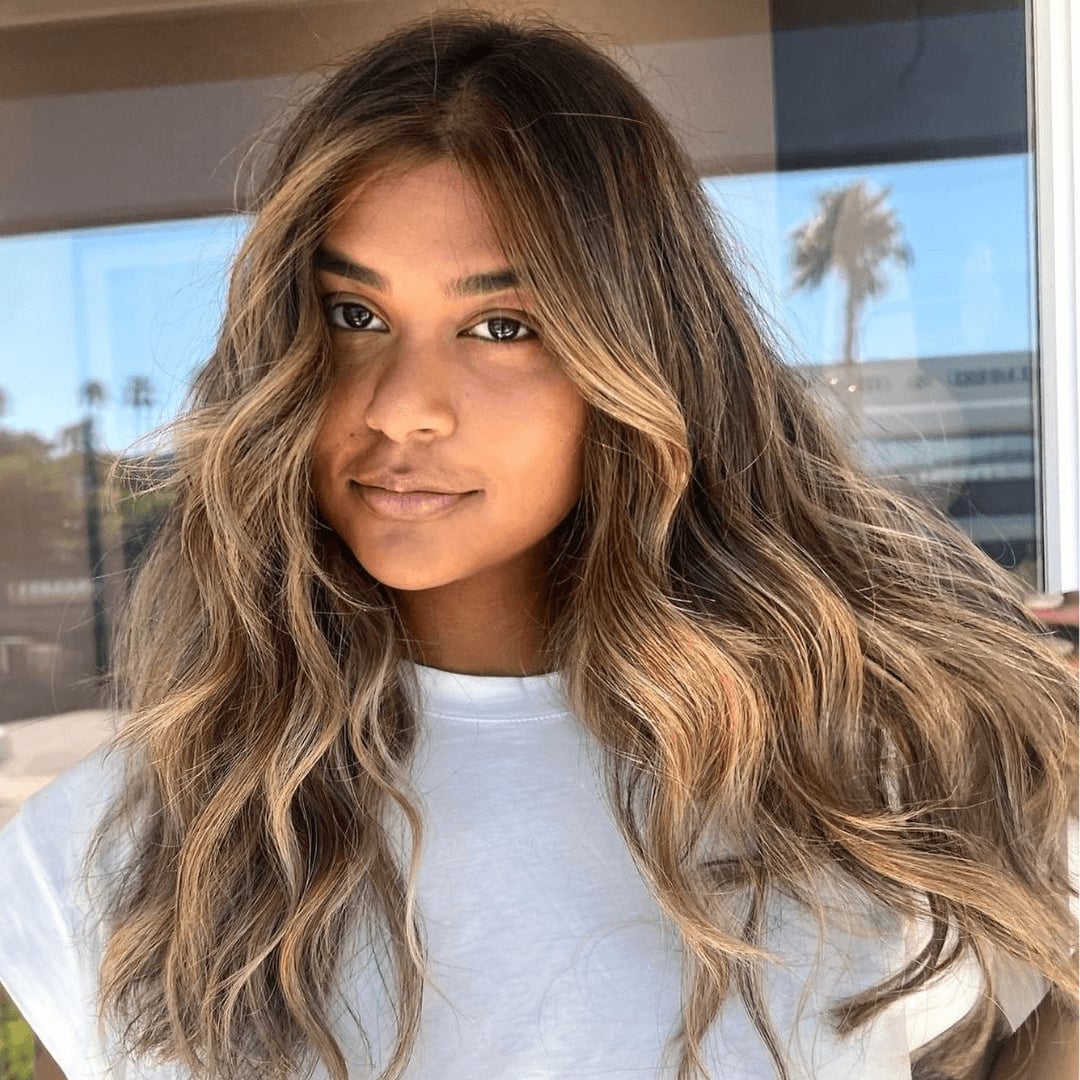
Source: belliata.com
A blend this soft only works when the highlight placement follows the natural fall of the hair, and air-dried waves expose every shortcut. The blonde tones here sit close together, so from the side the color reads as one shade with subtle highlights moving through it, no visible foil lines. Medium-density, wavy hair at collarbone length holds that texture without coaxing. Ask your colorist for: natural blonde highlight blend, collarbone length, air dried waves. Upkeep is the easy part: a sea salt spray on damp hair and you leave it alone, and the trim rhythm stretches to every eight weeks because there is no blunt line to keep sharp. Toning every six to eight weeks keeps the blend from drifting brassy. The catch is the grow-out: highlights this subtle show a root line sooner than a balayage, so book the toner before the warm tones set in.
Ash Blonde With Face-Framing Layers Mid-Back
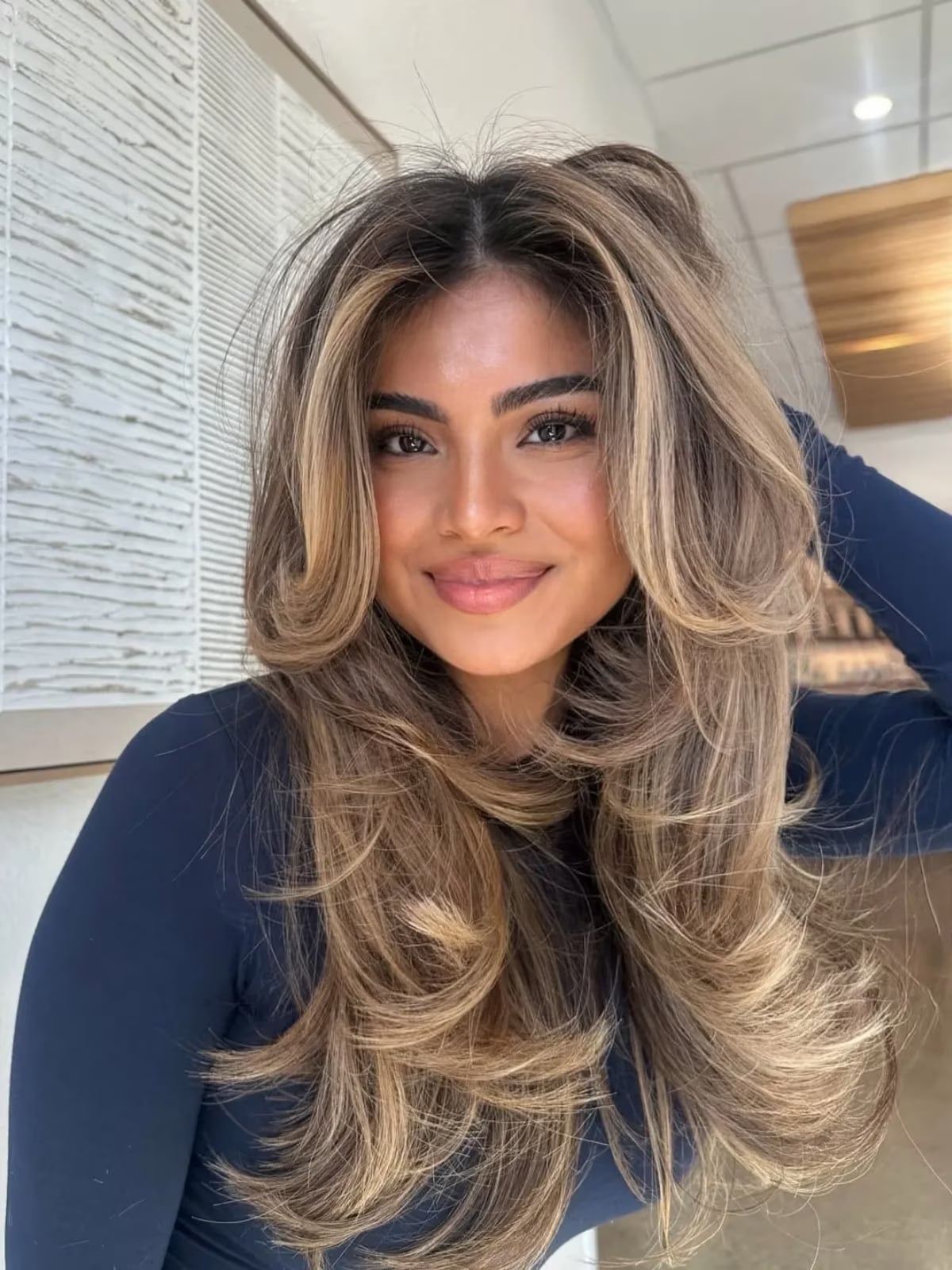
Via wella.com
The ash blonde base keeps the heat out of the color, so the loose waves and voluminous blowout look cool and deliberate, not brassy. Thick, wavy hair at mid-back length can handle the weight removal of soft face-framing layers and curtain bangs without losing body. A round face softens with the curtain bangs, and the layers around the jaw balance a square one.
Ask your colorist for: ash blonde with face-framing layers and curtain bangs, mid-back length. A large-barrel curling iron builds the loose waves in about twenty minutes. The curtain bangs need a trim every six weeks; the mid-back length can go eight.
Blonde Highlights Mid-Back With Curtain Bangs
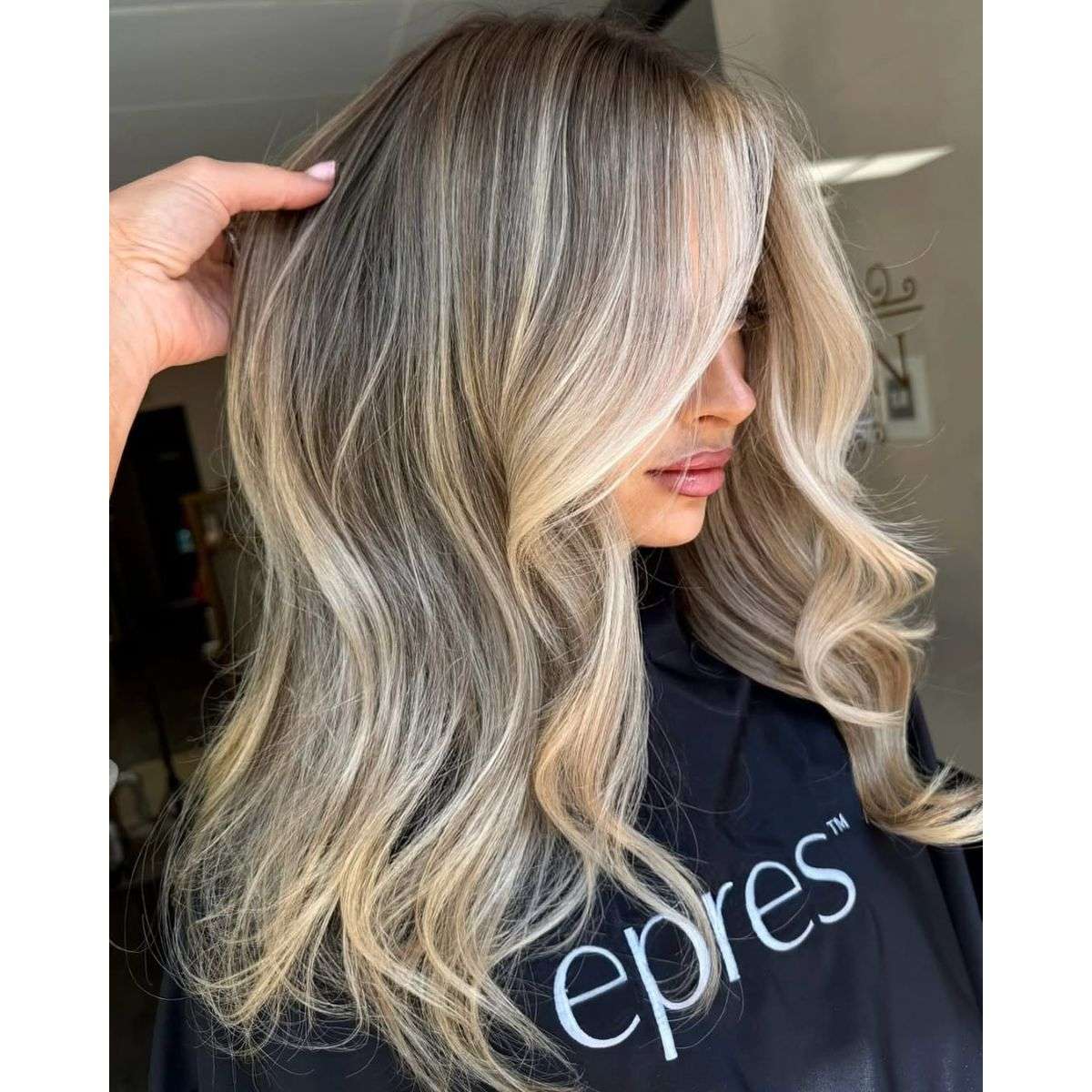
Courtesy of: behindthechair.com
The prominent blonde highlights sit on a base that is close to your natural shade, a combination that looks polished and keeps the color soft. Thick, wavy hair at mid-back length takes the face-framing layers well, and the curtain bangs work on most face shapes. The middle parting keeps the whole thing symmetrical.
Ask your colorist for: mid-back length blonde highlights, loose waves, curtain bangs. A texturizing spray gives the lived-in wave texture without re-curling every piece. The highlights need a toning appointment every six to eight weeks to stay bright, and the curtain bangs require a trim every six.
Dark Brown Base With Blonde Balayage Mid-Back
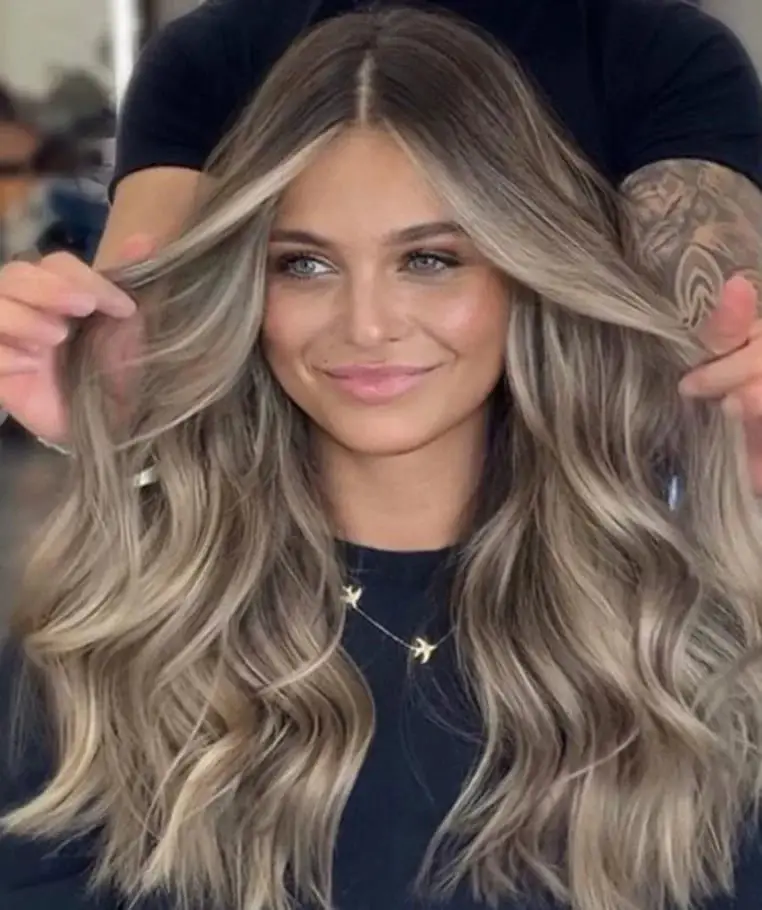
Photo credit: makeup.com
Solid blonde highlights demand a sharp root line that shows by week four. The blonde balayage on a dark brown base grows out as a shadow rather than a stripe, which is the difference between a calendar reminder and a suggestion. Thick, wavy hair at mid-back length with soft face-framing layers and curtain bangs carries the lived-in effect naturally. Ask your colorist for: dark brown base with blonde balayage, mid-back length, curtain bangs. A color-depositing conditioner in the shower keeps the warmth from veering orange. A trim every eight weeks keeps the ends clean.
Blonde Highlights On Darker Base Mid-Back Waves
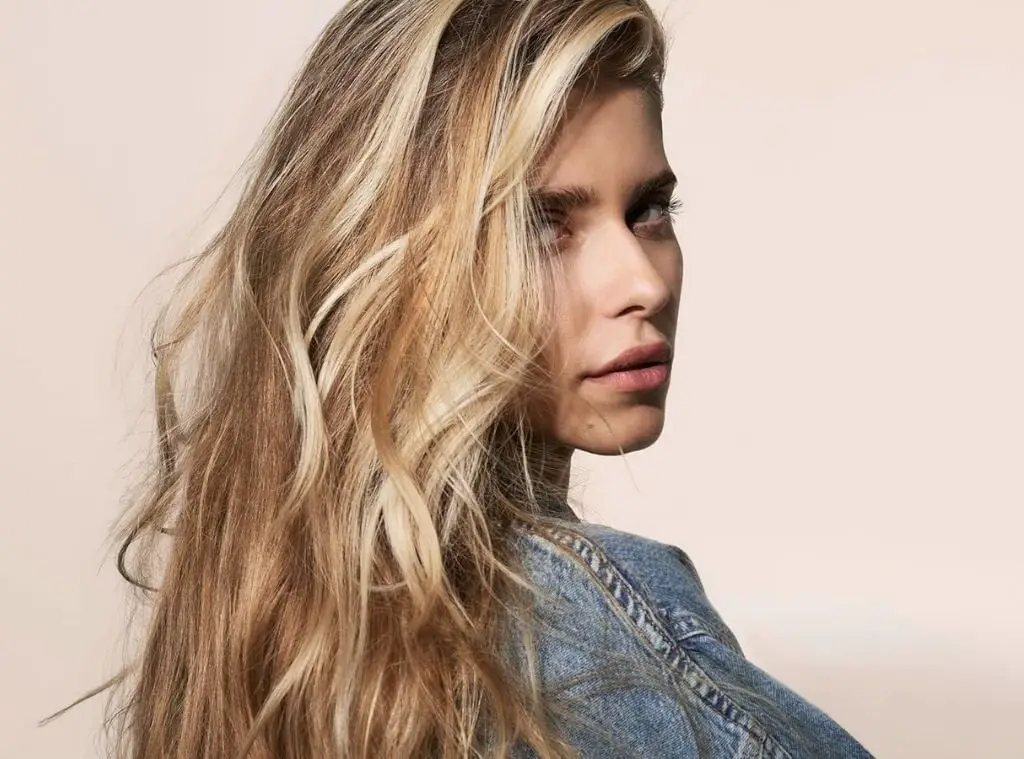
Image credit: eonline.com
Contrasting lighter blonde highlights against a darker blonde base gives dimension that a single-process shade cannot touch. Thick, wavy hair at mid-back length takes the lift without the color looking sparse. The darker base tends to warm up faster than the highlights, so a purple shampoo is not optional, it is the deal.
Ask your colorist for: lighter blonde highlights on darker blonde base, mid-back length waves. A volumizing mousse and a diffuser build the wavy blowout in under thirty minutes. The highlights need a toning appointment every five to six weeks to keep the contrast clean. If you cannot commit to that schedule, skip this one.
Dirty Blonde With Subtle Highlights Mid-Back Straight
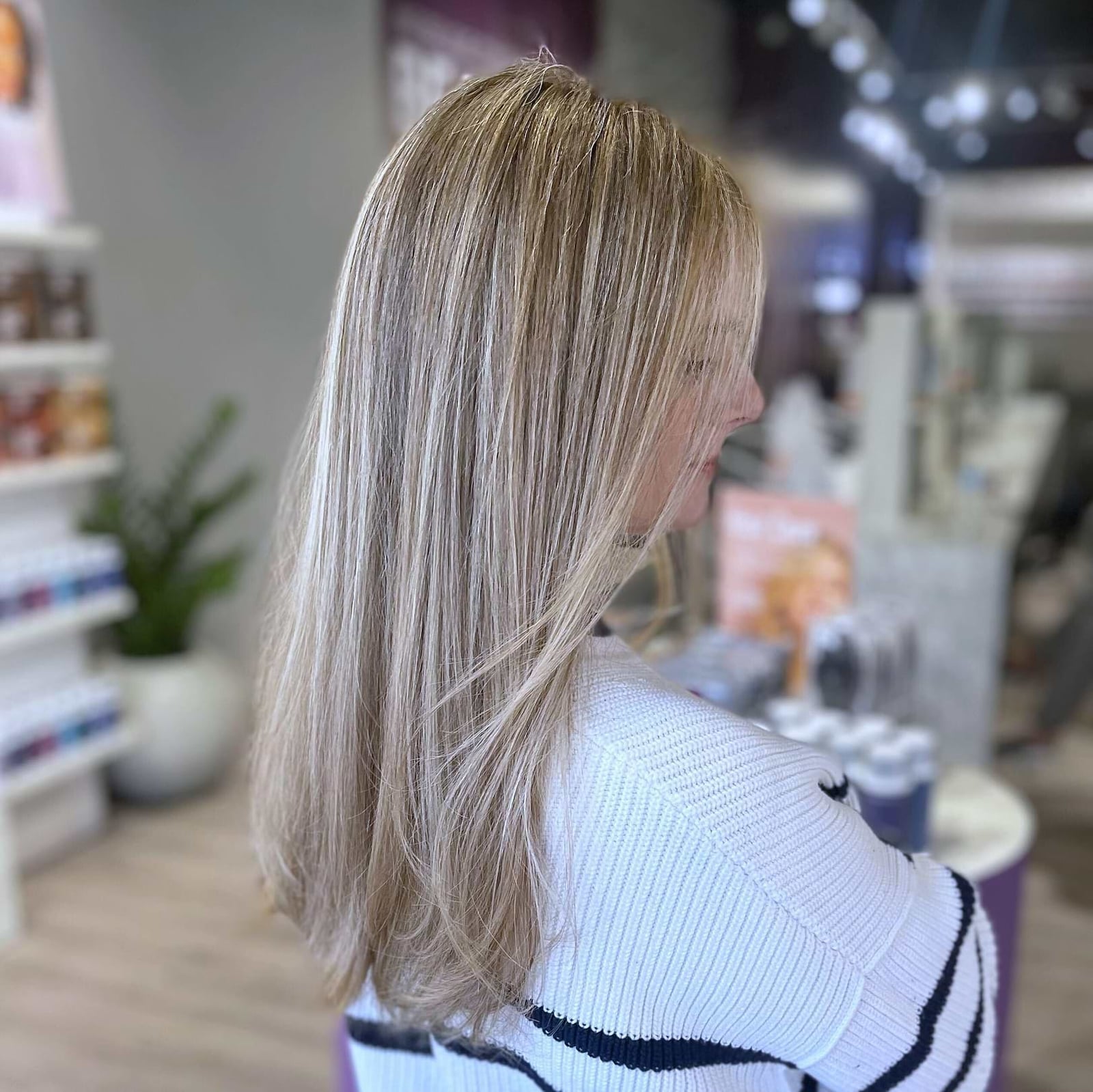
Via madison-reed.com
The dirty blonde base sits close to a natural level six or seven, so the finely woven highlights add dimension without a stark root line. Fine, straight hair at mid-back length benefits from the subtle lift; it stops the color from looking flat without weighing the strands down. The smooth blowout and middle parting keep the finish polished.
Ask your colorist for: dirty blonde with finely woven highlights, mid-back length, smooth blowout. A smoothing serum controls flyaways and keeps the shine. The grow-out is forgiving, so a toner every six to eight weeks is usually enough. A trim every eight weeks maintains the straight hemline.
Final Thoughts
Pick by upkeep first. Fine hair: ask for babylights or a soft balayage that blends into your base, and keep one blunt baseline so the ends still look full. Want more contrast? Go brighter and book a precise cut to hold the shape between visits.
- Tone every four to six weeks to hold the shade.
- Wash with a color-safe shampoo and conditioner.
- Deep condition weekly to keep shine.
- Book a gloss every six to eight weeks.
Blonde hair with highlights offers endless ways to express your style.
Hairstyle
20 Honey Balayage Hair Color Ideas 2027
Honey Balayage 2027 for hair color ideas. See 20 looks featuring golden brown with honey highlights and caramel honey balayage for brunettes.
Honey balayage paints warm gold and caramel tones through the mid-lengths and ends, hand-painted so the grow-out line stays soft. The technique has shifted toward lived-in color and glossy natural texture, with soft face-framing layers and curtain bangs doing the visible work instead of chunky highlights.
20 ideas here run from low-upkeep dark bases to brighter blondes, from chin-length bobs to long waves, for fine, thick, and coily textures alike. Honey Balayage suits round, square, and long faces once the length and layers are matched to the shape. Fine hair that falls flat and a fringe that will not sit both get a fix in the cut as much as the color.
Long Wavy Hair With Honey Balayage And Curtain Bangs
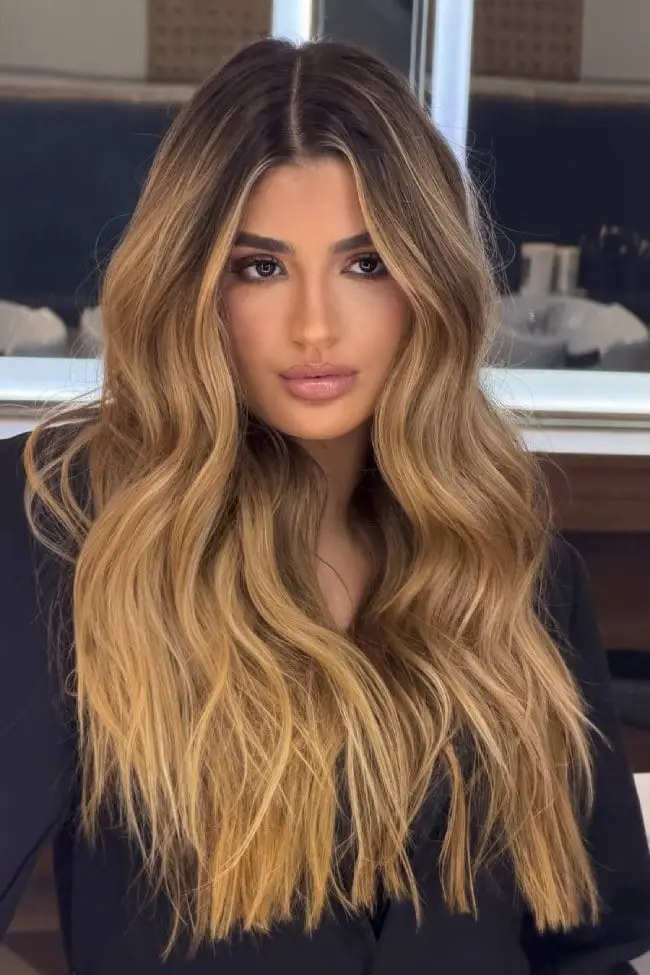
Courtesy of: itakeyou.co.uk
Ask your colorist for: mid-back balayage with soft layers and curtain bangs. Specifically, request that the lightener be painted closer to the roots around the face for a brighter, face-framing effect, while keeping the deeper color toward the back for dimension. The curtain bangs should be cut to blend into the layers, creating a soft, romantic finish.
Mid-Back Golden Brown With Honey Highlights
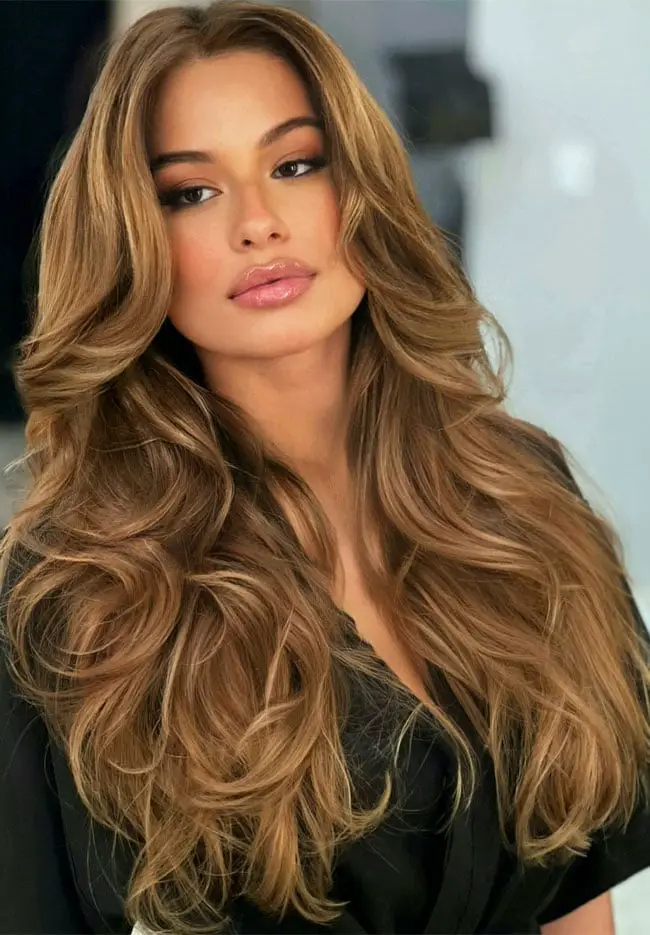
Photo credit: fabmood.com
If you are torn between a solid golden brown and a full honey balayage, this is the middle ground. The base stays a rich golden brown, but honey highlights are woven through the ends to add warmth and dimension. It is a more subtle take on the balayage trend, perfect for those who want color that looks natural and low-maintenance.
Thick, wavy hair at mid-back length shows off the texture and the honey tones. Ask your colorist for: golden brown base with soft honey highlights. To keep the waves looking their best, spritz on a texturizing spray after air drying. Plan to refresh the highlights every 8 to 12 weeks, as they grow out gracefully.
Layered Brunette With Caramel And Honey Balayage
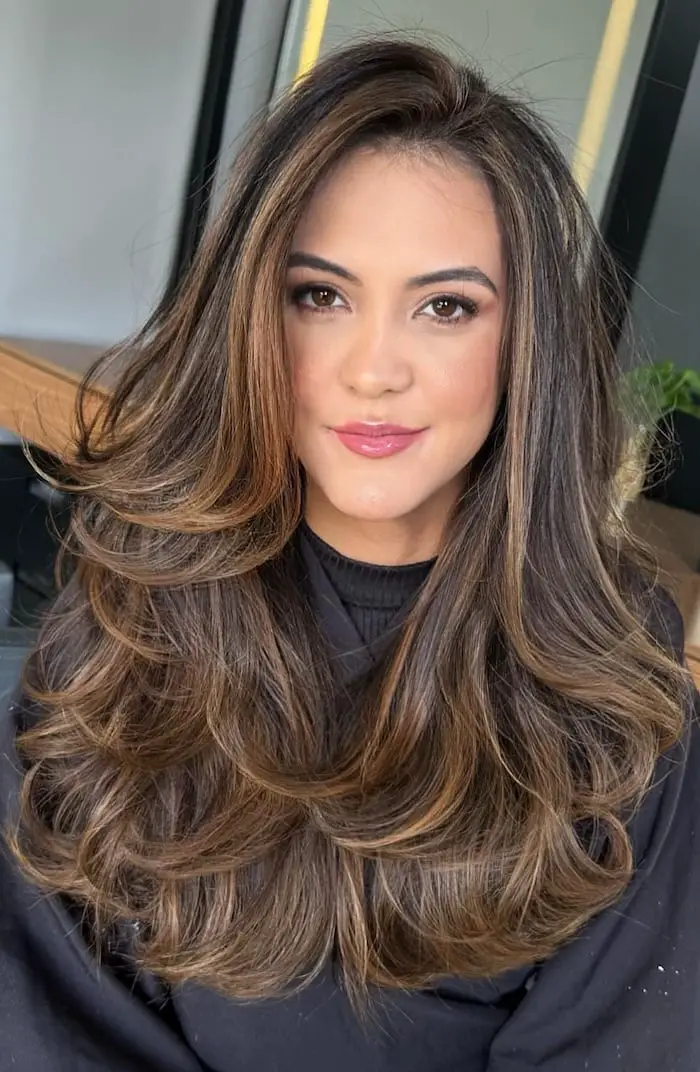
Image credit: itakeyou.co.uk
The technique here is a two-step process that builds depth. First, a caramel balayage is painted onto the hair to create a warm, rich base that contrasts with the natural brunette. Then, golden honey highlights are woven in at the top and around the face to brighten the overall effect. The result is a multi-tonal, voluminous look that moves with the hair.
Collarbone Lob With Honey Blonde Balayage
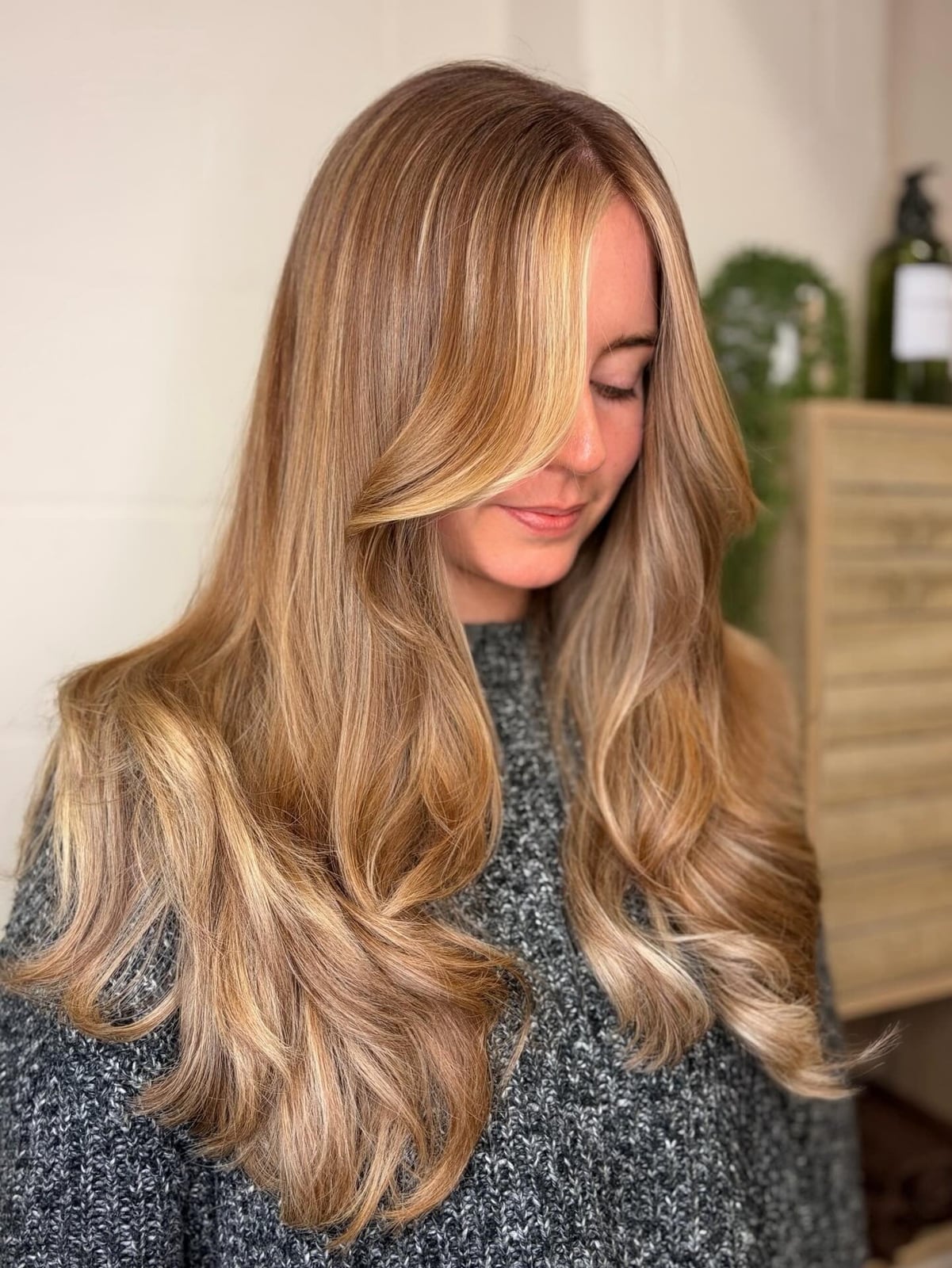
Source: creativebooster.net
Who should try this collarbone lob with honey blonde balayage? If you have thick hair and want to keep some length while adding movement, this is a solid choice. The soft waves and side-swept bangs work well on square and oval face shapes, softening the angles. The honey blonde balayage adds brightness around the face without overwhelming the base.
Blonde Base With Face-Framing Honey Blonde Balayage
Via itakeyou.co.uk
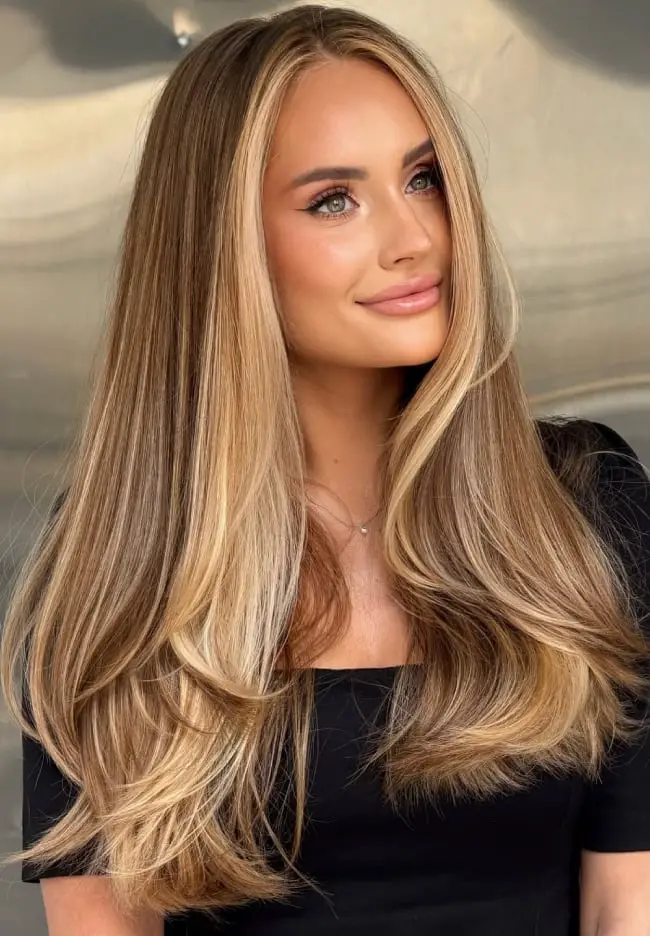
The bright honey blonde face-framing highlights are the first thing you notice, but the upkeep is the real story. On a blonde base, these lighter pieces around the face will need more frequent attention than the rest of the color. Ask your colorist for: blonde base with honey blonde face-framing balayage.
Plan for a touch-up every 6 to 8 weeks to keep those face-framing sections bright, as they tend to fade faster and show regrowth sooner. The rest of the mid-back length can go longer between appointments. A round brush blowout smooths the waves and shows off the glossy finish, but air drying with a texturizing cream works too if you’re short on time.
Long Blonde With Luxe Honey Blonde Balayage
Courtesy of: itakeyou.co.uk
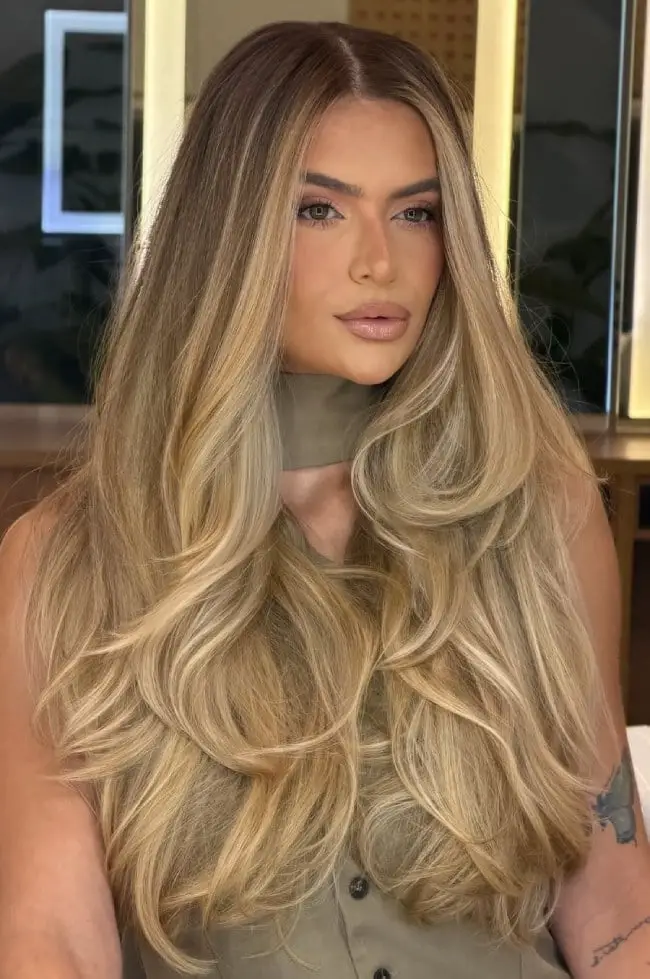
A blonde base with balayage painted through the lengths and finished with long layers gives the color somewhere to move. On thick, wavy hair the layers open up the shape so the honey blonde pieces show at every turn, not just at the ends. The blonde base stays as the anchor and the balayage builds the warmth on top.
Ask your colorist for: long blonde with luxe honey blonde balayage and long layers. This is a salon job from start to finish, since painting a consistent honey tone across a blonde base takes a trained eye and a few hours in the chair. The upkeep is the real commitment: a gloss every six to eight weeks keeps the tone from drifting, and a trim every eight to ten weeks keeps the long layers from collapsing into a heavy hem. Skip it if you want low-maintenance color, because blonde plus balayage means a standing appointment.
Medium Brown With Honey Caramel Face-Framing Layers
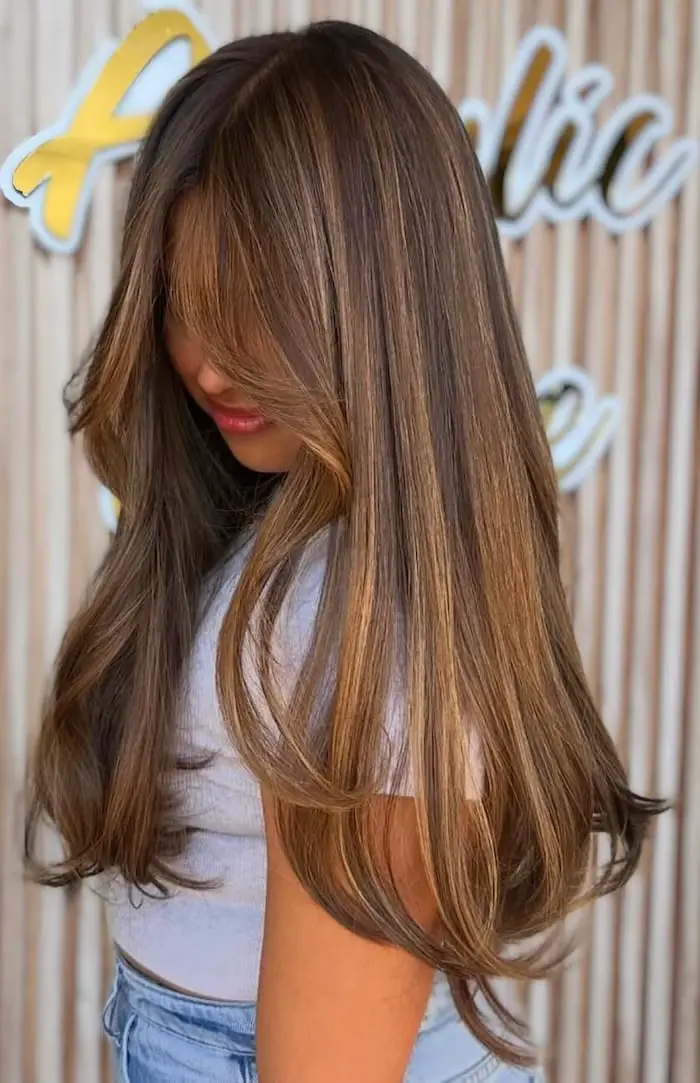
Photo credit: itakeyou.co.uk
Wondering whether warm color has a season? Honey and caramel balayage on a medium brown base reads especially well in autumn and early spring, when the light is softer and the two tones sit close enough to look natural. Mid-back length gives the balayage room to blend, and thick, wavy texture carries the face-framing layers and curtain bangs without going flat. Ask your colorist for: medium brown with honey caramel balayage, face-framing layers, curtain bangs. The layers do the shaping work around the jaw, which softens an angular face. A blowout with soft waves is all the styling this needs, and bangs want a trim every four weeks.
Thick Straight Hair With Golden Honey Balayage
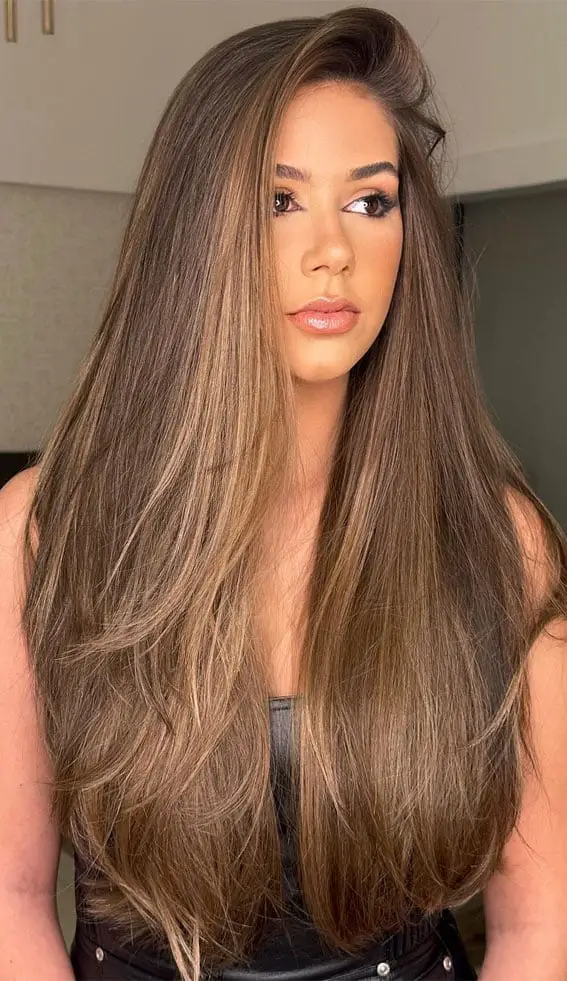
Image credit: toplink.com.br
Straight, thick hair shows every line of a color, which is why golden honey balayage here is painted in fine sections and blended low. The layers cut through the mid-back length so the gold catches at different depths instead of sitting in one stripe. On this texture the dimension stays subtle, and that subtlety is the hard part.
Ask your colorist for: mid-back straight hair with golden honey balayage and layers. A precise golden honey result on thick, straight hair is not a home project: the placement has to be even, because straight hair hides nothing and a patchy blend shows at eye level. Expect a salon visit, plus a gloss every six to eight weeks to keep the gold from going dull. Layers need a trim every eight to ten weeks. A smoothing serum and a flat iron finish the sleek look the cut is built for.
Buttery Blonde Base With Honey Balayage
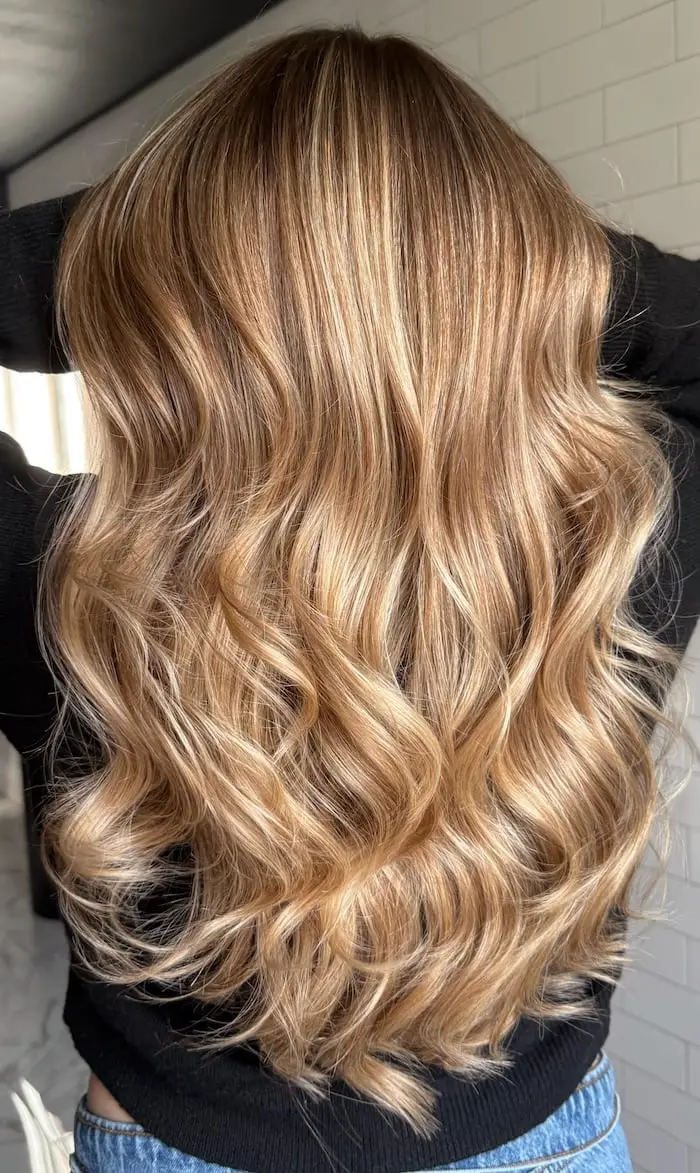
Source: fabmood.com
That narrow gap is also where the look goes wrong. The most common mistake is skipping the toner or letting it sit unevenly: a buttery base turns yellow fast, and honey over yellow reads brassy instead of warm. Ask your colorist for: buttery blonde base with honey balayage and long layers. Face-framing pieces suit oval and heart faces, and thick, wavy hair at mid-back length holds the loose waves this color wants. Book a toner every four to six weeks, because the buttery tone fades before the balayage does. Sea salt spray boosts the waves between washes.
Dark Brown Base With Honey Blonde Balayage
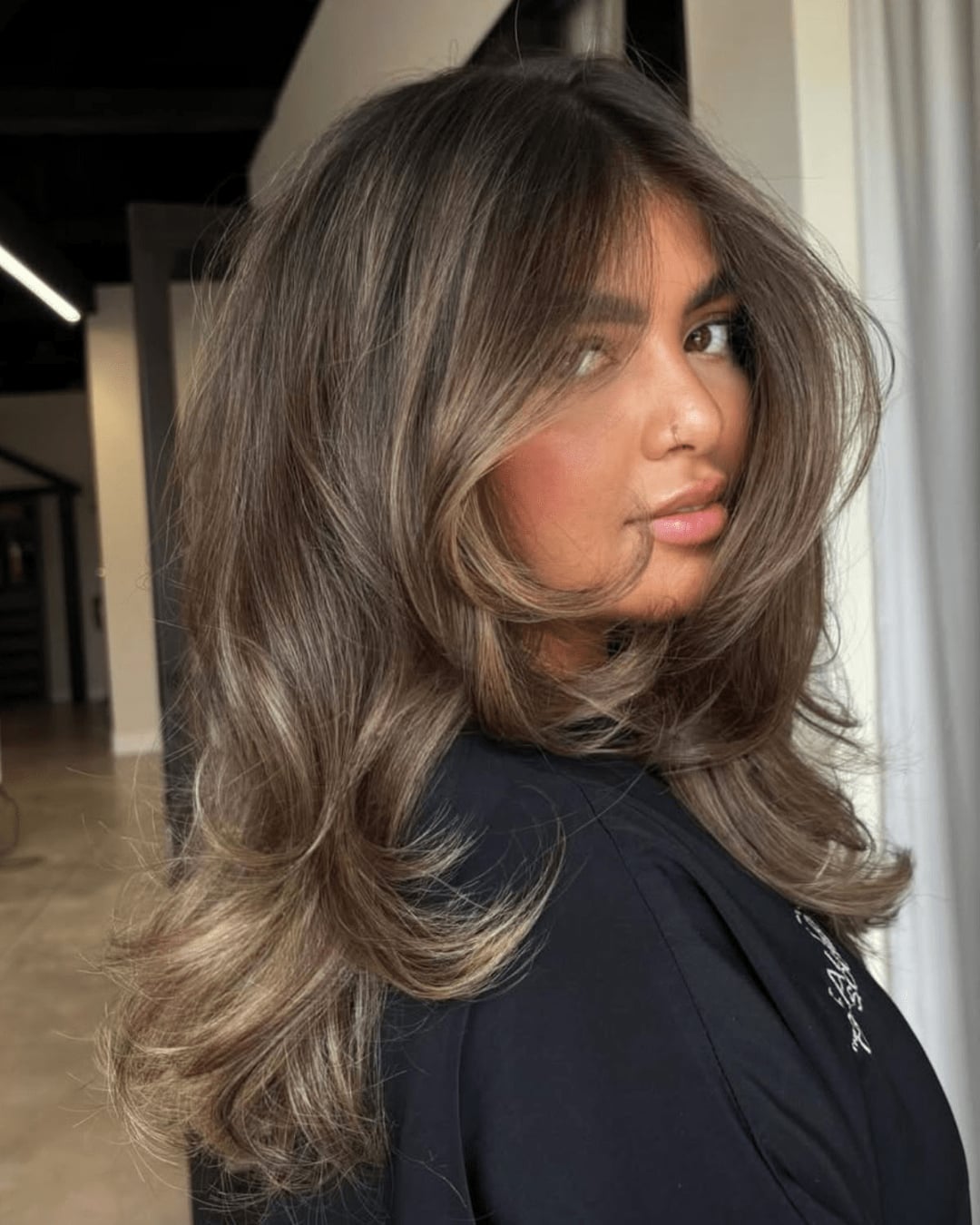
Source: haiirology.com
Honey blonde blends into dark brown without a hard line across the head through placement. The lighter pieces start lower on the dark brown base, well below the root, so the transition happens gradually through the mid-back length. Ask your colorist for:
- dark brown with honey blonde balayage
- face-framing layers
- curtain bangs
Request a low start with a soft root, since a high start creates the stripe. Thick, wavy hair carries the contrast well, and the curtain bangs soften an angular face. Color-safe shampoo keeps the honey from fading between appointments.
Mid-Back Partial Honey Balayage
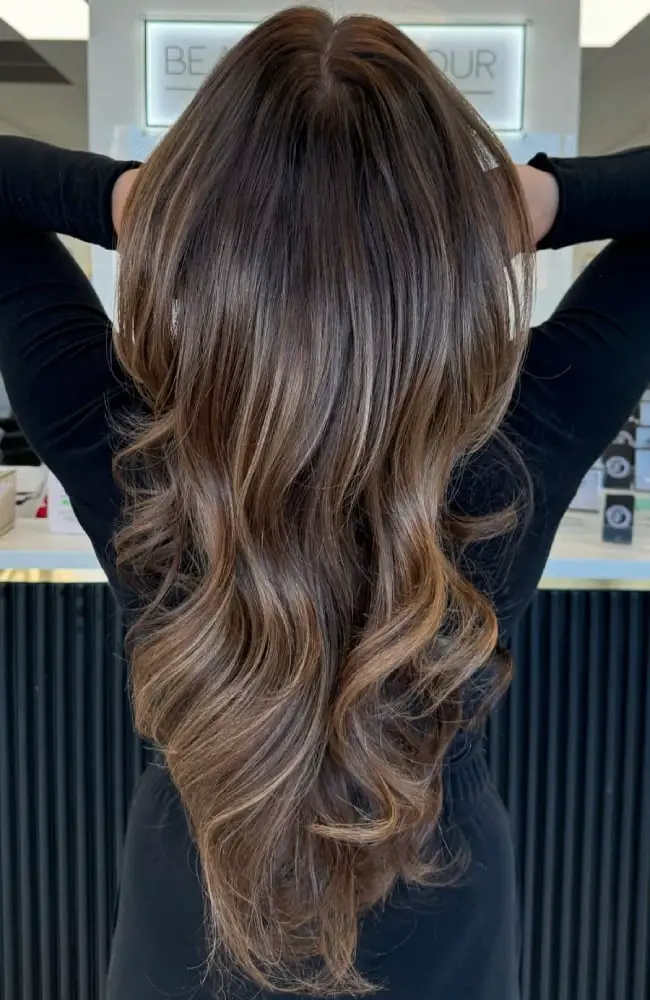
Via fabmood.com
A partial honey balayage skips the top section entirely, placing the lighter pieces from the mid-lengths down through the ends. That means the hair closest to your scalp stays your natural darker base, so the grow-out is softer and less obvious. This approach works best on thick, wavy hair at mid-back length seeking subtle dimension rather than a full color overhaul.
Ask your colorist for: mid-back partial honey balayage. The hand-painted sections are woven through the back and sides, leaving the crown untouched. Expect the tone to read warm and golden against the darker base. A toning gloss every 10 to 12 weeks keeps the honey from pulling brassy, and a leave-in conditioner helps the waves hold shape between washes.
Collarbone Lob With Honey Blonde Face-Framing
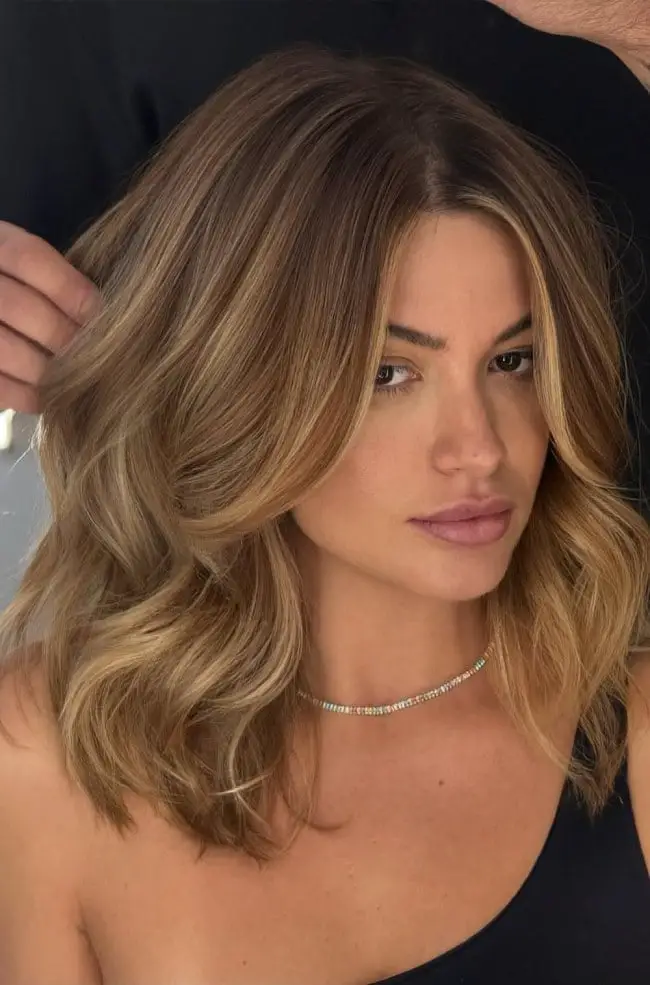
Courtesy of: fabmood.com
Wondering if honey balayage works on a shorter cut? On a collarbone lob, the color is most visible in the face-framing layers and curtain bangs, where the lighter pieces catch the most light. The honey blonde tones sit against a brunette base, so the contrast reads clear without being high-contrast. This setup suits medium density hair well, and the curtain bangs help soften round or square face shapes. Ask your colorist for: collarbone lob with honey blonde face-framing and curtain bangs. A flat iron smooths the lob in about ten minutes, and the bangs need a trim every four to six weeks to keep the shape.
Dark Brown With All-Over Honey Blonde Balayage
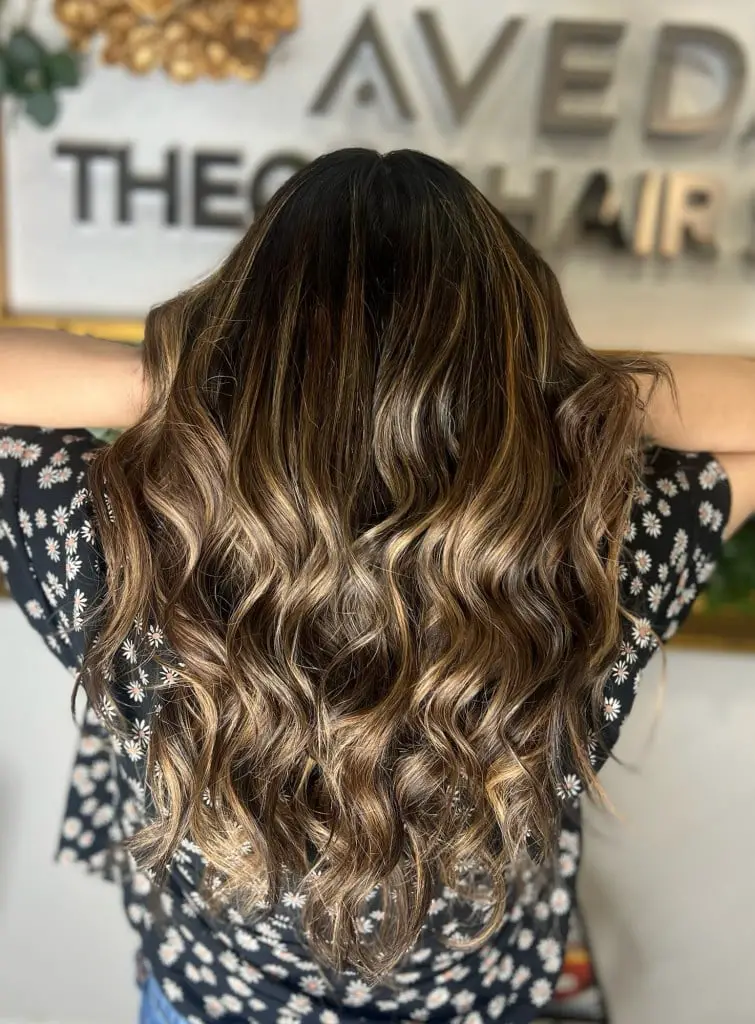
Photo credit: theoryhairsalon.com
An all-over honey blonde balayage on a dark brown base is a commitment to contrast. The lighter pieces are painted from the mid-lengths to the ends on every section, so the warm honey tones pop clearly against the deeper base. That means the grow-out is visible sooner compared to a partial technique, especially around the hairline and crown.
Ask your colorist for: dark brown base with all-over honey blonde balayage. The risk here is banding, where the color steps down in visible sections if the application is rushed. A color-depositing conditioner used every third wash keeps the warm tone from fading flat. Trim the ends every eight to ten weeks to prevent the lighter sections from looking ragged.
Long Layered Hair With Honey Balayage And Curtain Bangs, Mid-Back
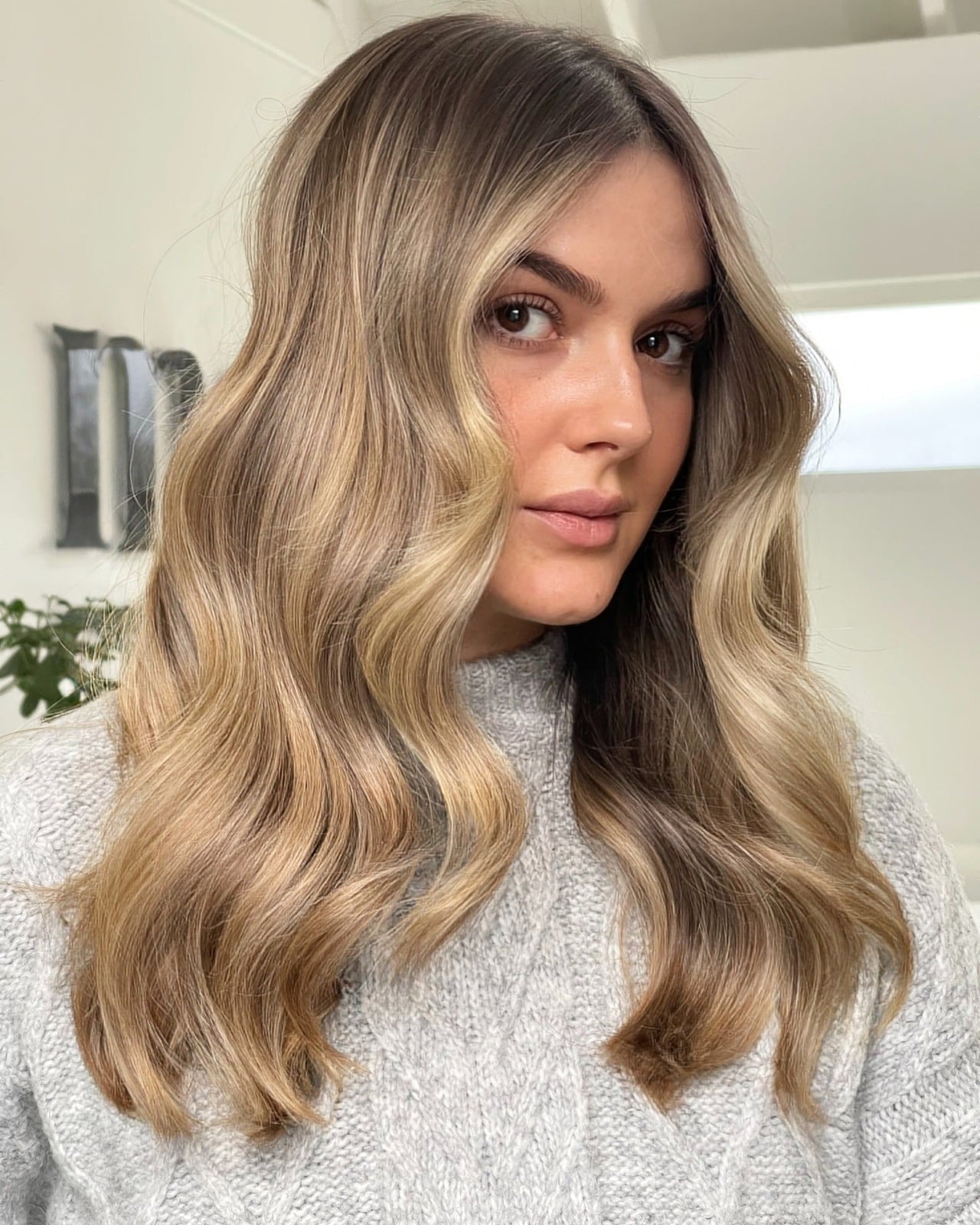
Image credit: creativebooster.net
A honey balayage with curtain bangs does something a standard all-over highlight cannot: it pulls the warm tone forward around the face, so the lighter pieces frame the features without needing to lighten the entire hairline. On long, layered hair at mid-back length, the curtain bangs blend into the longer layers instead of sitting as a separate section. This works for angular faces, as the soft pieces break up a strong jaw or forehead.
Ask your colorist for: long layered hair with honey balayage and curtain bangs. The honey blonde pieces are painted through the layers, not just the ends, so the dimension reads from the top of the bang down. A volumizing spray at the roots lifts the crown, and the bangs need a trim every four to six weeks to keep the curve.
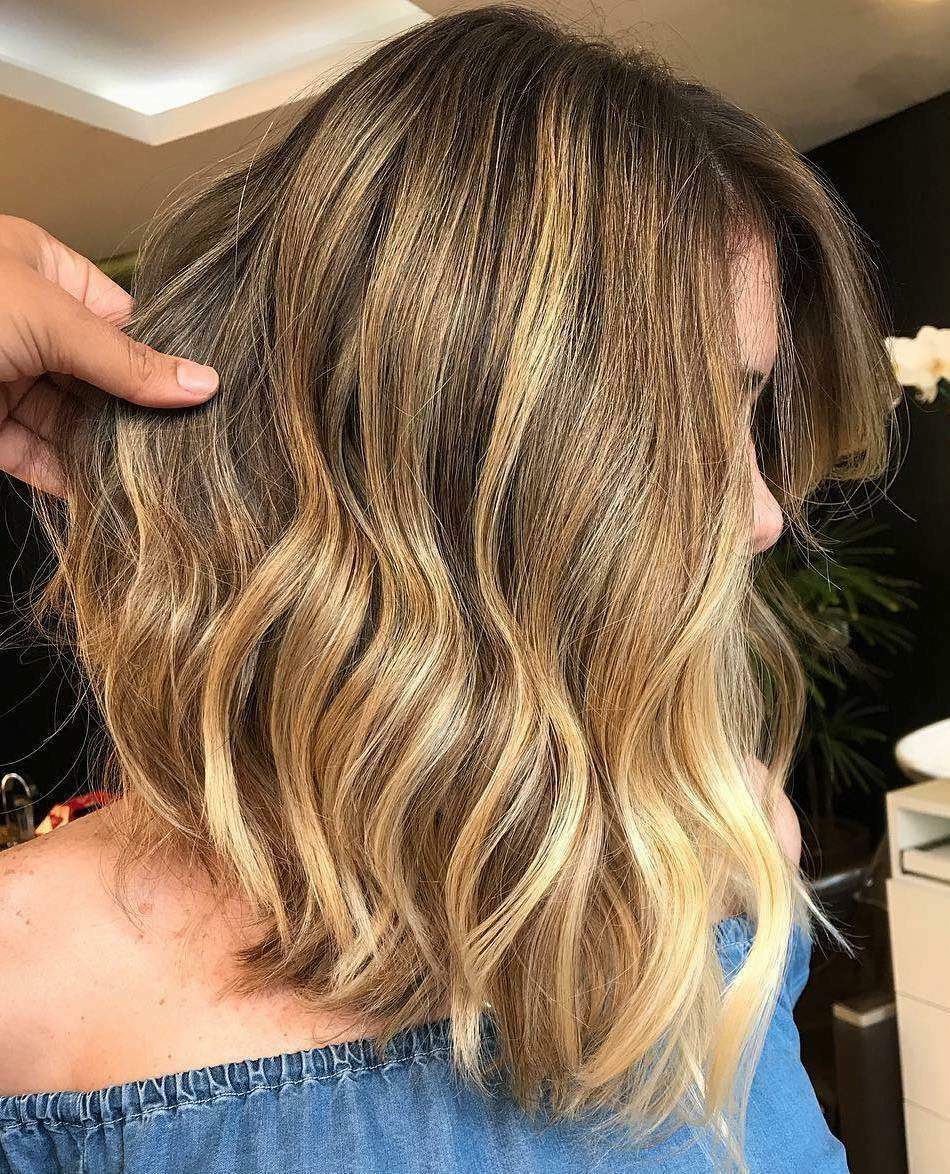
Shoulder Length Lob With Honey Balayage
Source: dollyluxuryhair.com
A shoulder-length lob with honey balayage is a salon-only situation. The hand-painted transition from warm brown base to honey blonde needs a colorist who can place the lighter pieces so they fall naturally through the shorter length. The honey tones require upkeep: a gloss every eight weeks to hold warmth and a trim every six to eight weeks to keep the lob shape. Ask your colorist for: shoulder length lob with honey balayage. On thick, wavy hair, the lighter pieces read as soft dimension rather than stripes. For a wash-and-wear routine, waves need only a light product.
Chin Length Bob With Honey Balayage
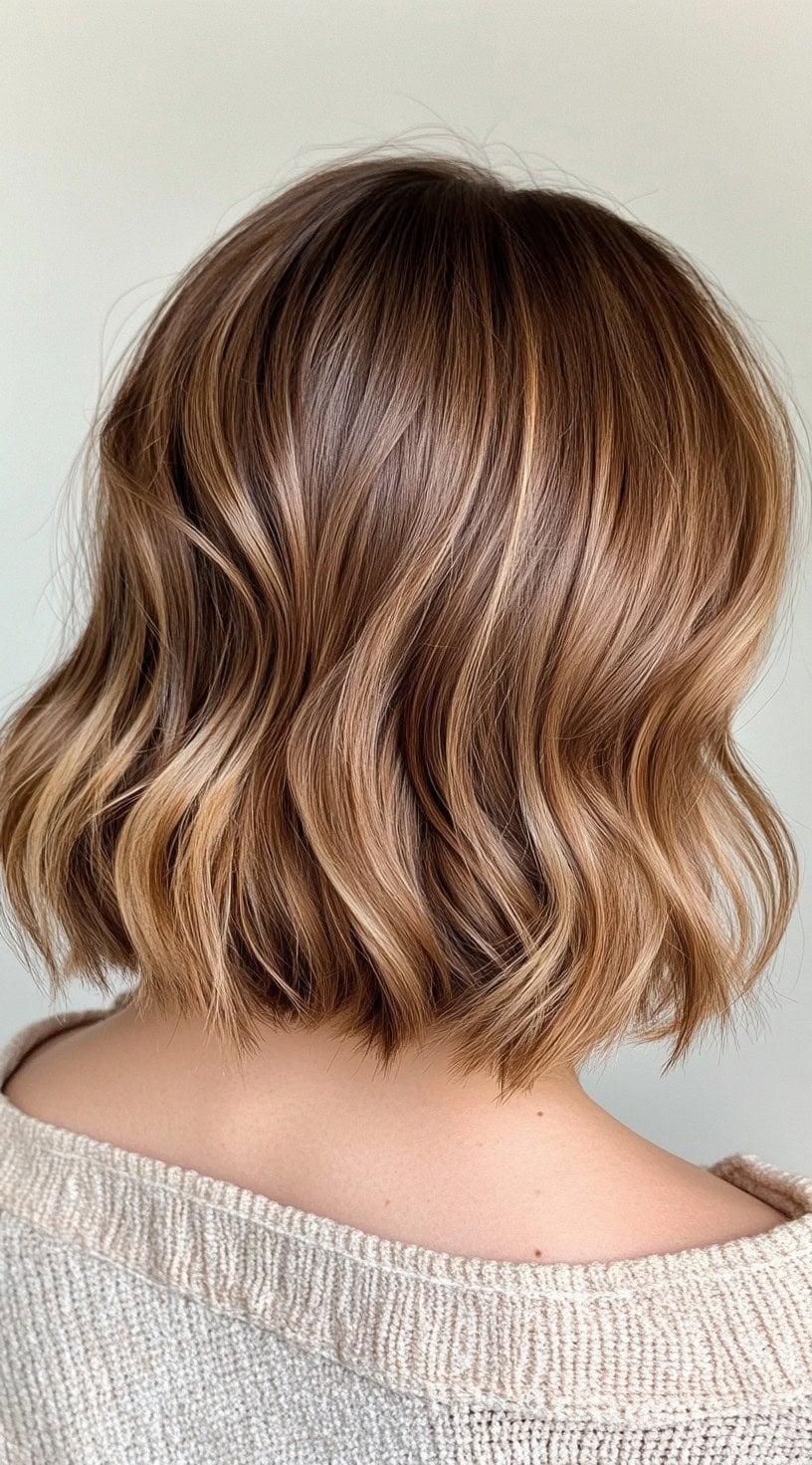
Can a chin-length bob carry balayage without looking striped? Yes, when the color sits close to a light brown base. The cut works best on medium-density hair that holds a wave, since fine hair at chin length can fall flat once the weight comes off. Round faces benefit from the blunt line and the way waves break up the width. Ask your stylist for: chin length bob with honey balayage. A trim every four to six weeks keeps the shape from growing into a mushroom, and the honey pieces stay subtle because they are placed on a base that is already close in tone.
Mid-Back Honey Brown With Lighter Balayage
Courtesy of: refinery29.com
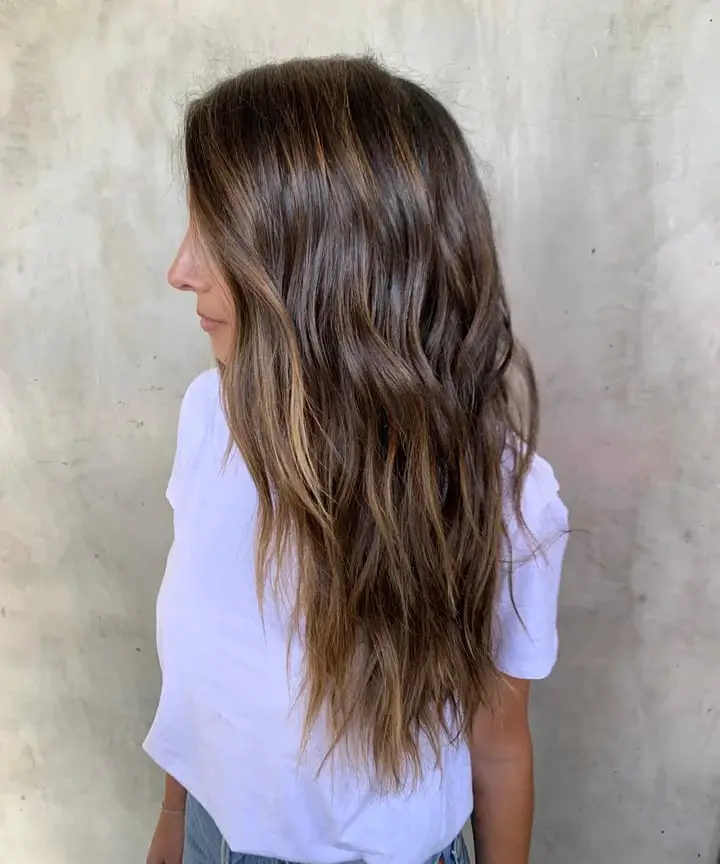
Layers do the work here, and the color follows the cut. A rich honey brown base carries lighter honey pieces painted through the mid-back length, so the dimension moves when the hair does. Air drying is the whole point: thick wavy hair left to dry on its own keeps that texture, and low heat helps the wave hold its shape without turning frizzy.
Upkeep is where this finish earns its keep. Because the base stays honey brown and the lighter pieces sit a few shades up, the grow-out line stays soft for months, and you can stretch a root touch-up to eight or ten weeks. Layers need a trim every eight to ten weeks to keep the ends from looking stringy. Ask your colorist for: honey brown base with lighter honey balayage, natural waves. The color is placed where the layers fall, so the lighter pieces sit on the movement instead of fighting it.
Collarbone Length With Honey Blonde Face-Framing Layers
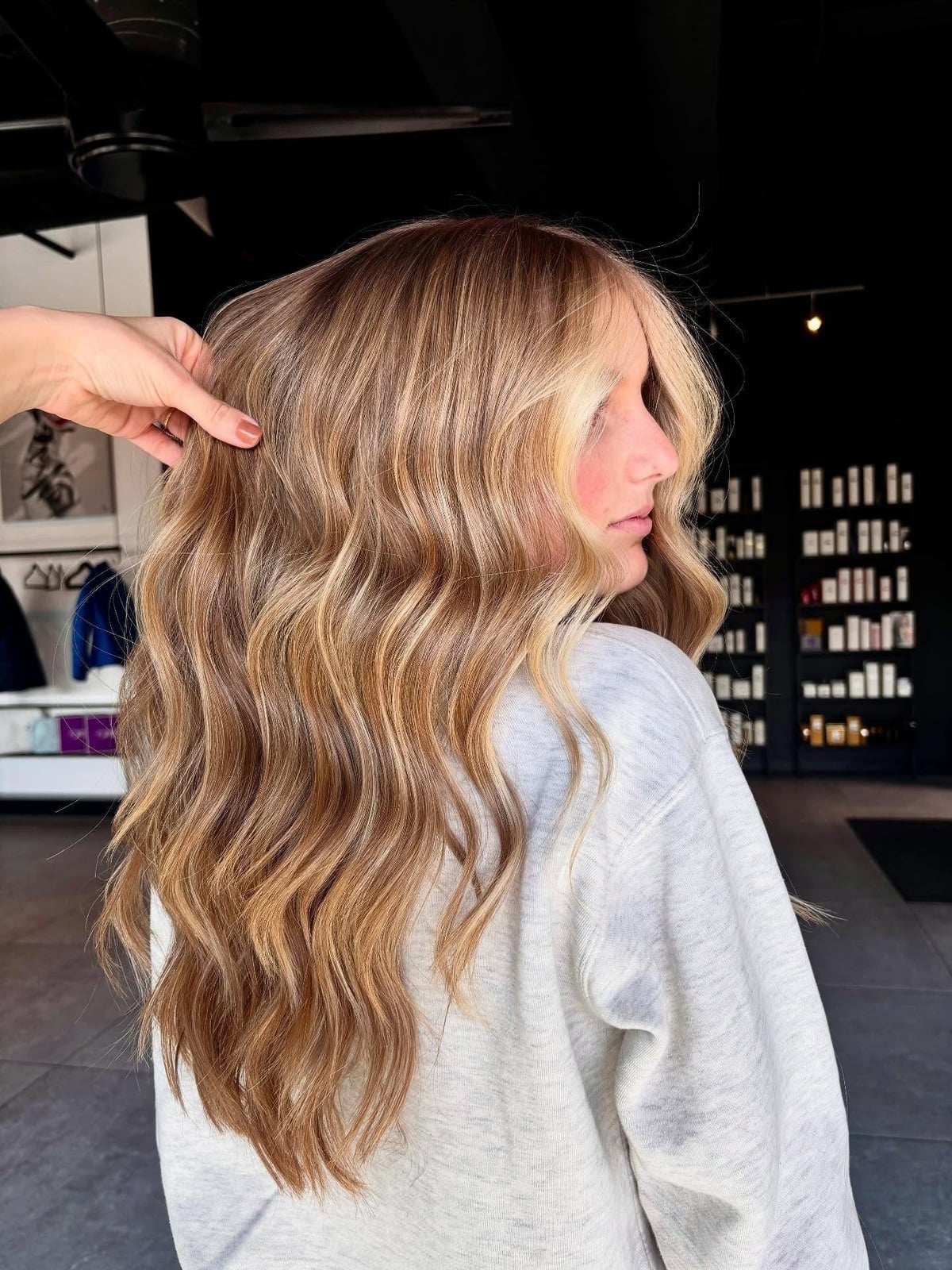
Photo credit: creativebooster.net
What do you actually say at the desk when you want color that starts quiet and builds? Start with the cut. Collarbone length keeps enough weight for thick hair to behave, and face-framing layers cut around the jaw soften an angular face. The color is a honey blonde balayage, subtle at the root and more pronounced toward the ends. Ask your stylist for:
- collarbone length
- honey blonde balayage
- face-framing layers
- a middle parting
- soft waves
Bring the words in that order and the consultation runs in minutes. The middle parting keeps the face-framing pieces balanced on both sides, and the soft waves stop the layers from reading as a hard line.
Shoulder Length Air Dried With Honey Blonde Balayage
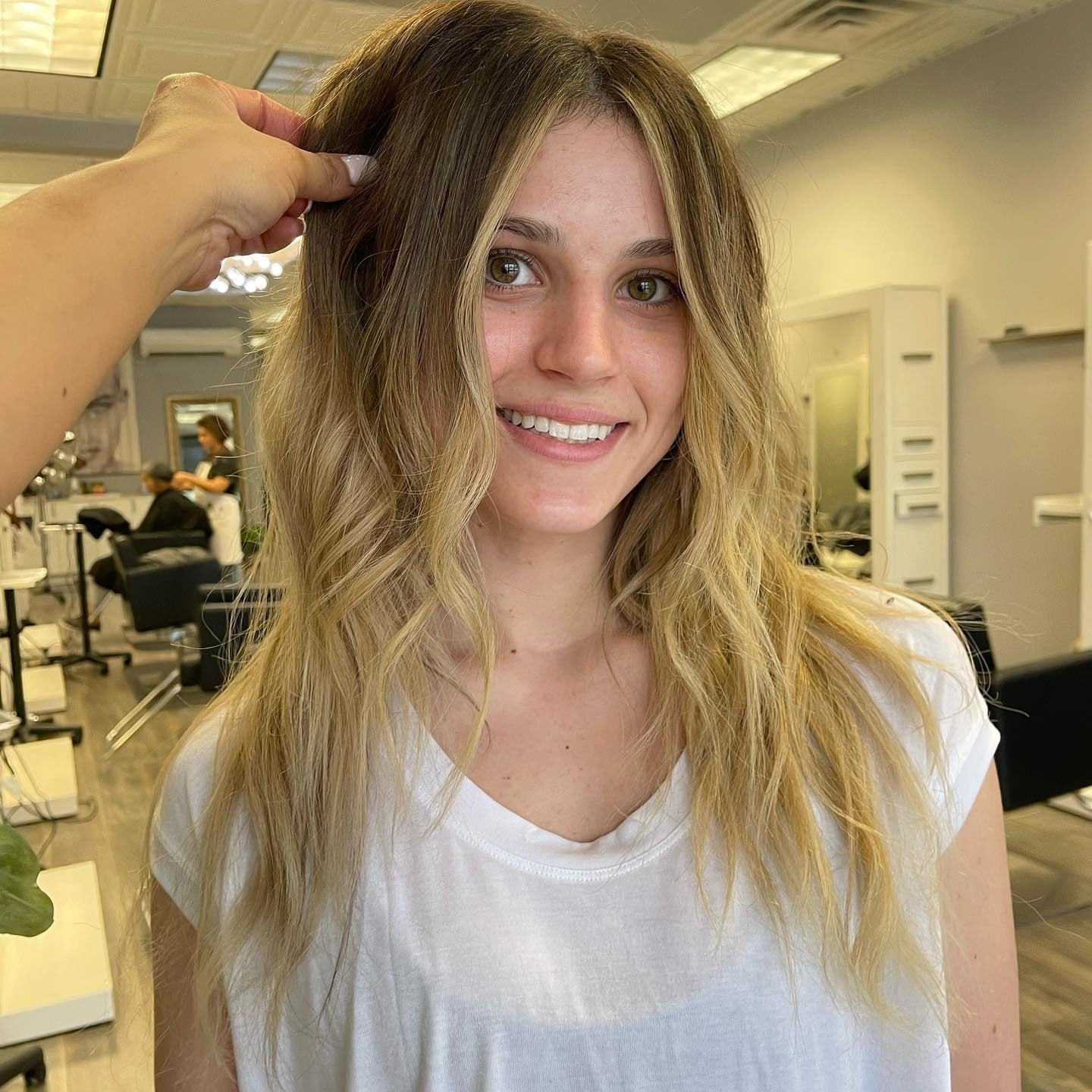
Image credit: creativebooster.net
The placement is what makes an air-dried finish work: honey blonde balayage painted through a medium brown base, with the lightest pieces sitting where the wave bends. On shoulder-length hair with medium density, that means the color starts a few inches below the root and travels through the layers, so the dimension shows up when the hair moves and stays quiet when it sits flat.
Wavy texture does the rest. A leave-in conditioner on damp ends and a few minutes of air drying give you the finish without a round brush, and the honey blonde pieces show their tone on the bends of the wave. Ask your colorist for: shoulder length air-dried hair with honey blonde balayage. A trim every eight weeks keeps the shoulder length from becoming a collar-length grow-out.
Mid-Back Dark Brown With Golden Honey Balayage, Wavy
Via fabmood.com
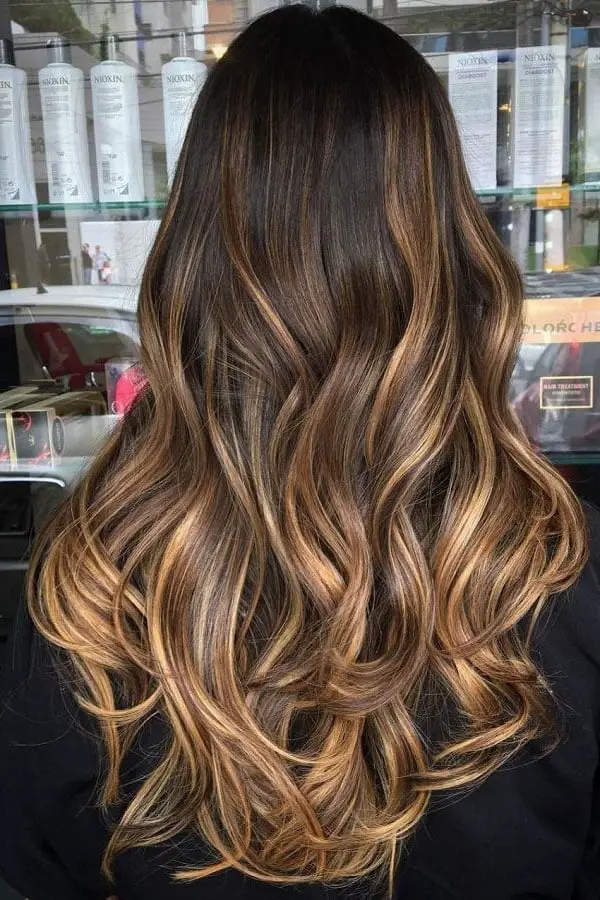
Is high contrast worth the chair time? On a dark brown base, golden honey balayage is the most dramatic version of the technique, and the most demanding. Lifting dark brown to a true golden honey means more than one session, because the ends need to reach that tone without going brassy. Thick wavy hair at mid-back length carries the contrast well: the layers give the golden pieces somewhere to sit, and the beach waves keep the whole thing from looking painted on.
Ask your colorist for: dark brown base with striking golden honey balayage. The drawback is real. That much lift on dark hair needs a toning appointment every six to eight weeks to keep the gold from drifting orange, and a glossing spray between visits helps the shine hold. If you want low-maintenance color, this is not the version to pick. If you want dimension you can see from across a room, it is.
Final Thoughts
For a low-maintenance honey balayage, opt for deeper, warmer tones blended into a darker base, which requires less frequent toning. Brighter, cooler honey shades on lighter bases will need more frequent touch-ups and toning.
- Toning is typically needed every 6-10 weeks to maintain the honey hue.
- Use sulfate-free shampoos to preserve color.
- Deep condition weekly to maintain shine and softness.
- Protect hair from heat with a thermal protectant spray.
- Allow 8-12 weeks for balayage grow-out before a refresh.
Embrace the warmth and dimension of honey balayage.
Hairstyle
20 Trendy Bob Haircuts with Bangs 2027 for a Fresh Look
Trendy Bob Haircuts with Bangs 2027 include layered bob with curtain bangs, blunt bob with straight bangs, and sleek chin bob styles.
A bob with bangs is a short cut, usually landing between the ear and the collarbone, finished with a fringe that changes the whole outline. The current version leans on soft face-framing layers and curtain bangs, with lived-in color and glossy natural texture replacing the flat-ironed finish of earlier seasons.
Below you get 20 Trendy Bob Haircuts with Bangs, from ear-length and blunt to collarbone and wavy, with the ask-for words, the styling time and the trim rhythm for each. It is built for fine hair that collapses by noon, thick hair that needs weight removed, and anyone who has watched a fringe refuse to sit straight. Find the one that matches your density and your morning patience.
Layered Bob With Soft Curtain Bangs
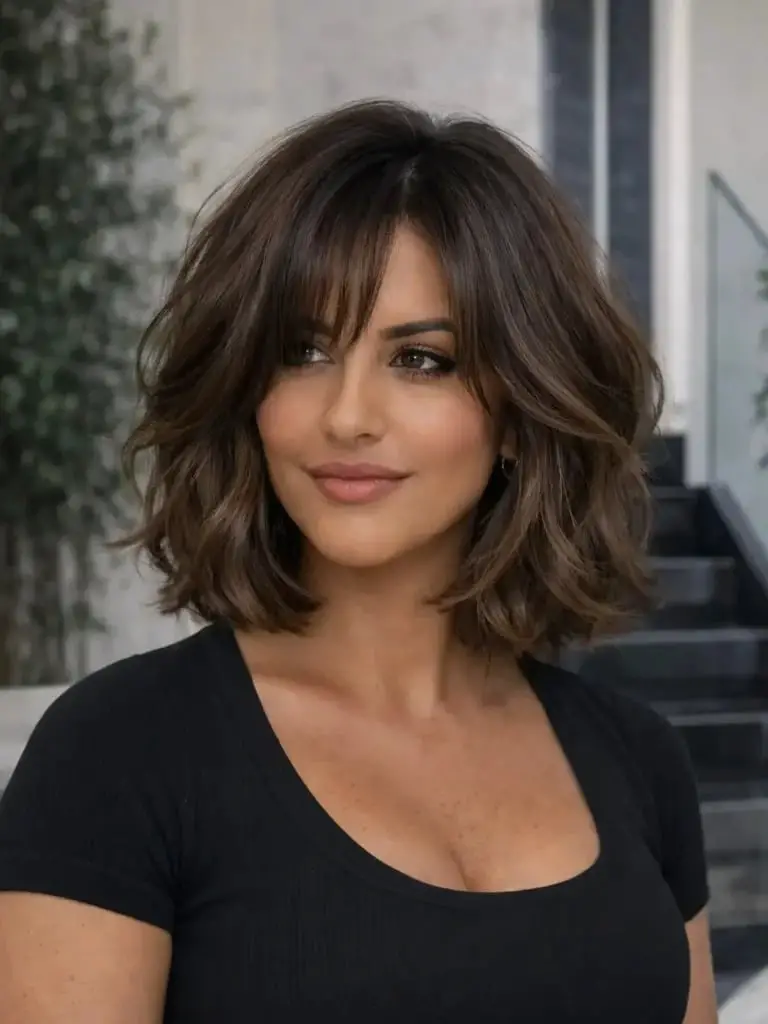
Courtesy of: instyluxe.com
Face-framing layers cut a soft path from the curtain bangs down to a collarbone-length bob. The loose waves and medium density give the shape volume without turning it into a helmet. This layered bob curtain bangs combo suits oval and heart-shaped faces best, and fine to medium hair holds the wave well. Curtain bangs soften a round face, and the length draws the eye down. Ask your stylist for: layered bob, collarbone length, soft curtain bangs. Round brush the fringe forward, then sweep it to the sides. Trim every six to eight weeks to keep the layers from collapsing into a single blunt edge.
Textured Chin Bob With Wispy Bangs
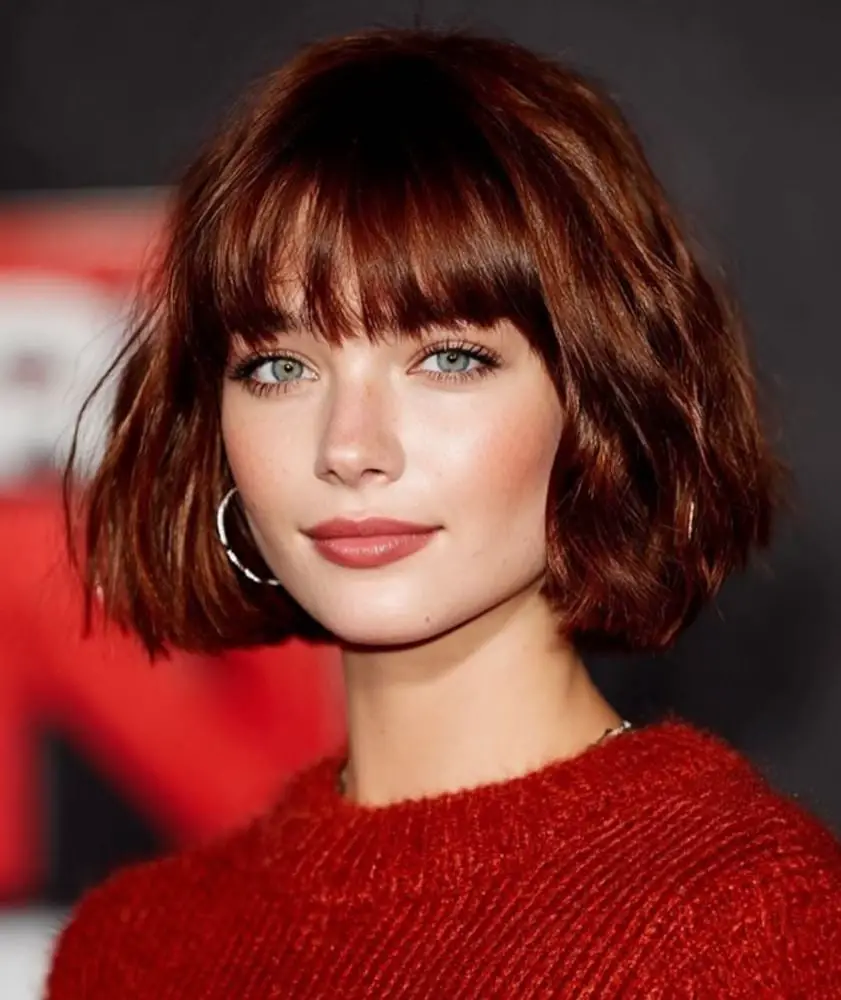
Photo credit: fabbon.com
What do you actually say to get that air-dried, piecey finish? Start with the length and the texture, then get specific about the fringe.
- A chin-length textured bob, not a blunt one.
- Wispy bangs that are deliberately piecey, not a uniform block.
- Enough texture to look air-dried, even if you blow-dry it.
Ask your stylist for: textured bob, chin length, wispy bangs, air-dried finish. Wispy bangs suit most face shapes, and fine wavy hair in a reddish brown takes the texture without looking fussy. The cut does the styling work here, so a texturizing spray on damp hair is enough.
Ear Length Blunt Bob With Straight Bangs
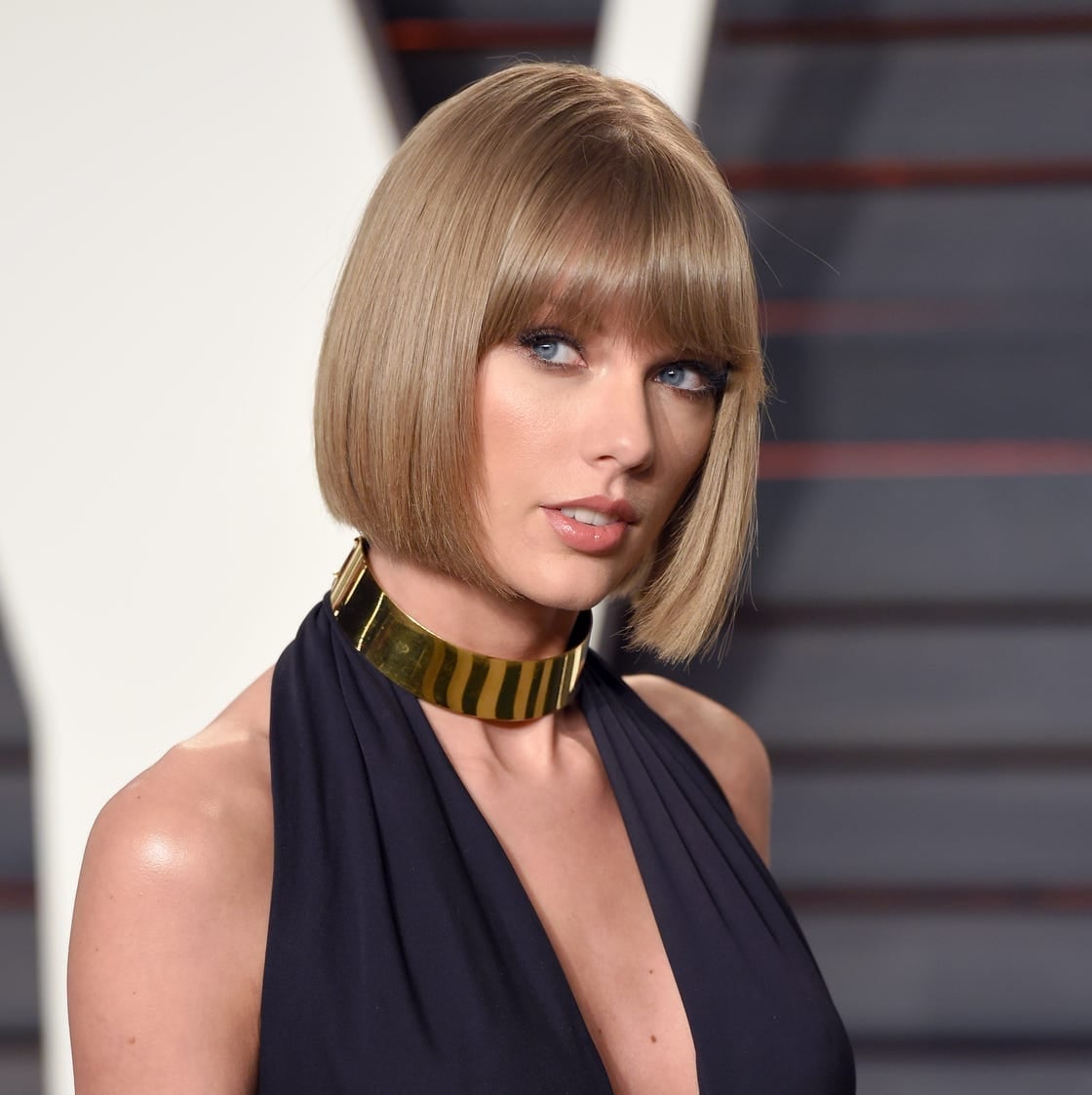
Image credit: cosmopolitan.com
An ear-length blunt bob with straight-across bangs is a graphic choice, and ash blonde fine hair shows every sharp edge. It suits fine, straight texture that holds a smooth blowout, and the blunt fringe can accentuate a strong jawline. Ask your stylist for: ear length blunt bob, straight across bangs. There is no room for a ragged edge at this length, so a trim every six to eight weeks keeps the perimeter clean. Skip it if you need a cut that forgives a missed appointment.
Collarbone Bob With Honey Balayage
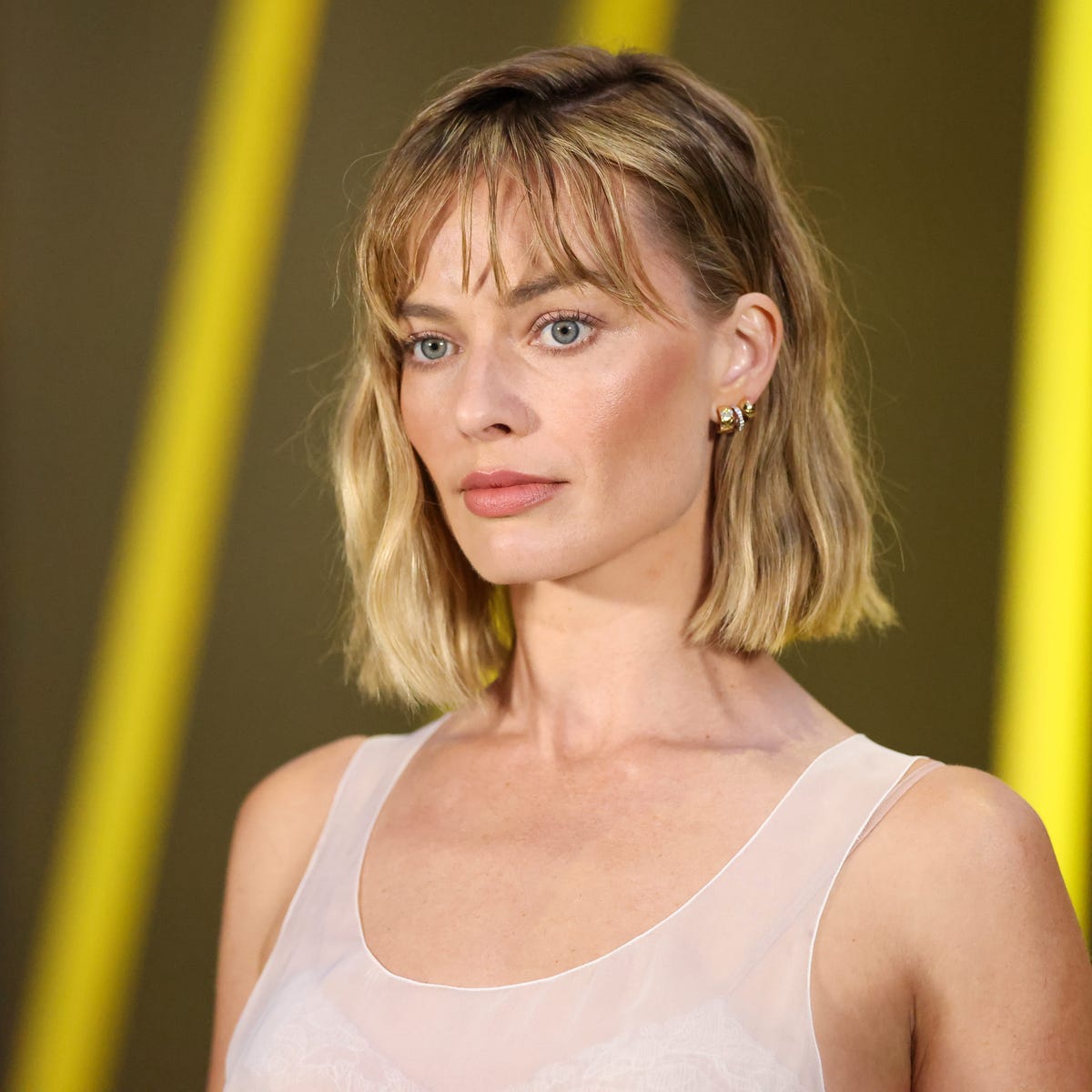
Source: harpersbazaar.com
Honey blonde balayage on a collarbone bob is built by painting the lighter tone through the ends, so the root stays dark and the grow-out line stays soft. The placement matters more than the shade: keep the transition blended and the curtain bangs stay face-framing instead of striped. Fine to medium wavy hair carries the loose, natural texture well, and curtain bangs soften a square face. Ask your colorist for: honey blonde balayage, soft transition. Ask your stylist for: collarbone bob, curtain bangs.
For daily wear, a sea salt spray on damp hair and a scrunch is enough to bring the wave back. Balayage touch-ups land every twelve to sixteen weeks, which is the quiet advantage of a painted technique over a full head of foils. A trim every eight to ten weeks keeps the collarbone line from turning into a shoulder-length grow-out.
Sleek Chin Bob With Blunt Bangs

Via fabmood.com
A chin-length bob cut poker straight with blunt bangs is a precise line. Fine, straight hair in dark brown holds the sleek finish best, and blunt bangs suit oval and long faces. Ask your stylist for: chin length sleek bob, blunt bangs. The drawback is daily: this finish needs a flat iron and a smoothing serum most mornings, and any stray hair breaks the line. A trim every six to eight weeks keeps the bangs sitting flat. Worth the effort if you like a sharp edge, a chore if you do not.
Black Collarbone Bob With Soft Waves
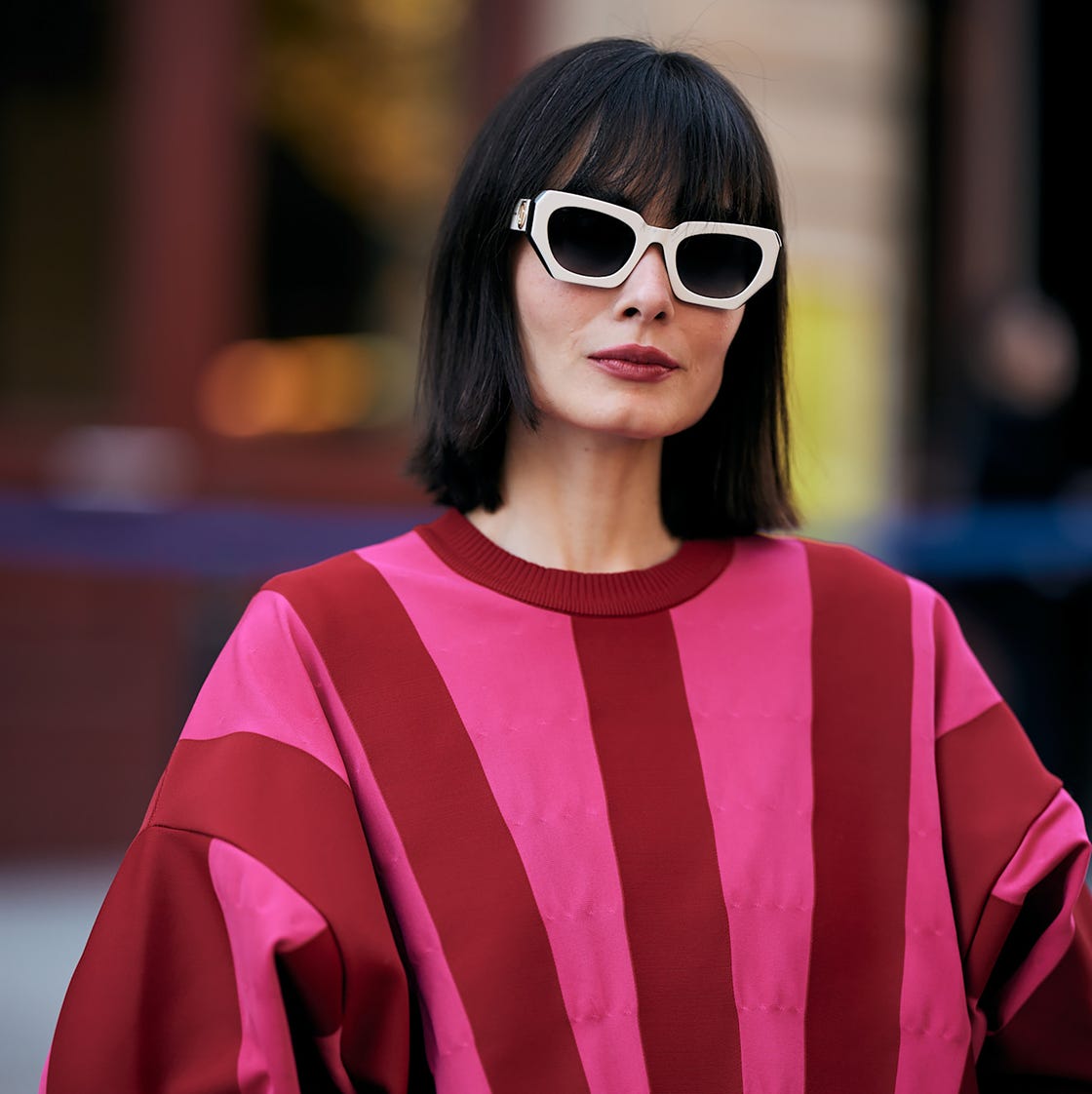
Courtesy of: elle.com
Can a collarbone bob keep soft waves without a round brush marathon every morning? On medium, straight hair, that finish will not appear on its own. Ask your stylist for: collarbone bob, soft waves, curtain bangs. The curtain bangs are cut to blend into the collarbone length at the middle part, so the front and back read as one shape. Wash-and-go gives you a straight bob; the waves come from a large barrel curling iron, worked section by section, or overnight rollers if you plan ahead. Budget ten minutes for styling. A trim every eight to ten weeks keeps the ends from drooping and the bangs from grazing your lash line.
Pink Chin Bob With Sleek Bangs
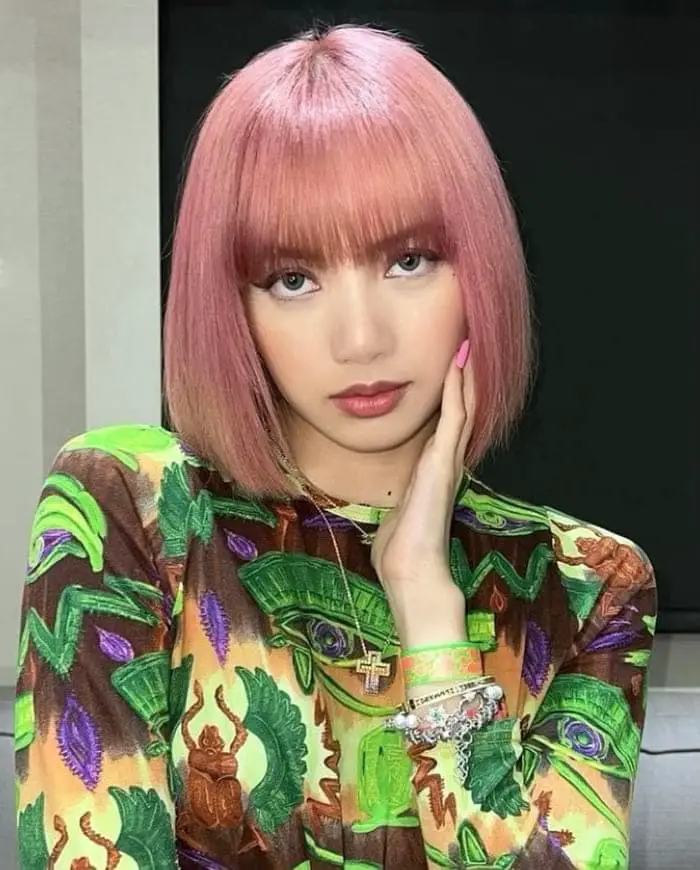
Photo credit: hairstyleonpoint.com
A jet black chin bob plays it safe; vibrant pink does the opposite. The chin length and blunt bangs stay sharp and polished, straight and smooth to the ends, which keeps the color from tipping into novelty. Fine, straight hair holds this finish best, since it lies flat with a pass of a flat iron. It also fits the season when holiday parties call for something with a little more nerve than a standard bob. Ask your stylist for: chin length bob, blunt bangs, vibrant pink. Keep a color-depositing conditioner in rotation to stretch the shade between salon visits, and book a trim every six to eight weeks to hold the blunt line.
Dark Brown Chin Bob With Side Bangs

Image credit: itakeyou.co.uk
The side parting breaks up the width of a thick bob and gives the smooth blowout somewhere to fall. Thick, straight hair at chin length is the right starting point, because the density holds the shape without layers collapsing by lunch. Side-swept bangs soften a square or round face, and the dark brown keeps the finish clean. Ask your stylist for: chin length bob, side-swept bangs, smooth blowout. Fine hair tends to fall flat at this length. Use a round brush to direct the bangs off the forehead, and book a trim every eight to ten weeks.
Collarbone Bob With Dark Highlights
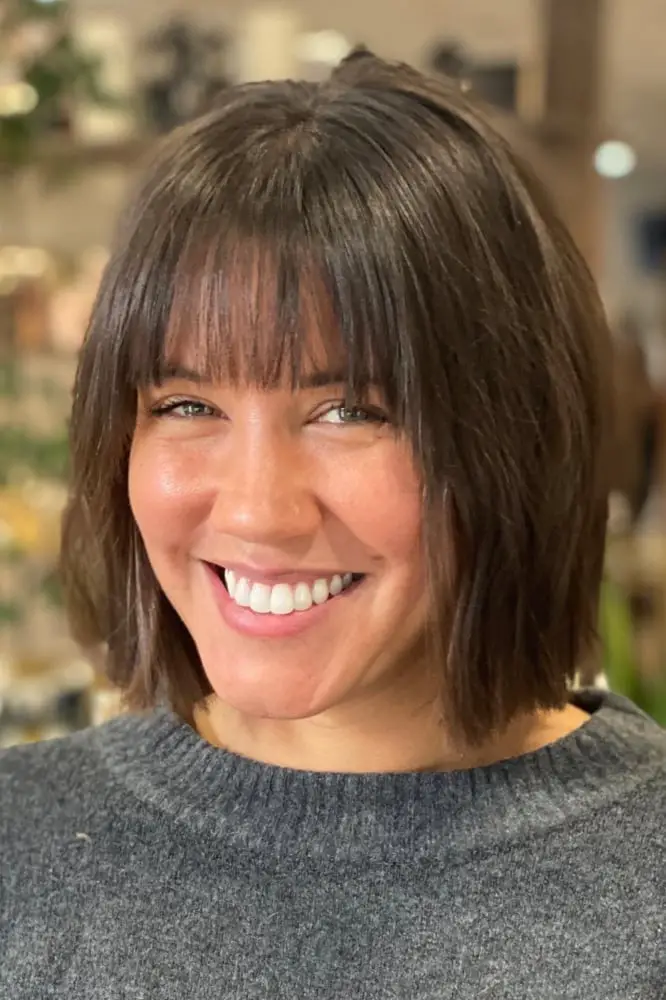
Source: fabbon.com
Order curtain bangs long enough to merge with the collarbone length, not to sit as a separate fringe. That is the mistake that undoes this cut: bangs chopped too short leave a gap between the fringe and the loose waves below, and the whole shape looks pieced together. The subtle lighter highlights through dark brown add dimension without a visible root line, and medium density wavy hair carries the collarbone length well. Ask your stylist for: collarbone bob, loose waves, curtain bangs, subtle highlights. A middle part keeps the bangs symmetrical. Work a texturizing spray through dry hair on day two, and book a trim every eight to ten weeks to keep the ends from weighing the waves down.
Ear Length Textured Bob
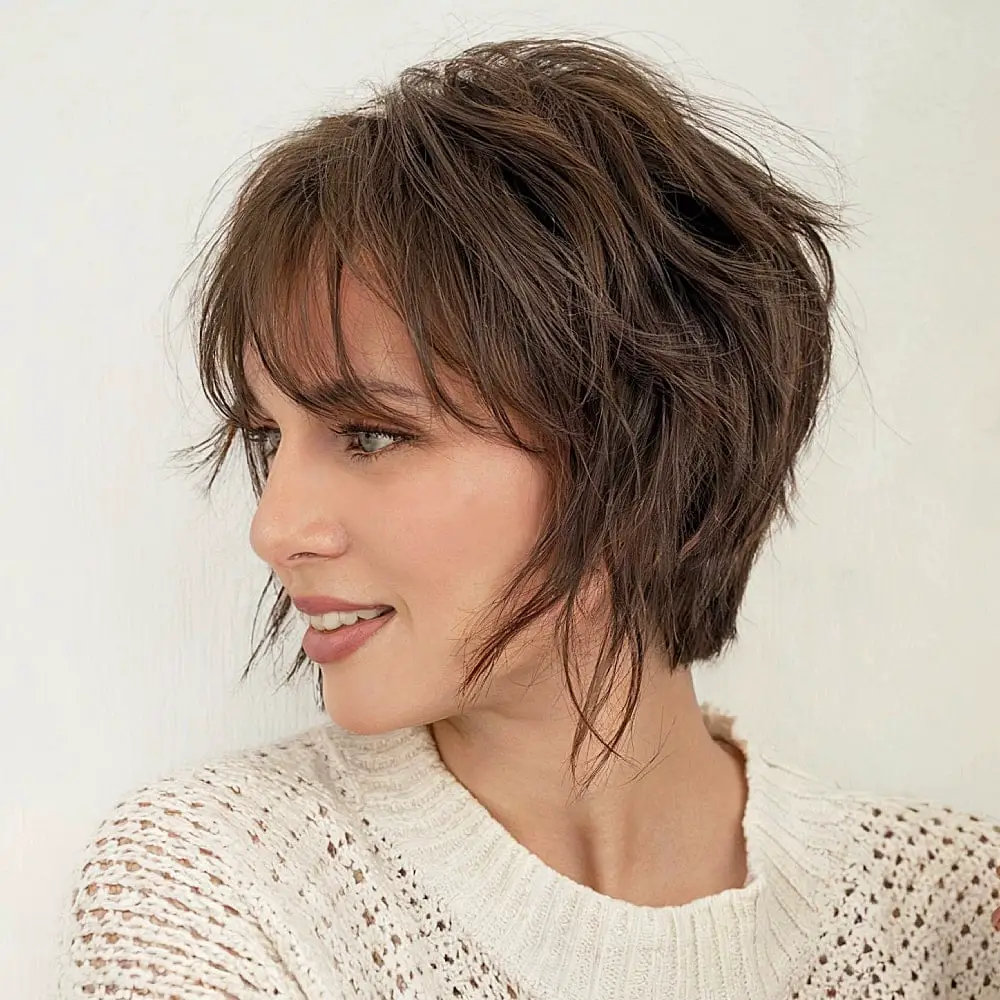
Source: latest-hairstyles.com
Can you cut an ear length textured bob at home? The wavy body, yes, roughly. The wispy bangs, no. Those piecey ends need a side parting and a practiced eye, or they land crooked and too short to fix. Fine wavy hair suits this length, since the texture supplies the lift that fine hair loses below the chin, and the dark brown picks up subtle tonal variation through the layers. Ask your stylist for: ear length textured bob, wispy bangs. At home, rough-dry, then work a texturizing paste through the ends and tousle. A trim every six to eight weeks keeps the shape from growing into a helmet.
Japanese Bob With Blunt Bangs
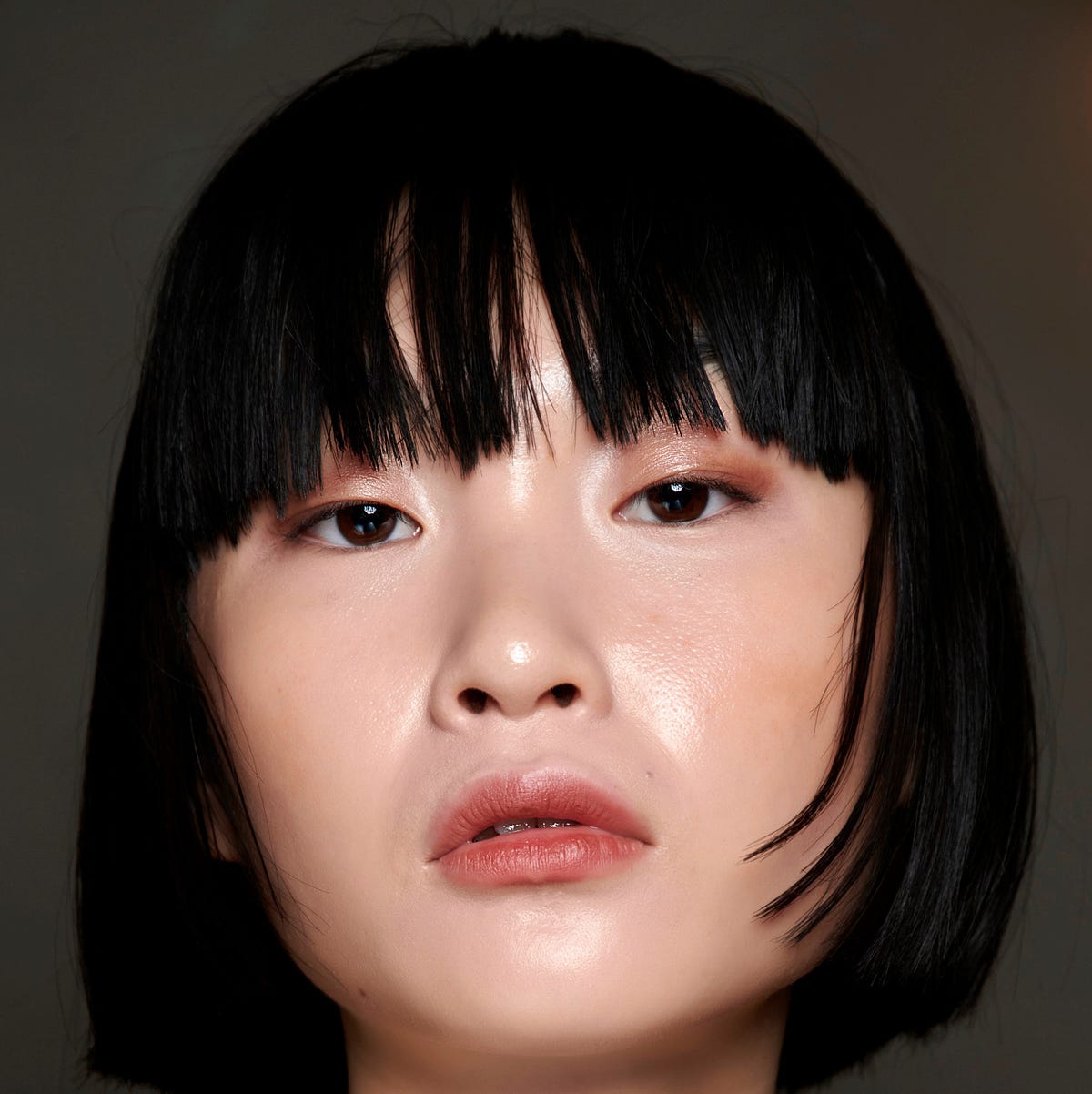
Via elle.com
The geometry is the point: a chin-length Japanese bob with blunt bangs and a dead-center part, cut to absolute precision. The thick, poker-straight texture is what makes the sharpness possible, so thinner hair may struggle to hold the same angular line. Ask your stylist for: chin length Japanese bob, blunt bangs, poker straight. A ceramic flat iron and a drop of anti-frizz serum are required for the mirror finish, and a trim every six to eight weeks keeps the ends from losing their edge.
Collarbone Shag Bob With Curtain Bangs
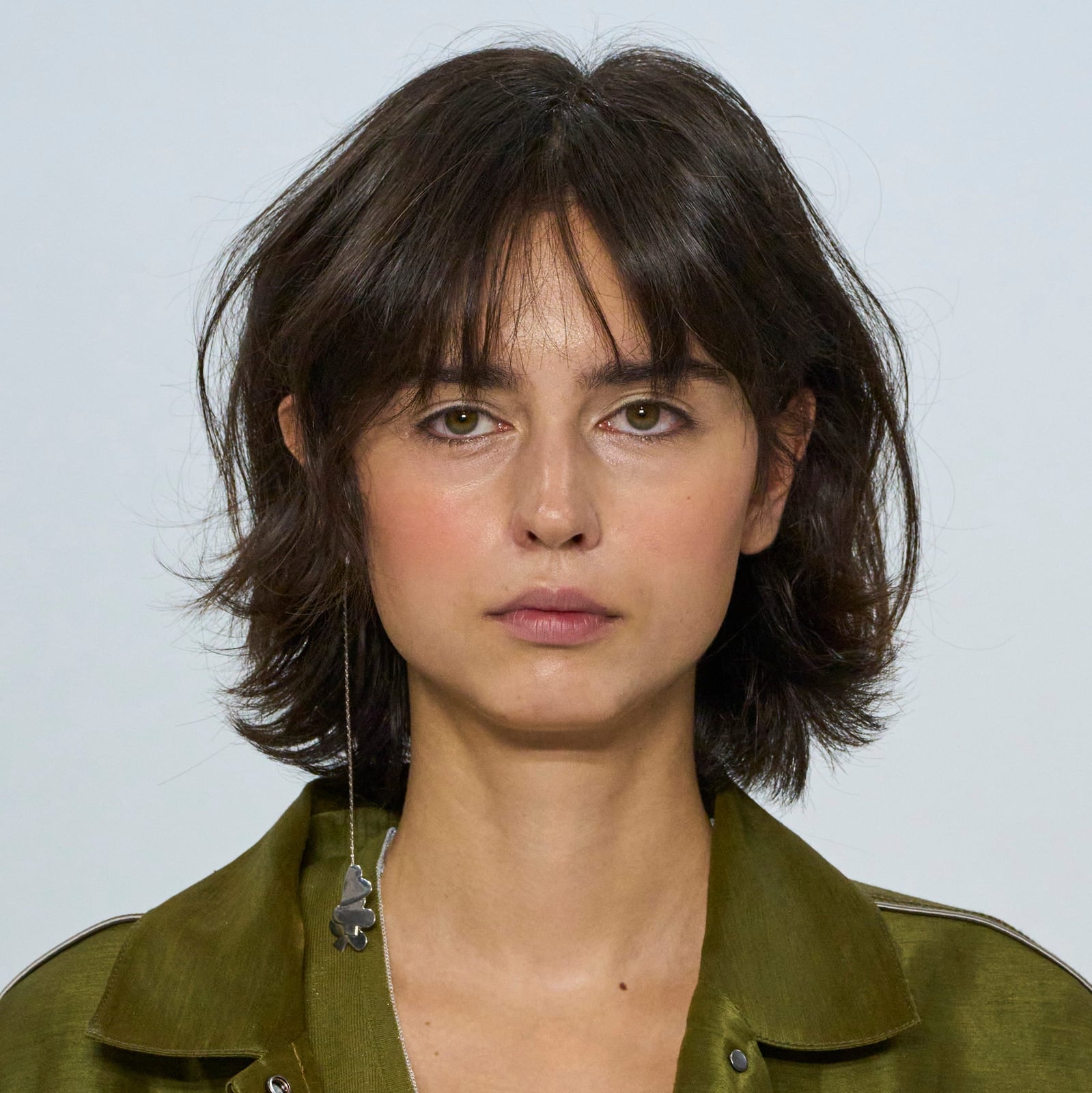
Courtesy of: cosmopolitan.com
Does the lived-in look actually live up to its name, or does it just look like you gave up? With a collarbone shag bob, the answer depends on your wave pattern. The choppy layers and curtain bangs are designed for medium wavy hair, and they do relax into an air-dried texture nicely. However, the same cut can read as frizzy rather than deliberate if your wave is uneven. Ask your stylist for: collarbone shag bob, textured waves, curtain bangs. A lightweight texturizing cream on damp hair, then hands off, is the only styling move you need.
Chin Bob With Ash Blonde Bangs

Photo credit: stylecraze.com
Ash blonde is a demanding color on a chin bob with blunt bangs, since the cool tone shows every hint of warmth. The fine, straight texture in this sleek blowout lets the color read clearly, but the same shade on coarse or porous hair can pull greenish without a proper base. Ask your colorist for: chin length bob, blunt bangs, ash blonde, sleek blowout. A purple shampoo once a week keeps the brass away, and a trim every six to eight weeks preserves the blunt line that makes the whole shape work.
Wavy Chin Bob With Blunt Bangs
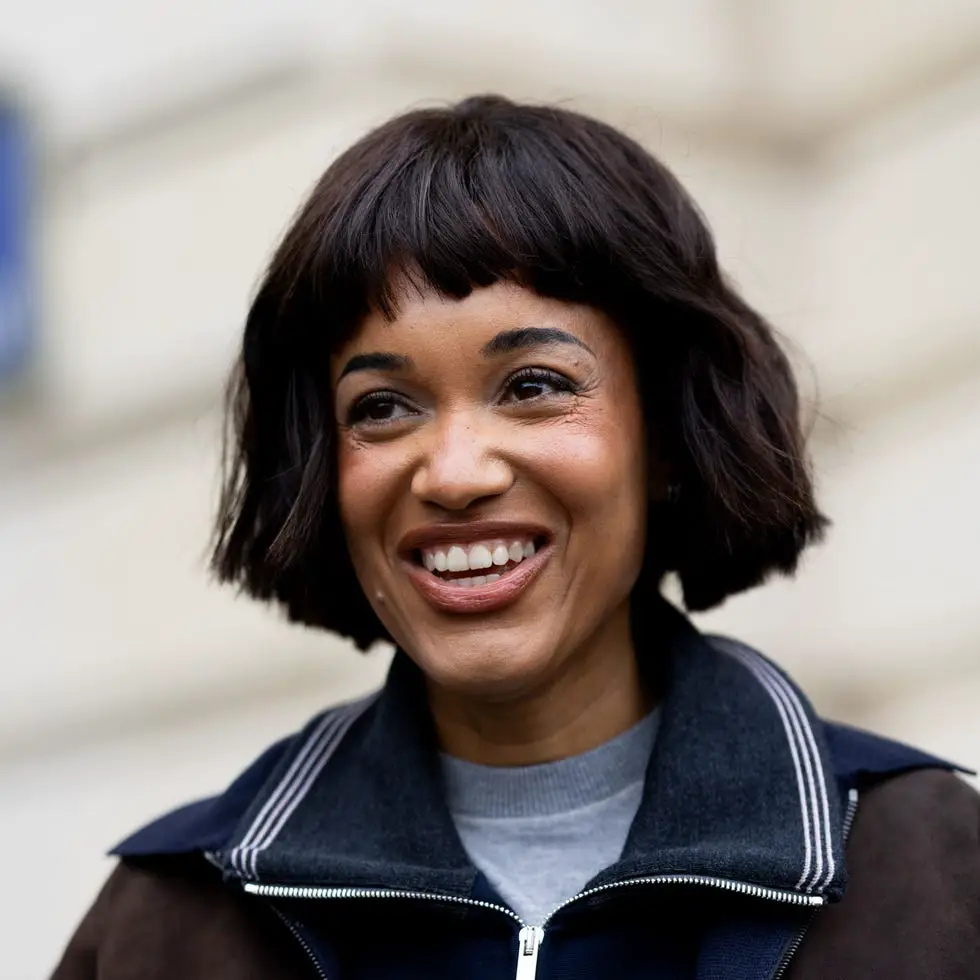
Image credit: cosmopolitan.com
Blunt bangs on a wavy chin bob create a deliberate contrast: the hard horizontal line above the brows versus the soft waves below. The look is achievable at home if you have medium-density wavy hair and a diffuser, but the real drawback is that the bangs will need a flat iron touch-up every morning while the rest air dries. Ask your stylist for: chin length bob, blunt bangs, loose waves. Damp hair and a diffuser on low heat will keep the wave pattern defined without frizz, and a trim every eight weeks stops the bangs from drifting into your eyes.
Collarbone Wavy Bob With Wispy Bangs
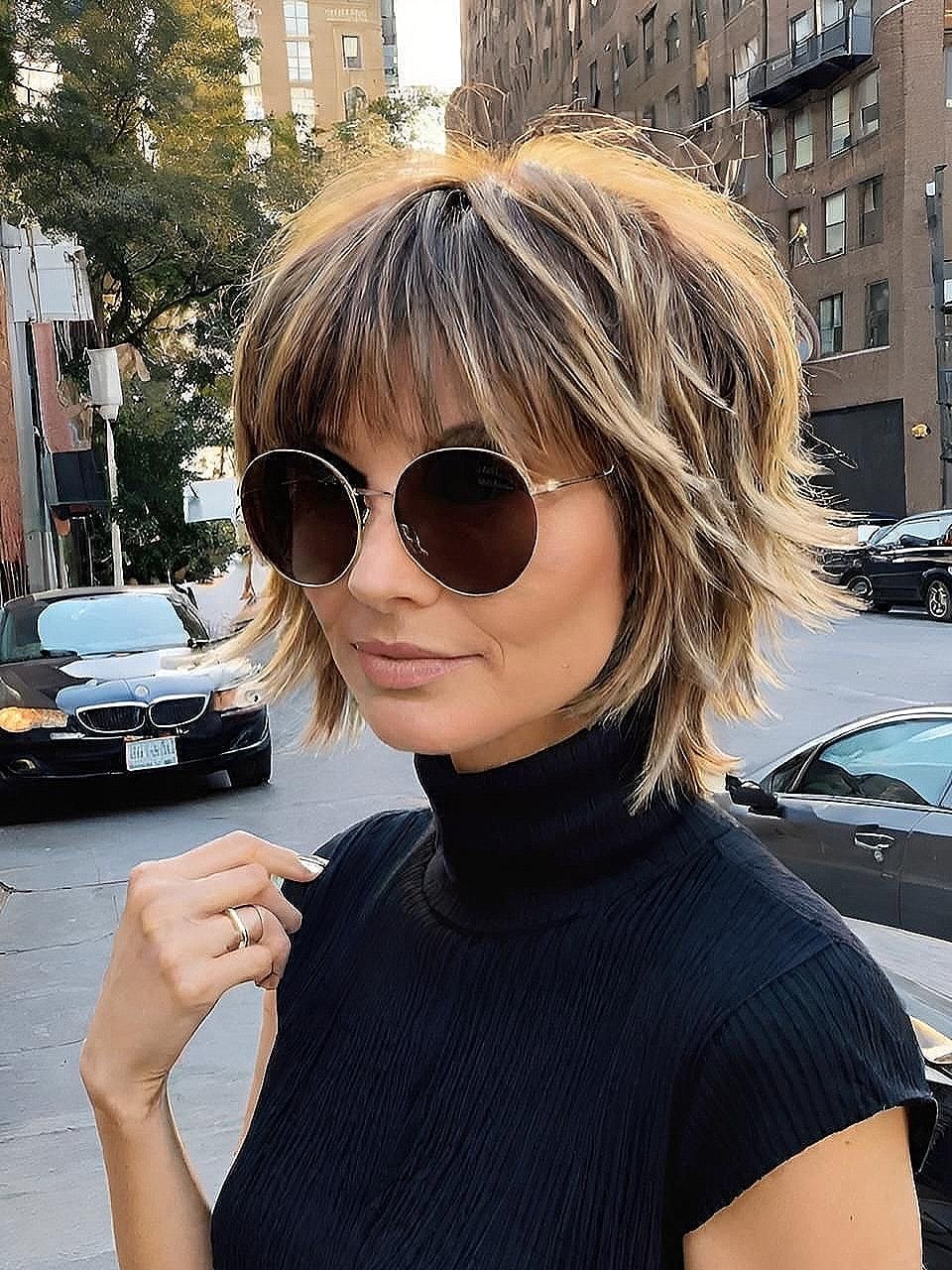
Source: latest-hairstyles.com
Which bob gives you the most movement for the least effort? A collarbone wavy bob with wispy bangs and subtle balayage highlights, where the length allows a proper wave pattern to develop. The wispy bangs feather across the forehead rather than sitting as a solid block, so they blend into the rest of the hair instead of demanding separate styling. Ask your stylist for: collarbone wavy bob, loose waves, wispy bangs. A curl cream scrunched into damp hair and an air-dry finish will produce the same soft texture, and a trim every eight to ten weeks maintains the shape without sacrificing length.
Medium Shag Bob With Wispy Bangs
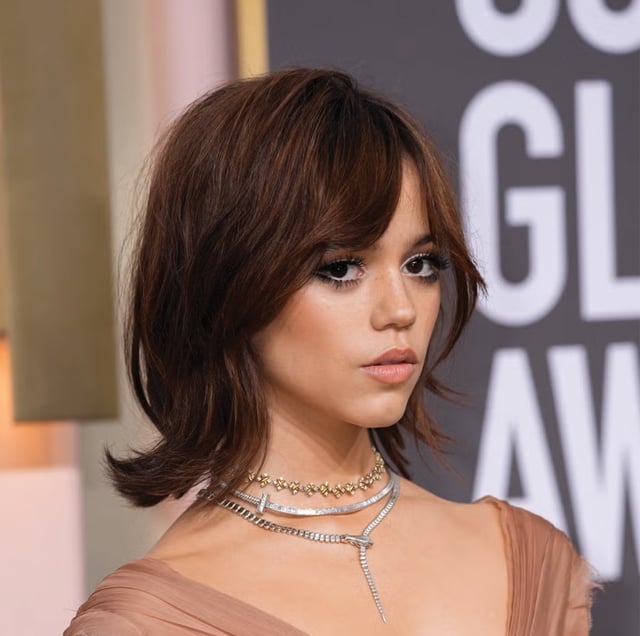
Via cosmopolitan.com
A blunt bob keeps its edges sharp and its layers minimal; a shag bob loosens all of that on purpose. This collarbone-length cut carries textured layers through medium brown hair with subtle highlights, and the wispy bangs sit soft against the forehead instead of squaring it off. Medium wavy texture is the starting point: on hair that already bends, those layers move. On fine, straight hair they need a stylist who cuts them shallow, because stacked layers on a shag bob can read heavy fast. Ask your stylist for: medium shag bob, wispy bangs, textured layers. A texturizing spray and a diffuser on low heat bring the waves forward between washes. Book a trim every 8 to 10 weeks to keep the shape from collapsing into a pyramid.
Ear Length Pastel Bob With Wispy Bangs
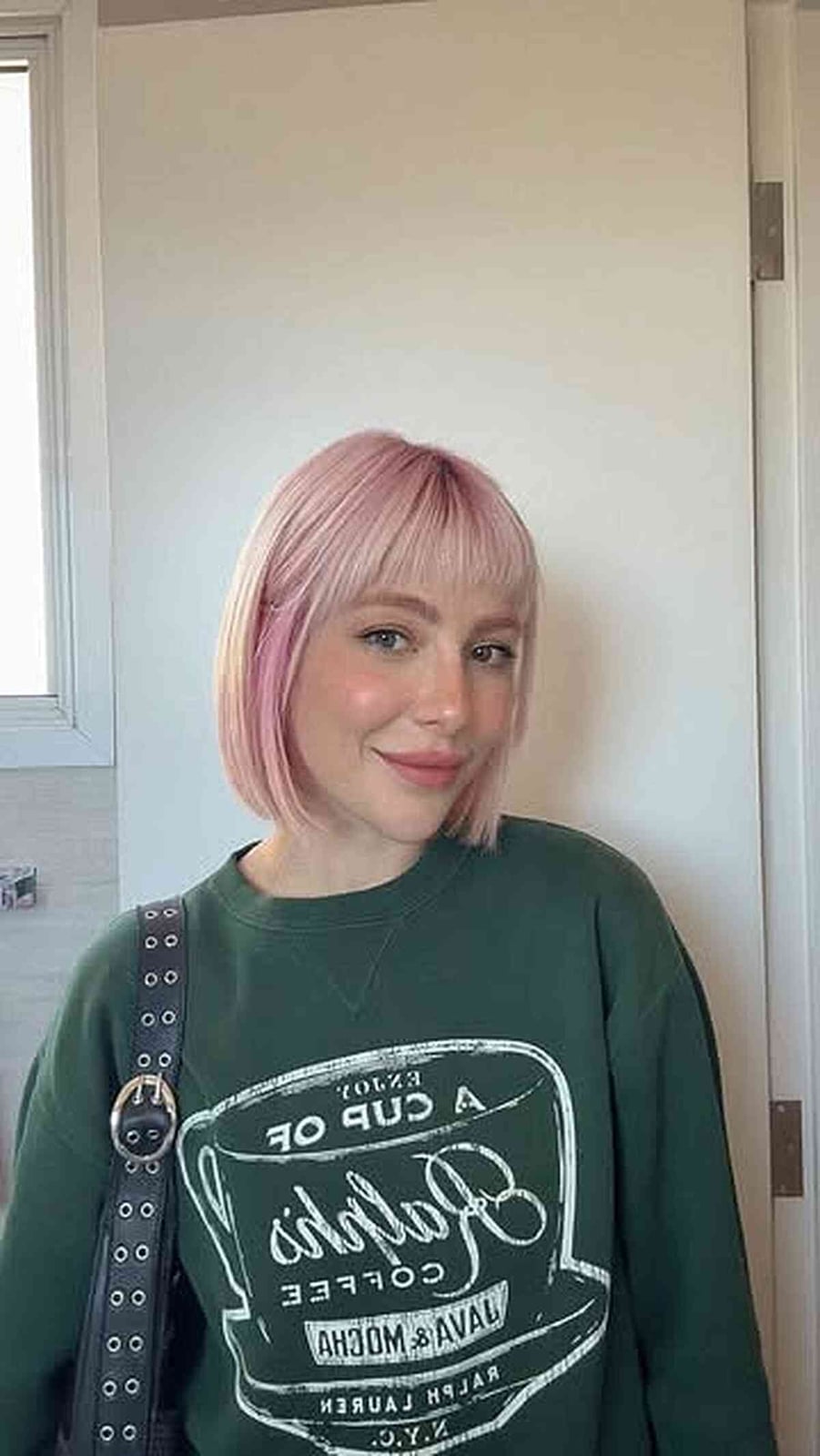
Courtesy of: latest-hairstyles.com
The pastel pink does the talking here, and the ear-length blunt cut keeps the volume low so the color reads clean. Wispy bangs on fine, straight hair sit light across the forehead, which softens an angular face without adding bulk. This is a spring and summer cut with a short shelf life: pastel fades faster than any natural shade, so plan on toning every four to six weeks to hold the pink, plus a trim every 6 to 8 weeks to keep the blunt line crisp at the ear. Ask your stylist for: ear length blunt bob, wispy bangs, pastel pink.
Silver Ear Bob With Straight Bangs
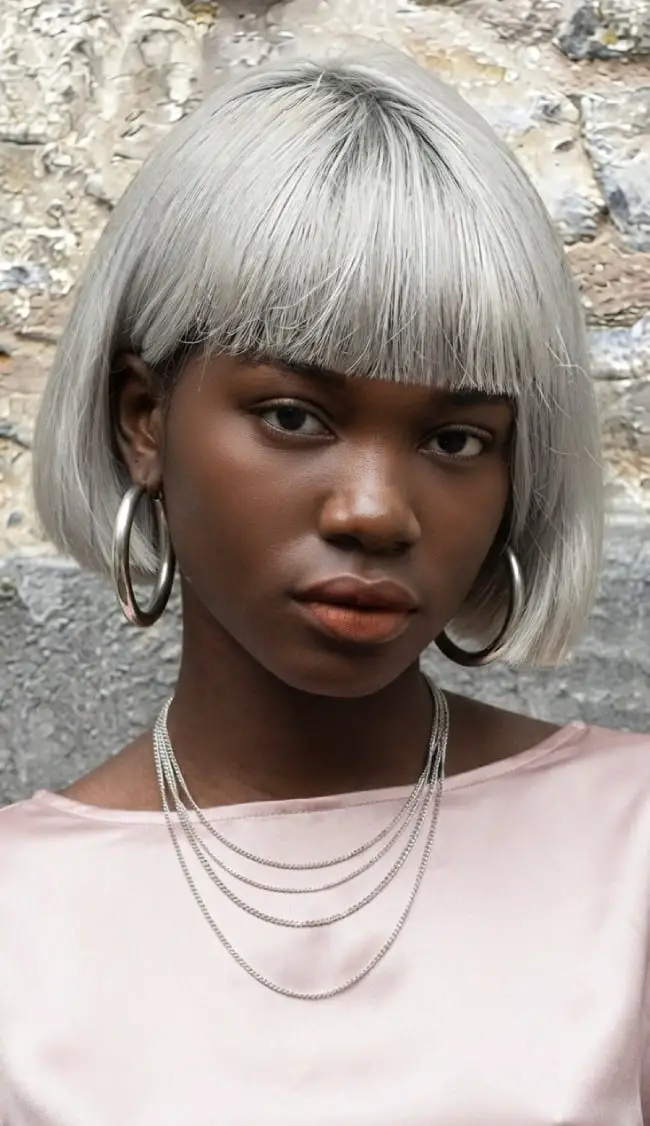
Photo credit: fabmood.com
What does silver actually cost in upkeep? More than the cut. This ear-length blunt bob with straight-across bangs is a sleek blowout in fine, straight hair, and the middle parting keeps the line graphic. Silver shows every shift in tone, so a purple shampoo becomes part of the routine and a toning appointment every four to six weeks keeps the cool cast from drifting warm. Straight bangs suit oval and long faces; on a round face, ask for a fraction more length at the brow. The trim runs every 6 to 8 weeks, and the color is the real commitment. Ask your stylist for: ear length blunt bob, straight across bangs, silver.
Honey Blonde Layered Bob
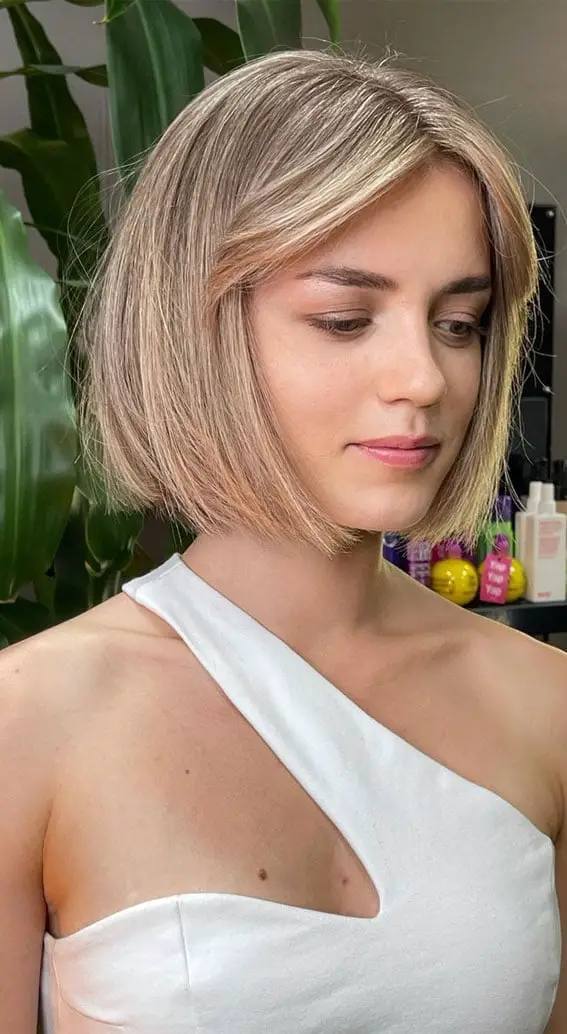
Image credit: fabmood.com
This one is a layering conversation, not a length conversation. The cut is a collarbone layered bob with soft curtain bangs, and the face-framing layers are what separate it from a plain lob. Honey blonde with highlights runs through medium-density wavy hair, styled in a soft blowout. When you sit down, be specific: face-framing layers that start around the jaw and blend into the collarbone length, curtain bangs that part off center, and highlights woven through in a natural blend. Ask your stylist for: collarbone layered bob, soft curtain bangs, honey blonde. A round brush does the work on the fringe and the bends; budget 8 to 10 weeks between trims and a gloss every six to eight to keep the blonde from going brassy.
Auburn Bob With Side-Swept Bangs
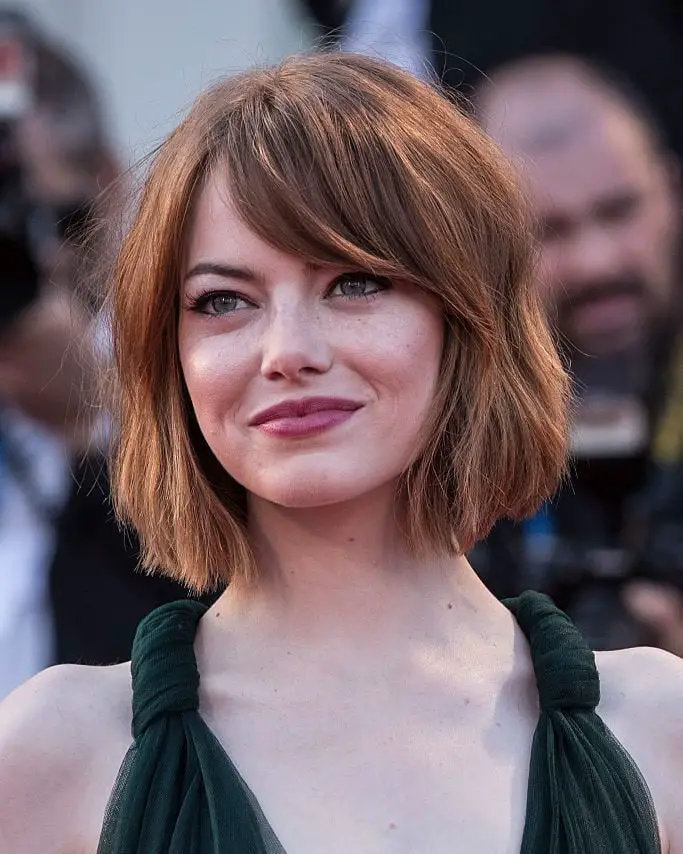
The side-swept bangs are cut on a diagonal so they skim the cheekbone and merge into the face-framing layers, which is why they move instead of sitting flat. This collarbone bob in warm auburn is wavy, medium density, styled in loose waves with a side parting that gives the sweep somewhere to go. The technique matters: bangs cut too short at the inner edge will spring up and break the line, so ask for length that reaches the cheek first. Ask your stylist for: collarbone bob, side-swept bangs, warm auburn. Run a texturizing spray through dry hair to separate the waves, and keep the shape with a trim every 8 to 10 weeks; a gloss every six to eight weeks holds the auburn rich.
Final Thoughts
Use density as your filter. Fine hair holds a blunt baseline best, with minimal layers so the ends stay full; thick hair takes a textured bob and strategic layering to shed weight and keep movement.
- Trim blunt bobs every six to eight weeks to keep the line sharp.
- Refresh wispy or curtain bangs every four to six weeks.
- Mist a heat protectant before any hot tool.
- Air-dry textured bobs with a texturizing spray for lived-in waves.
Find the bob with bangs that speaks to your style.
-

 Makeup Trends2 years ago
29 Harley Quinn Makeup Ideas: Iconic Looks for Every Occasion
-

 Hairstyle2 years ago
Round Face Haircuts Ideas 2025: 29 Flattering Styles to Try
-

 Hairstyle2 years ago
25 90s Layered Hair Ideas to Inspire Your 2025 Look
-

 Fashion2 years ago
27 Every Day Spring Outfits Inspiration for 2025
-

 Hairstyle2 years ago
29 Long Layered Haircuts Ideas for 2025
-

 Hairstyle2 years ago
64 Fall Hair Color Trends to Elevate Your Style in 2024
-

 Hairstyle2 years ago
Choppy Bob Haircuts 2025: 29 Stylish Ideas
-

 Hairstyle2 years ago
27 Medium Length Haircut with Layers Ideas for 2025